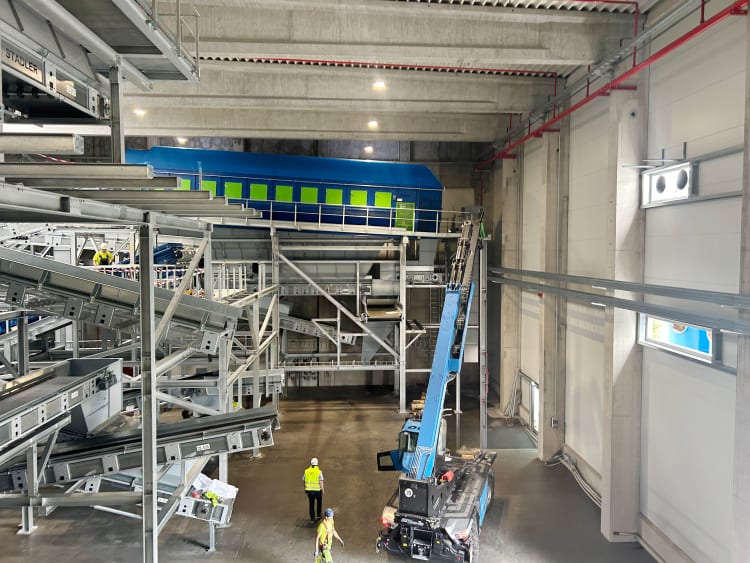
Stadler Anlagenbau GmbH has completed the reconstruction of the Sortierkontor Nord (SKN) plant in Bremen, which specialises in sorting lightweight packaging waste. The facility, operated as a joint venture by Nehlsen AG and PreZero Recycling Deutschland GmbH, was severely damaged by two fires in 2022. The scope of work covered the redesign and rebuilding of the damaged areas, with a focus on raising fire safety standards, increasing process automation and improving operational reliability.
The plant was originally designed and commissioned by Stadler in 2021 and is one of the most modern lightweight packaging sorting facilities in Europe. It processes around 120,000 tonnes of material per year from dual collection systems in Bremen and the neighbouring federal states. After reconstruction, completed in early spring 2025, SKN has restored its original throughput while significantly improving fire protection, process stability and preparedness for implementing automated battery extraction, which is becoming a key challenge for the waste and recycling sector.
Reconstruction focused on safety and operational continuity
The reconstruction process differed significantly from a greenfield project. Around one third of the machinery area was destroyed, and despite extensive preservation measures, further damage occurred to equipment that initially remained in place. This happened during a complex insurance claim process. Stadler had to integrate modern sorting technology into the existing infrastructure while taking into account substantially tightened safety requirements.
"Fire incidents in light packaging sorting plants tend to cause immense damage because hazardous components such as lithium-ion batteries are often concealed in the material stream," said Tom Schmitt, Sales Manager at Stadler. "In redesigning the Bremen facility, our priority was to ensure stable sorting performance while significantly increasing fire safety. This required architectural changes, new system layouts and the integration of technologies based on our latest projects."
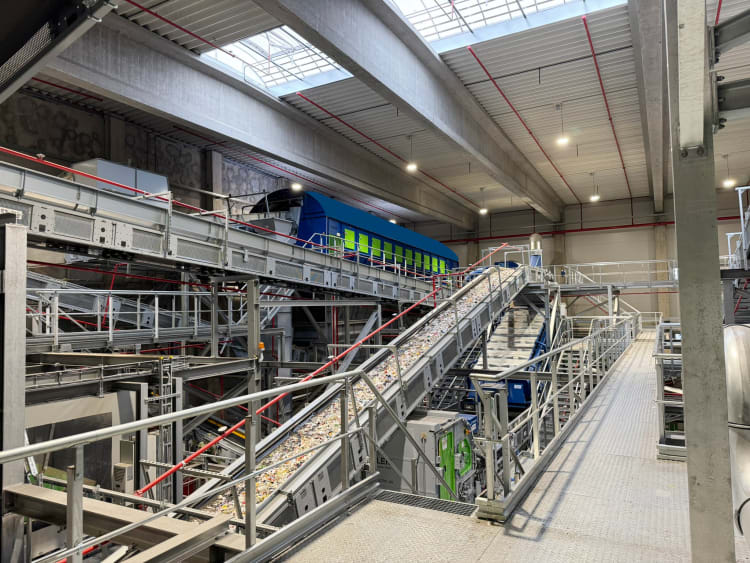
A key modification was relocating the first classification stages, namely air separation, magnetic separation and 2D Flex sorting, to a hall that is structurally separated from the main machinery area. This spatial redesign improves fire protection by isolating critical early process stages, thereby reducing the facility's vulnerability to fire incidents. In addition, a second 100 m³ fire extinguishing water tank was installed, together with modern protection systems including sprinklers and integrated suppression lines on equipment such as trommel screens.
Modernised sorting process and higher automation
The rebuilt parts of the plant feature an optimised material flow, which reduces bottlenecks and inefficiencies of the original layout. Three trommel screens, previously positioned in a single area and connected by long conveyor belts, are now arranged opposite each other. This facilitates operation and improves service accessibility.
The film fraction, which represents one of the largest volume streams at the plant, is now sorted fully automatically, with the option to add a third sorting stage in the future. SKN produces transparent LDPE and mixed film fractions with improved consistency, while significantly reducing manual handling.
The facility continues to deliver twelve high-purity mono-material fractions, including PP, PET, PE, PS, mixed polyolefins, paper-cardboard-carton, aluminium and additional composite materials. At the same time, the new process layout enables future integration of an automated battery extraction system similar to the solution operating at PreZero's plant in Sollenau, which allows the detection and removal of batteries from the material stream.
"Restoring and securing sorting capacity was our first priority," said Benjamin Kreie, Managing Director of Sortierkontor Nord GmbH & Co. KG. "However, together with Stadler, we went far beyond simple reconstruction. The modified sorting technology, the creation of more monitored fire sections and the possibility to integrate a battery extraction system take the plant to a new level, safer, more robust and better suited to current and future waste streams."
"Achieving the highest possible level of fire protection, both technical and organisational, was crucial for us," added Andreas Thiel, Managing Director of Sortierkontor Nord GmbH & Co. KG and Branch Manager at PreZero Recycling Deutschland GmbH. "The new plant structure, combined with state-of-the-art sorting systems, allows us to operate with greater reliability and significantly reduced risk, so that the facility meets both operational requirements and the conditions set by insurers."
Partnership based on experience and trust
Stadler's long-standing cooperation with Nehlsen and PreZero was an important factor in the implementation of the project. The sorting plant manufacturer had previously built facilities for Nehlsen and worked with PreZero on several large projects, including the plants in Eitting and Sollenau. Technical experience and good knowledge of the clients' organisational structures facilitated coordination of activities in Bremen.
The reconstruction required close cooperation between the three partners, external project management teams and insurance stakeholders. The period from the fire incidents to completion of the rebuild extended over nearly three years and demanded persistence, detailed documentation and joint decision-making at successive stages.
"During planning and installation, Stadler's approach was communicative, open and focused on problem solving, with strong emphasis on keeping to the project schedule," said Andreas Thiel. "Commissioning was more demanding due to the need to coordinate subcontractors, which caused some delays. Despite this, the final result is a high-performance facility capable of reliably meeting the targeted sorting volumes."
More resilient facility prepared for future challenges
The completion of the SKN reconstruction means that Bremen once again has one of the most advanced lightweight packaging sorting plants in Europe, this time designed as a more resilient, safer facility that is better prepared for future requirements. The project demonstrates how modern recycling infrastructure can adapt to rising safety demands while maintaining high throughput and output quality.
"Fire risks in light packaging sorting can never be completely eliminated," concluded Wolfgang Köser, Sales Director at Stadler for Germany, Austria and Switzerland. "With the measures implemented in Bremen, including structurally separated classification halls, monitored fire zones, sprinklers and integrated fire suppression systems, the plant now operates at a significantly lower level of risk and with much greater resilience. This project shows what can be achieved when long-term partners work together not only to rebuild what was lost, but to create a facility that is ready for current and future challenges."