
At this year's Techtextil trade fair in Frankfurt, which will take place from 21 to 24 April, Barmag will present a comprehensive portfolio of solutions for the production of industrial filament yarns. The focus will be on automotive applications, where technical fibers are crucial for vehicle safety, durability and efficiency, as well as on solutions for geotextiles used in infrastructure construction.
Modern cars contain on average 30 to 35 kilograms of industrial yarns, most of which are used in safety-relevant components such as airbags and seat belts. In these applications, reproducible quality, spinning process stability and compliance with strict strength and service requirements under varying climatic conditions and throughout the vehicle's life cycle are essential. Barmag focuses on technologies that enable energy-efficient, high-output production of such fibers, both based on polyamide and the increasingly used polyester, and on developing solutions for geotextiles where very high yarn titers and production system efficiency are required.
Yarns for airbags and safety requirements
In airbags, filament yarns made of polyamide and, to an increasing extent, polyester are predominant. The materials used must maintain their mechanical and functional properties over a wide temperature range and during long-term service.
For these applications, Barmag offers technologies characterized by high energy efficiency and productivity, while ensuring a stable process and consistently high yarn quality. As Dr Jen Supra, Technology Manager for Industrial Yarns at Barmag, emphasizes: "Our solutions meet all the demanding standards for airbag yarns worldwide throughout the entire service life of a vehicle, regardless of climate or operating conditions."
Seat belts and the high-tenacity yarn process
Seat belts are another key application area for industrial filament yarns in the automotive sector. A single belt contains around 300 high-tenacity (HT) yarns, whose individual filaments must withstand very high tensile forces exceeding 3 tons, while in an emergency they must elongate in a controlled manner.
For the production of such yarns, Barmag uses its patented Single Filament Layer technology. It enables a gentle, high-precision spinning process for high-tenacity yarns intended for applications where safety is a priority. The solution is designed to reduce the stresses acting on individual filaments during processing and to improve the homogeneity of the mechanical properties of the finished yarn.
Industrial yarns in geotextiles for road construction
Industrial filament yarns are also used outside the vehicle, for example in road construction. Geotextiles, such as geogrids used in the substructure beneath asphalt layers, require yarns with very high titers of up to 24,000 denier.
Barmag systems enable efficient production of three filament yarns with a titer of 6000 denier each, which can then be combined cost-effectively to obtain higher titers. This approach allows flexible adjustment of product configuration to the requirements of specific geotextile applications.
Complementing the portfolio in this area is Barmag's product brand Neumag, which supplies spunbond technologies for geotextiles made from polyester or polypropylene. These solutions are characterized by high production capacities and low energy consumption, which is important for the large volumes typical of road infrastructure projects.
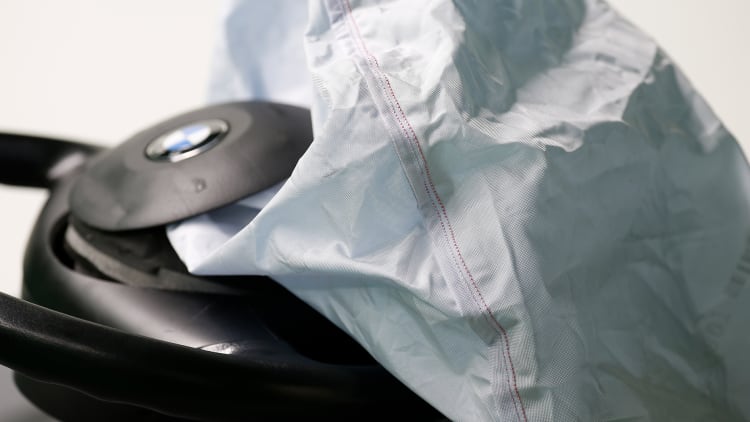
Today's modern vehicles contain an average of 30 to 35 kilograms of technical yarns, most of which are used for safety-related components such as airbags and seat belts
Neumag PP inline: new standards in staple fibers for geotextiles
In staple fiber production, Barmag is setting new standards for geotextiles with the Neumag PP inline concept. The improved technology is designed for fibers with strengths above 6 cN/dtex and high residual elongation.
The resulting fibers significantly exceed the parameters previously established in this application segment. The first production line equipped with the new spinning concept was recently commissioned at a well-known staple fiber producer in Asia, confirming the technology's readiness for industrial use.
Air handling and process stability solutions
An integral part of the Neumag PP inline concept is the EvoDuct air ducting system, introduced to the market last year. It was designed to ensure more efficient air flow distribution, reduce energy consumption and improve fiber homogeneity.
Another development is the optimized EvE2 monomer and hot air suction system, also developed by Neumag. This solution minimizes turbulence in the spinning zone while increasing process performance. Improved control of air flows and thermal conditions supports spinning stability and the repeatability of finished fiber properties.