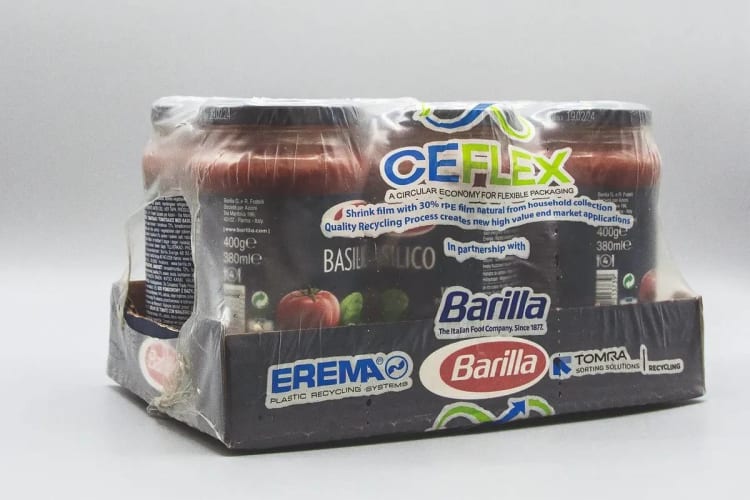
The secondary packaging that bundles six Barilla sugo jars is based on a shrink film made with 30% recycled polyethylene. The recycled content comes from post-consumer LD/LLDPE films collected in the DSD 310 household waste fraction. Material that previously formed part of mixed packaging waste is converted into high-quality regranulate and then into new film, without compromising on optical or functional properties that are relevant for brand image and processability.
The process starts with the collection of suitable LD/LLDPE film waste from household streams and its preparation for recycling. The objective is to obtain a melt and, ultimately, a regranulate that can be used in demanding applications such as printed shrink films for food industry outer packaging. Achieving this requires both controlled thermal and mechanical treatment of the polymer melt and effective removal of moisture and contaminants, including components that can cause odour.
Recycling process based on Intarema TVEplus technology
The transformation of post-consumer LD/LLDPE films into regranulate for shrink film is carried out on an Intarema TVEplus recycling system from Erema. In this process the material is extruded and processed under conditions designed to minimise shear and thermal stress from melting through to pelletising. The system features a Preconditioning Unit (PCU) combined with patented Double Disc (DD) technology, which enables efficient homogenisation, degassing and drying of the feed material. High moisture levels, typical of household film fractions, are reliably removed at this early stage, stabilising downstream extrusion and filtration.
The TVEplus process configuration is designed to produce a melt with stable viscosity and low degradation, which is a prerequisite for consistent film quality. This is particularly relevant when the recycled stream is intended to be blended with virgin material and used in thin-gauge shrink films that must meet tight tolerance and performance requirements during conversion and application.
Double filtration and contaminant removal
Purity of the polymer melt is critical for high-performance rPE film. To achieve this, the line uses a two-stage filtration concept. In the first stage, an Erema laser filter removes solid contaminants such as aluminium, foreign polymers including PET and PA, and temperature-sensitive paper particles. Early removal of these components prevents their decomposition in the extruder and limits the formation of burnt residues that could lead to visual defects or odour.
In the second stage, the melt is subjected to ultra-fine filtration down to 50 µm. This fine filtration step yields a regranulate with low levels of residual particulates, supporting good optical quality and mechanical properties in the final film. The combination of laser filter and fine downstream filtration enables the production of a high-purity rPE suitable for applications beyond standard non-critical film uses.
Odour reduction and suitability for food outer packaging
For outer packaging in the food industry, material cleanliness alone is not sufficient. Odour-neutral characteristics are essential to avoid any negative impact on packaged goods or brand perception. To address this, the process incorporates Erema ReFresher technology for deodorisation of the recycled material. This step is designed to remove volatiles and odour-causing substances that originate from the post-consumer stream.
By combining controlled melt treatment, efficient moisture management, double-stage filtration and ReFresher-based deodorisation, the resulting regranulate meets the requirements for use in shrink films that serve as secondary packaging for food. The Barilla sugo jar multipacks are an example of this, with a shrink film that integrates 30% recycled content while maintaining functionality in terms of wrapping performance, protection and appearance.
Contribution to circular economy in packaging
The rPE shrink film solution for Barilla sugo jars illustrates how post-consumer household waste can be integrated into value-added packaging applications. By using regranulate sourced from DSD 310 LD/LLDPE films, the system closes a loop between consumer packaging waste and new packaging products. Food brands can increase the recycled content in their secondary packaging without sacrificing film quality, printability or pack integrity.
This application shows how circular economy principles can be implemented in practice in the packaging sector, particularly through the combination of targeted feedstock selection, advanced recycling process control, high-efficiency filtration and odour reduction technologies. Further technical details on the double filtration approach, including the Intarema TVEplus DuaFil Compact machine configuration, are available from the technology supplier.