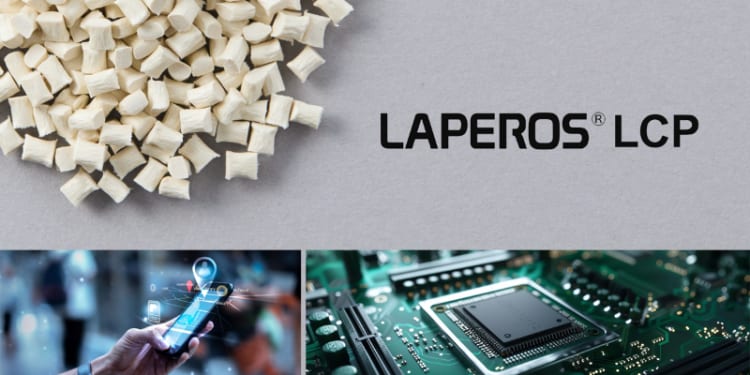
Polyplastics Group has expanded its Laperos liquid crystal polymer (LCP) portfolio with new LH and TF series, developed to address the electronics market's growing requirements for higher material performance and component miniaturization. The new grades are intended to support the development of next-generation electronic products through two complementary approaches: greater versatility in meeting diverse design needs and very high processing flowability. The manufacturer expects that Laperos LCP will thus be used in a wider range of applications, especially where complex part geometry must be combined with high packaging density and dimensional stability at elevated temperatures.
Characteristics of the LH series
The LH series has been designed as a solution with well-balanced properties. These materials combine high flowability, mechanical properties and heat resistance, which is intended to facilitate their use in a broad spectrum of designs. The adaptability of the LH series allows it to be tailored to a variety of product designs, making these materials suitable for numerous applications in the field of electronic components. The use of such a balanced property profile is aimed at simplifying material selection for designers and part manufacturers who must simultaneously meet requirements for strength, processability and performance at elevated temperatures.
TF series for highly complex geometries
The TF series has been developed with a focus on exceptionally high flowability to enable efficient molding of parts with very complex geometries, typical of smartphones and precision electronic components. While maximizing flow, TF materials also maintain high mechanical properties and a wide processing window. This combination of parameters is intended to support miniaturization and high-density integration in electronic devices, where thin-walled parts, accurate replication of mold details and dimensional stability during service are required.
The processing flexibility of the TF series is particularly important in the production of small-sized components, where the injection molding window is constrained by the short filling time of mold cavities and the need to maintain appropriate melt rheology. The high flowability of LCP in this series is intended to reduce the risk of short shots in areas with complex geometry and to facilitate the molding of very thin sections.
Use of materials informatics methods
In developing new material grades, Polyplastics applies methods referred to as materials informatics, based on the use of artificial intelligence and data analysis. By analyzing extensive sets of material data collected over many years, the company defines property combinations considered optimal for specific applications. This approach is intended to shorten development cycles and enable the design of materials with a high degree of alignment to end-user requirements.
In practice, the use of materials informatics means applying algorithms to process data on, among other aspects, material composition, processing parameters and test results, and then identifying correlations that make it possible to predict the behavior of new formulations. For customers in the electronics industry, this is significant in terms of faster implementation of materials with defined strength, heat resistance and dimensional stability parameters.
Production and market position of Laperos LCP
Laperos LCP is produced in the Japan and Taiwan region, with an annual production capacity of 20,000 tons. According to the Fuji Keizai 2025 report, this material holds a 34% share of the global LCP market. For many years, this high-performance material has supported the development of the electronic components sector, which requires a combination of good mechanical strength, dimensional stability and resistance to elevated operating temperatures.
The relatively low coefficient of linear thermal expansion, combined with high mechanical strength and heat resistance, favors the use of Laperos LCP in applications that require precise dimensions to be maintained under changing temperature conditions. These properties are important, among other areas, in components mounted on printed circuit boards and in connectors for high-speed data transmission.
Application areas in electronics
The properties of Laperos LCP, including mechanical strength, heat resistance and coefficient of linear thermal expansion, support its growing use in high-speed transmission-related solutions. This applies, among other uses, to ultra-thin, fine-pitch connectors used in smartphones and tablets. In such components, miniaturization, high signal path density and long-term reliability are required at the same time.
The new LH and TF series are expected to further extend design capabilities in this area by enabling material selection tailored to specific geometry and operating conditions. For connectors and surface-mount components, the ability to precisely mold sockets and female connector parts is also important, and at very small dimensions this largely depends on melt flow behavior during injection molding.
Additional technical information on the new LH and TF series grades and the broader Laperos LCP portfolio is available on the manufacturer's website at: https://www.polyplastics.com/global/s/ourapproach/a5nRB0000013bX7YAI/220?language=en_US.