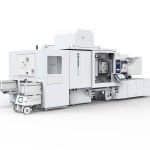
Netstal has announced that it will present an integrated production solution at FIP 2026, which will take place in Lyon from June 2 to 5. The system is intended for highly efficient serial production of autoinjector housings used for the administration of GLP-1 drugs. The central element of the complete, fully automated installation will be the new fully electric Elion injection molding machine in a medical version, with a clamping force of 1200 kN. The manufacturer emphasizes that the new generation of the Elion series has been developed to shorten cycle time, improve process stability and reduce energy consumption. The solution is aimed not only at medical applications, but also at other areas where high availability, process cleanliness and efficient use of production floor space are important.
The new generation of the Elion series was first shown to the international trade audience at K 2025 in Düsseldorf, in a version for medical technology. The design is based on previously used solutions, but a number of changes have been introduced to increase production efficiency. Compared with the previous model with the same clamping force, the machine has a shorter and more compact design, which is intended to improve the efficiency of production area use per square meter of plant space. The revised geometry of the double-toggle lever mechanism is intended to ensure shorter dry cycles, optimized force distribution and greater long-term stability. Separate shafts for tie bars and ejector functions are intended to improve service accessibility, shorten regular maintenance work and extend effective production time. The redesigned protective cover, thanks to its smooth surfaces, is intended to facilitate cleaning and also allow quick disassembly and easier access during maintenance work. In turn, a new injection gearbox with a compact metering drive, more even load distribution and steadier power consumption is intended to reduce the energy consumption of the injection molding machine by up to 5%. As standard, Elion machines are designed for operation in cleanrooms up to ISO 7 class. With additional medical equipment, adaptation to higher cleanroom requirements is also possible according to user needs.
Expansion of the Elion series
The modernization of the Elion series is to proceed gradually, in line with market demand. At present, configurations with clamping forces of 1200 and 1750 kN and electric injection units up to size 870 are already available from the modular system. Ultimately, the portfolio is to cover a clamping force range up to 4200 kN. In the higher clamping force ranges, users are expected in future to be able to choose between hybrid and electric injection units. According to Netstal, this is intended to allow configurations to be matched to the requirements of various applications, from medical technology to packaging and closures.
Production of autoinjector housings at the FIP stand
At stand K22-L09 during FIP 2026, the company will produce autoinjector housings using the new Elion MED machine. As stated, autoinjectors are needed in very large quantities due to the rapidly growing GLP-1 drug market. Together with mold partner Zahoransky, a solution was developed that, compared with conventional lift-and-strip molds and while maintaining the same number of cavities, reduces cycle time by 50%, to around 9 seconds. According to the company, this represents a significant advantage over increasing output by raising the number of cavities, which would require plant expansion with additional costly cleanroom space.
The four-cavity mold from Zahoransky, equipped with hot runner technology from Ewikon, uses an indexing concept with an unusual design. The index plate is located off-center in the mold. This solution is made possible by an integrated rotary unit with servo drive, which rotates the parts from the injection position to the removal position while the mold is closed. While the six-axis robot mounted on the injection molding machine removes the finished parts, the next injection cycle is already running. Part removal is therefore cycle-neutral and does not extend the process. An additional factor improving efficiency is the continued cooling of the parts on the cores outside the cavity after injection has ended. This shift of residual cooling is intended to significantly shorten the effective cooling time in the cycle. Conformal cooling routes the cooling channels very close to the part geometry, enabling faster and more uniform heat removal and delivering high dimensional stability. The concept is complemented by an integrated scraper function and the absence of complex relative movements, which is intended to simplify automation integration. As stated, the four-cavity mold was designed as a technology demonstrator, while concepts with 16- and 32-cavity molds are planned for serial production.

Integrated production solution from Netstal for autoinjectors
Automation and control
Saxe's ultra-compact automation solution, dimensionally adapted to the size of the injection molding machine, includes optical quality inspection as well as a production-ready system for automatic container changeovers. The handling system has been fully integrated into the Axos control system of the injection molding machine. This means that Axos acts as the central management system through which the entire production setup is controlled.

Live production at FIP, autoinjector housings