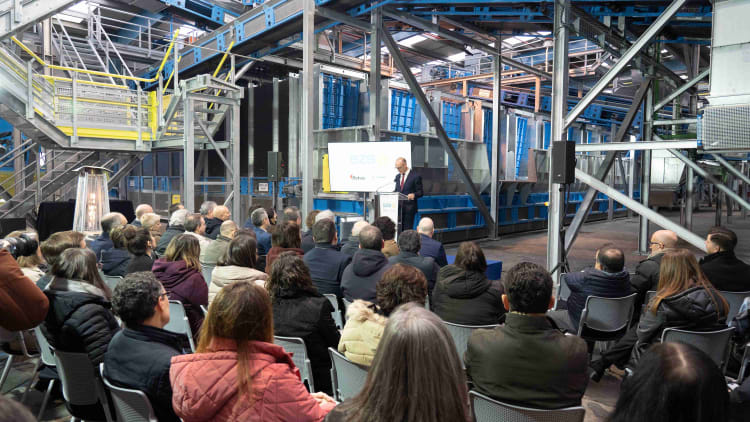
Stadler Anlagenbau GmbH has completed the comprehensive modernisation of the BZB (Bizkaiko Zabor Berziklategia) light packaging sorting plant in Amorebieta-Extano in the province of Bizkaia. The upgraded facility, officially commissioned on 27 January 2026, significantly increases the plant’s processing capacity, level of automation and digitalisation, and improves the quality of the sorted material fractions. The project continues the nearly 25-year cooperation between Stadler and BZB and refers back to the first complete sorting plant that the German company built in Spain more than two decades ago.
BZB is a public-private partnership involving Garbiker, a company owned by the provincial authority of Bizkaia, and Trienekens País Vasco. The plant specialises in the collection, sorting and processing of packaging waste from households and the commercial sector, converting it into secondary raw materials and supporting the development of the circular economy in the region. The modernisation of the facility responds to increasing regulatory and market requirements to raise recycling rates and improve the quality of material streams sent for further processing.
Continuation of cooperation with the first Spanish turnkey customer
The original BZB plant was commissioned in 2002. It was the first complete waste sorting facility that Stadler implemented in Spain on a turnkey basis. This project laid the foundations for the company’s long-term presence on the Spanish market and initiated cooperation that continues to this day.
"This plant is personally very meaningful to me," says Carlos Manchado Atienza, international sales director at Stadler. "It was the first full facility contract we signed in Spain when I was still acting as Stadler’s distributor. Being able to participate in the delivery of the new BZB plant today as part of the Stadler team is a true source of pride for me. I feel genuinely honoured to be part of this journey and to see how far we have come."
On the operator’s side, the investment is summarised by Pedro Goicoechea, general manager Basque Country at BZB Amorebieta. "The modernisation of our plant is transformative for BZB. It allows us to increase efficiency and recover more materials, while positioning us to meet future challenges and sustainability goals."
The decision to modernise the existing sorting plant instead of relocating it reflects BZB’s commitment to maximising the use of existing infrastructure while implementing the most advanced sorting technologies available. Working within the constraints of the existing building required precise planning and compact design solutions, which ultimately resulted in the creation of a highly efficient installation with performance parameters exceeding the previous configuration.
The sorting criteria were defined in close cooperation with Ecoembes, which, as a system partner, plays a key role in the planning and implementation of facilities of this type. BZB highlights the contribution and commitment of the entire Ecoembes team throughout the project.
Increased throughput and higher level of automation
The new configuration of the BZB plant enables an increase in throughput from 3 to 8 tonnes per hour, which means more than a twofold rise in the processed material stream while simultaneously improving recovery rates and the purity of output fractions. The facility has been designed to process a wide spectrum of light packaging waste and enables the separation of high-quality plastic and metal streams.
The plant produces dedicated plastic fractions including PET, HDPE, PP, PS and two film qualities, as well as ferrous and non-ferrous metal fractions. The recovered materials are transferred to dedicated bunkers, from where they are baled and prepared for shipment for further recycling.
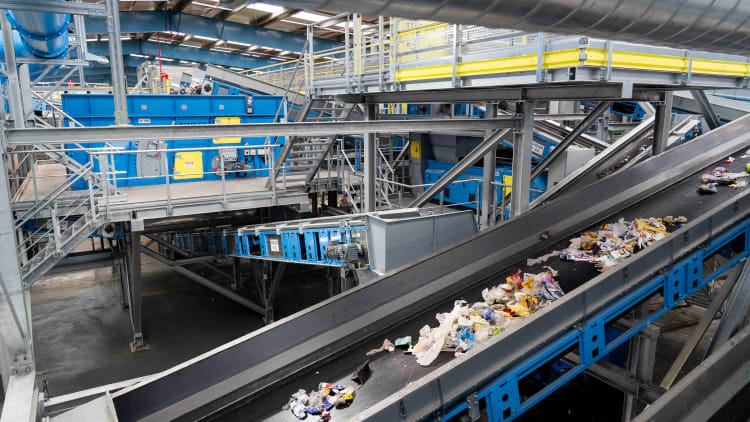
The input stream is fed into the system via an automatic feeder and a pre-shredding stage, the purpose of which is to open bags and loosen the waste stream. The material then passes to a trommel, which separates it into three size fractions. Each of these fractions is subsequently processed independently using a combination of Stadler ballistic separators, magnetic and inductive separators, and high-performance NIR optical sorters.
The installation is equipped with reversible conveyors that enable flexible control of the material flow direction. The system also includes bunker level sensors and automatic container change signalling, which streamlines day-to-day operation. All processes are supervised by a central monitoring system that provides a high level of transparency for operational data and control of plant performance.
A characteristic feature of the new installation is its high level of automation. Compared to the 2002 plant, the modernised sorting facility makes much more efficient use of the available space and reduces the scope of manual intervention. This translates into lower operating costs and higher overall efficiency, while also improving working conditions for the plant personnel.
Digitalisation and predictive maintenance
One of the most important elements of the modernisation is the integration of the Stadlerconnect platform used for plant monitoring and maintenance. The BZB facility is the first Stadler sorting plant in Spain to benefit from Stadlerconnect Predictive Maintenance. This solution enables continuous supervision of equipment condition and supports the implementation of predictive maintenance strategies aimed at maximising line availability.
Process digitalisation allows the operator to better manage operating data, detect deviations in the performance of key components at an early stage and plan service interventions in a way that minimises downtime. From a long-term operating perspective, the high degree of automation and the use of analytical tools enhance the stability and predictability of plant performance.
Environmental effects and achieving circular economy goals
Beyond improving technical and operational parameters, the modernisation of the BZB sorting plant significantly supports sustainable development objectives and the principles of the circular economy. Increasing sorting accuracy and recovery rates reduces the amount of waste sent to landfill or final disposal and enables more of the waste stream to be fed back into the value chain as secondary raw materials.
Improved energy efficiency per tonne of processed material further strengthens the environmental balance of the installation. With its new configuration, the plant is better positioned to meet current and future requirements relating to packaging recycling targets and the use of recyclates in new products.
Short implementation time and user assessment
The installation work for the plant modernisation was completed in a relatively short period of three and a half months. Commissioning was finalised at the end of October, two months earlier than originally planned. This indicates close cooperation between Stadler and BZB at the preparation and implementation stages of the project.
The investor’s satisfaction is emphasised by Pedro Goicoechea. "Completing the project ahead of schedule demonstrates the strength of our partnership with Stadler and their commitment to excellence. The modernisation ensures we are ready to meet future challenges while continuing to provide high-quality waste sorting services to the region."
Carlos Manchado Atienza also comments on cooperation with the private partner. "I would like to sincerely thank the entire Trienekens team in Spain and in Germany and, in particular, Mr Joachim Domrös, managing director of Trienekens, for their outstanding professionalism throughout the negotiation and installation process. Everything was handled smoothly and efficiently, and it has been a real pleasure working with them."
In the long term, the high level of automation and the use of predictive maintenance tools mean that the BZB plant is prepared for stable and efficient operation. For Stadler, the project is both a showcase of technological capabilities and a symbol of continuity, linking the first turnkey sorting plant implemented in Spain with the next generation of intelligent, digitalised facilities for sorting packaging waste.