The beverage and packaging industries are currently operating under strong cost and organizational pressure. Producers are affected by political tensions, economic instability, rising energy and raw material prices, as well as persistent supply chain problems. Another factor is the growing number of legal requirements concerning packaging design and packaging waste management. In this environment, KHS presents an approach based on a holistic line strategy intended to combine flexibility, reliability, cost-effectiveness and sustainability. The company emphasizes that consumer purchasing decisions are largely linked to packaging, which must simultaneously provide an attractive appearance, product protection, the right choice of material and an acceptable cost. The response to these expectations is intended to be integrated systems, from packaging design to complete line solutions tailored to market requirements and the individual needs of the user.
KHS, as a turnkey supplier from Dortmund, states that it supports customers worldwide through the design of processes with high flexibility and availability. According to the company, this approach is intended to help producers respond more effectively to changing market conditions and limit the impact of external factors on operational efficiency. Automation and the reduction of labor input are of particular importance here, which is linked to the decreasing availability of qualified operating personnel. At the same time, the market expects resource-saving solutions, especially in secondary packaging, where cardboard, paper and film with a high recyclate content are becoming increasingly important.
Broad portfolio of machinery and packaging systems
KHS indicates that, thanks to its extensive packaging and machinery portfolio, it can adapt its solutions to changing market conditions. One example is the further developed KHS Innopack Kisters TSP Advanced machine. This is a fully automatic machine designed to pack PET bottles, glass bottles and cans on trays, in film and in tray or pad and film configurations. At Interpack, the company says it will present this system for the first time with the new patented optional BottleClip Carrier application.
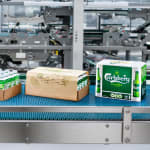
The BottleClip Carrier solution uses a cardboard carrying handle that joins PET containers into stable packs. According to KHS, it is a resource-saving alternative to plastic ring systems that are no longer permitted in some countries. The option is to be available for all standard KHS Kisters machines in the Advanced series, developed for the high-performance segment. In the case of the Innopack Kisters TSP Advanced model, output reaches up to 7,200 packs per hour. The company also highlights the low operating costs of these machines, high line availability and a fully automatic process that reduces operator requirements.
Secondary solutions developed by KHS also include paper-based packaging systems and the Carton Nature Pack. In this case, cans are grouped into stable packs using a cardboard topper attached to the upper rim of the can. The system uses no plastics. The Nature MultiPack solution, in turn, eliminates both cardboard and plastic film. Packs of cans or PET bottles are formed using small dots of adhesive. KHS states that this approach reduces material consumption while ensuring pack stability and carrying convenience. Individual containers can be easily detached from the pack.
The growing importance of resource-saving packaging
According to KHS, regulatory changes, including the new EU PPWR on packaging and packaging waste, will have a significant impact on the entire sector. Solutions that reduce the amount of plastics and increase the share of recycled materials are becoming particularly important. The company points out that in many regions of the world, especially in Asia, Africa and South America, secondary film packaging and PET bottles still dominate the market. KHS declares that it supports companies in implementing more sustainable systems, both for secondary packaging based on film, cardboard, paper and adhesive applications, and for primary packaging based on cans, cartons, glass and PET. In plastic-based solutions, the company focuses on increasing recyclate content and lightweighting packaging.
An example of this approach is the KHS Premium Lite bottle. The 0.25-liter PET container, developed in cooperation with Husky Technologies, weighs 6.2 g. According to the manufacturer, it combines minimum material consumption with a premium appearance and remains suitable for processing at maximum filling speeds. The second innovation presented is KHS Supreme, a PET bottle intended for oxygen-sensitive products. The solution uses Plasmax barrier technology, based on applying a very thin silicon oxide layer to the inside of the PET bottle. This layer is intended to protect products such as juices, carbonated soft drinks, beer, tea, wine and liquid food against oxidation and carbon dioxide loss.
According to KHS, the use of the Plasmax coating helps preserve product taste, color and quality for longer and also significantly extends shelf life. The technology can be used both in lightweight containers and in bottles made of virgin PET or material containing up to 100% recyclate. The company emphasizes that the coating completely dissolves during the standard recycling process. Unlike conventional barrier systems such as scavengers or multilayer structures, this solution does not make recycling more difficult because the purity of the separated PET is maintained. This means that Plasmax-coated bottles remain fully recyclable and are suitable for use in closed-loop PET systems.

KHS helps companies worldwide develop and establish sustainable packaging systems, whether for secondary film, cardboard, paper and adhesive dot applications or for primary packaging based on cans, cartons, glass and PET containers
Services and automation as part of line availability
The development of resource-saving packaging prepared for future requirements also means the need for design and service support. In this area, KHS offers consulting on container systems under the Bottles & Shapes program. The aim of this approach is to combine consumer and environmental requirements with reliable line behavior and efficient use of raw materials. This applies to PET and rPET bottles, as well as glass and cans. The company declares support from the design stage through to the launch of a product tailored to the specific requirements of the company.
KHS' broad service portfolio is intended to maintain long-term line availability at a low total cost of ownership. It includes, among other things, Innoline Basic Line Monitoring software, 3D line design, ReDiS remote diagnostics and maintenance system, and an augmented reality service. In the area of changeovers, the company points to the InnoPET iflex solution, which enables automated line format changes. According to KHS, a format change can be completed within 30 minutes and a product change within 10 minutes. When the iflex option is applied on PET lines, up to 80% of manual line conversion tasks are to be eliminated. In automation, operators can also use AI-assisted inspection technology for tethered caps.
A single source of packaging and line expertise
KHS presents its approach as a combination of expertise in packaging design, machinery technology and service support. The aim is to provide beverage and liquid food producers with greater operational stability under political, economic and regulatory pressure. The company emphasizes its focus on solutions intended to deliver maximum flexibility, reliability, cost-effectiveness and sustainability, from a single package to a complete production line.