The progressive tightening of environmental targets in the packaging sector directly affects the way PET preform systems are designed and operated. Producers are required to increase the share of recyclate in products, reduce energy consumption and further lightweight packaging, while maintaining high output, repeatability and product quality. As a result, the approach to line design is changing: instead of separate stand‑alone units, fully integrated systems comprising the machine, mold and auxiliary equipment that optimize the entire preform manufacturing process are gaining importance.
One of the key challenges is large‑scale processing of PET recyclate. Variability in rPET quality and composition makes it difficult to achieve stable process parameters and consistent product quality. For manufacturers of molding systems this creates the need to develop advanced solutions for melt management and precise process control, so that the recyclate share can be increased without deteriorating line performance.
Processing rPET at industrial scale
In response to the growing importance of recyclate, systems are being developed that enable the use of a high or even full share of rPET in the material stream. These solutions focus on improving melt homogeneity, stabilizing the process and compensating for fluctuations in the quality of secondary raw material.
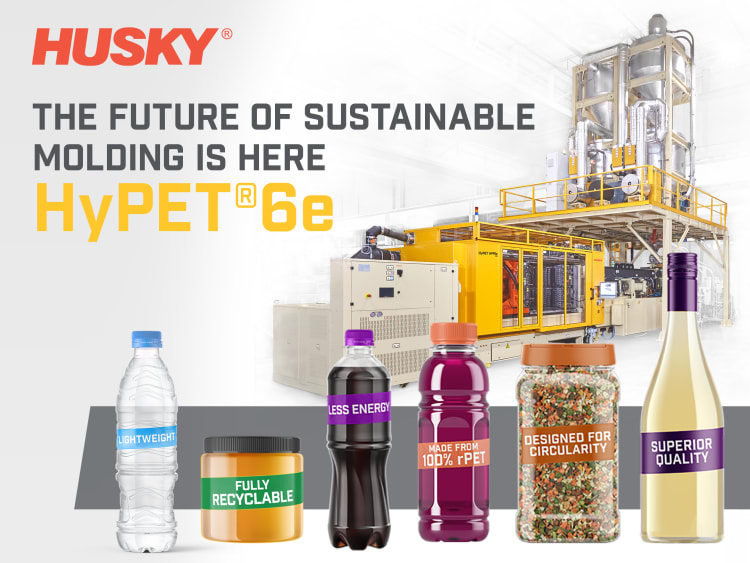
The HyPET 6e platform from Husky has been designed for sustainable PET preform production with an emphasis on the use of recyclate. The concept links the machine, mold and key auxiliary equipment into a single integrated system. According to the design intent, the platform enables processing of up to 100% rPET while maintaining production efficiency and consistent preform quality. The use of a high‑throughput screw, targeted melt distribution and closed‑loop monitoring systems is intended to improve management of rPET property variation and achieve stable preform quality under mass production conditions.
The role of drying and energy optimization
Pellet drying is crucial for PET material quality, especially in the case of recycled feedstocks, which may have increased moisture content and contamination. Modern vacuum drying systems are designed to more effectively remove contaminants and control moisture levels, while at the same time reducing energy consumption compared with conventional solutions.
In integrated systems such as HyPET 6e, drying technologies form part of the overall line concept. Shorter material changeover times are intended to enable faster transitions between different feedstocks and applications, minimizing downtime and maintaining stable operating parameters. Energy optimization at system level includes, among other things, the use of servo drives and adaptive pressure control so that energy is supplied only where it is strictly needed. The objective is to reduce total energy consumption while maintaining short cycle times and high cavity productivity.
Maximizing productivity and system performance
Sustainability aspects in PET preform production must be balanced with productivity requirements, which remain essential for plant competitiveness. The development of injection system designs is oriented towards the ability to use molds with a higher number of cavities, implement more advanced preform geometries and further shorten cycle times. All of this is aimed at reducing unit conversion costs while maintaining or improving product quality.
The HyPET 6e platform is presented as a solution that allows integration of automation, real‑time monitoring and intuitive controls. Automated quality control systems and closed‑loop control are intended to support consistent manufacturing parameters while reducing dependence on operator experience. This approach is expected to improve overall efficiency, line availability and process repeatability.
The importance of integration for the circular economy
The development of PET preform production technologies is increasingly defined by the degree of integration of individual components into a single, complete system. A holistic approach, combining advanced polymer processing, energy efficiency and material optimization, is becoming a prerequisite for implementing circular economy principles in the PET packaging segment.
Platforms such as HyPET 6e illustrate how designing systems as coherent, integrated solutions can help producers reduce environmental impact while maintaining required levels of performance and productivity. The integration of processing technologies, quality control and energy management is redefining what is possible in sustainable PET preform manufacturing, without the need to sacrifice high line output, operational efficiency or consistent product quality.