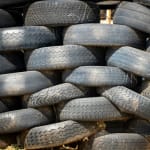
The report “Noise in the City. Warsaw 2024-2025”, prepared by the Institute of Acoustic Ecology on the basis of 100 field measurements, indicates a high level of exposure of the capital’s residents to transport noise. The data presented show that none of the surveyed locations met the recommendations of the World Health Organization, and at some measurement points the standards in force in Poland were also exceeded. The Polish Tyre Recyclers Association assesses that one of the available tools for reducing this phenomenon is solutions using rubber obtained from the recycling of end-of-life tyres. This includes both road surfaces with the addition of rubber material and elements reducing noise and vibration in rail infrastructure. The organization emphasizes that technologies of this kind are already in use and that the domestic recycling sector has the raw material base for their broader implementation.
The study covered the period from March to August 2025. As reported, at Ignacy Mościcki Roundabout the average noise level was 82.3 dB, nearly 30 dB above WHO recommendations. On the 46 surveyed arterial roads and intersections, not a single location within safe limits was recorded. Maximum values reached 118.8 dB, including at the intersection of Jana Pawła II Avenue and Sienna Street. The report also draws attention to the situation in particularly sensitive places, such as hospital surroundings, where noise levels regularly exceeded 70 dB. In the Wisłostrada tunnel, at the stop of line 185, the average noise level was 92.9 dB. According to the cited data, Polish standards allow road noise in central Warsaw at 68 dB during the day and 60 dB at night, while WHO recommends 53 dB and 45 dB respectively. The European Environment Agency, meanwhile, estimates that noise is responsible in Europe for 66,000 premature deaths annually and tens of thousands of new cases of cardiovascular disease.
Rubber-modified asphalt as a solution for roads
One of the solutions indicated by PSRO is rubber-modified asphalt, in which the traditional bituminous binder is supplemented with powder or granulate derived from the recycling of end-of-life tyres. According to the data cited in the material, the wet process makes it possible to reduce rolling noise by 4 to 8 dB. In turn, the dry process, described as technologically simpler and cheaper, is to provide a reduction of 3 to 5 dB. The organization points out that both approaches are also expected to improve pavement performance parameters, including safety. The material states that the use of such mixtures can shorten braking distance by 6 to 12 per cent, especially on wet pavement, and can also increase road durability. As an example of practical application, a section of Wołoska Street in Warsaw was indicated, where this type of pavement is said to have been in use for more than a decade.
Reduction of noise and vibration in tram infrastructure
The possibilities of using rubber recyclate described in the material also concern rail transport. The report notes that in the area of the depot on Woronicza Street, a difference exceeding 16 dB between measurements on the A and C scales indicates a strong presence of low-frequency noise capable of penetrating building walls. In response to this problem, the results of research conducted by Krakow University of Technology on railway tracks were cited. According to these findings, rail dampers made of recycled rubber reduce the sound level by an average of 4.5 dB, while under-sleeper pads provide a further 3.4 dB reduction. At the same time, these solutions are expected to reduce vibrations felt by residents by 5 to 8 times in the immediate vicinity of the tracks. The combined application of both technologies may, according to the cited data, reduce rail noise by nearly 8 dB.
As Andrzej Kubik, President of the Polish Tyre Recyclers Association, said: “We do not have to wait for breakthrough inventions; technologies based on rubber from recycled tyres are proven, tested and ready for implementation in Polish cities immediately. Polish recycling plants have processing capacities of around 400,000 tonnes of tyres annually, so there is no shortage of raw material. Every used tyre, instead of ending up in a forest or at a landfill, can become part of a quieter and safer road. It is solely a matter of decision-making at the administrative level.”
Standardization work and planned implementations
Information provided by PSRO shows that work is under way on a Polish Standard for rubber-modified asphalts, carried out in cooperation with the Oil and Gas Institute and the Polish Committee for Standardization. Their completion is scheduled for 2026. This is intended to facilitate the inclusion of such solutions in public procurement. In parallel, the association is pursuing efforts for pilot implementations in Warsaw. These include preparing a section with rubber-modified asphalt on one of the city’s noisiest arteries, as well as the installation of rail dampers and USP pads on selected critical sections of tram tracks.


