Rising demand for silicone micro parts for medical technology, automotive electronics and other industries is making micro injection molding a highly specialized processing field. At starlim's site in Marchtrenk, Austria, a dedicated department has been established for this segment, equipped with Wittmann MicroPower injection molding machines and its own cleanroom. As Dominik Kreuzmayr explains, starlim classifies parts weighing less than 10 mg as micro parts. The company emphasizes that there is no universally accepted definition of micro injection molding, and that its classification is based on many years of experience and an understanding of material behavior in extremely fine mold structures. At this scale, different rules apply than for larger parts. Two sample products illustrate this, an O-ring measuring 0.7 x 0.4 mm and a hearing aid component measuring 6 x 5 x 1 mm. The first is so small that it is difficult to pick up with one's fingers, while the second demonstrates design complexity at the micro scale because it is a two-component part. At its center is a membrane made of blue liquid silicone rubber, LSR, surrounded by a rigid thermoplastic PBT frame that facilitates assembly in the hearing device.
In the case of this hearing aid component, the part was produced in a single-cavity mold on an all-electric MicroPower injection molding machine. As Kreuzmayr notes, starlim limits industrial production to four cavities, because when the highest precision is required below the millimeter range, it is crucial to arrange the cavities as closely together as possible. The main challenge lies in the narrow tolerances in the corrugated area of the membrane body. Günter Polt, application engineer in starlim's micro injection molding department, points out that with such small parts, the decisive factor is the injection molding machine's control accuracy, because unlike the injection molding of larger parts, the residual melt cushion does not play a significant role here. Polt, who has been involved in silicone processing for almost 30 years, also stresses that the quality of such parts often cannot be assessed with the naked eye and must be examined under a microscope.
Process precision and control stability
According to starlim representatives, MicroPower machines stand out for their very high precision in executing all process settings. The company points to the combination of highly sensitive dynamics with absolutely stable and accurate control. In the case of hearing aid components, impression accuracy is important not only for efficient assembly, but above all for correct sound reproduction. The tolerance range of the finished two-component part is plus/minus 2 µm. This requires very precise adjustment and control of the clamping force, as well as a highly accurate mold.
The mold comes from the company's own mold-making shop. The roots of today's group lie in mold manufacturing. In 1974, Franz Sterner founded Sterner Werkzeugbau GmbH, and ten years later Starlim Spritzguss GmbH was established. These two business areas are now closely linked, and molds are made exclusively for the company's own production. For customers, this means coordinated solutions from a single source and knowledge transfer between mold design and processing. According to the company, only new laser technologies and micro 3D printing make it possible to build molds for such small hearing aid components while meeting stringent acoustic quality requirements.

Two-component part for hearing aids: ultimate injection molding precision is the prerequisite for accurate sound reproduction
Integrated in-line quality control
For series production, it is planned to test the vibration properties of the membrane in-line, directly after injection molding and still inside the mold cavity. According to starlim, this is the most efficient solution because the very small parts remain in a defined position there and do not need to be repositioned for quality inspection. For the vibration test, the mold makers integrated a sound emitter and a laser measuring system into the robot gripper. As Kreuzmayr says: "With this hearing aid component, we have achieved a real breakthrough thanks to innovative mold technology and exceptionally efficient processing technology."
The integration of further production steps such as quality control is also supported by the MicroPower design concept itself. On a floor space of just 2 m2, the all-electric work cell accommodates the complete equipment, including the clamping unit with a rotary plate, the patented two-stage injection system, material handling, automation, temperature control unit, quality control system and additional process units. At the same time, the mold space with a 400 mm distance between platens remains easily accessible. Linear guides ensure highly sensitive mold protection, and a precise five-point toggle lever system distributes the clamping force evenly across the mold parting line.
As Jochen Sassmann, regional sales manager at the Wittmann Group, emphasizes, the machine design makes it possible to move the injection plunger right up to the mold parting line. This significantly reduces the sprue and in some cases even eliminates it completely. In silicone injection molding, this is particularly important from a material standpoint, because fully vulcanized LSR cannot be recycled.
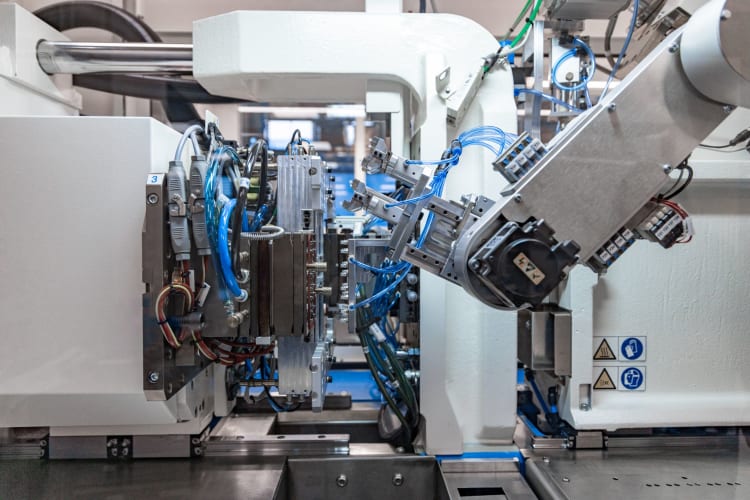
MicroPower offers ample scope for automation. In addition to the vertically integrated Scara robot, solutions developed by customers can also be integrated via interfaces
Micro injection molding as a field of mass production
starlim's micro injection molding department has been operating for 15 years. As Kreuzmayr indicates, the first Battenfeld micro injection molding machine arrived there at a time when it was the only company capable of supplying such machines for industrial mass production. According to representatives of both companies, the machine concept has been continuously developed and today defines the state of the art in micro injection molding in terms of precision and efficiency. Several MicroPower injection molding machines are now operating in Marchtrenk, some of them in the new cleanroom, where precision products for eye surgery are among the items being manufactured.
Each of these machines is configured to meet the requirements of a specific product group. The site operates both machines for single-component injection molding and two-component machines, as well as an integrated system consisting of two separate machines connected by a robot. This arrangement increases flexibility because it enables efficient production of two-component parts, while also allowing both machines to be used independently with single-component molds. In terms of automation, the MicroPower concept leaves broad freedom. In addition to the vertically installed Scara robot, which is an integral part of the production cell, various handling systems can be integrated via interfaces, including solutions developed in-house by starlim.
For each new project, an analysis is carried out to determine whether a multi-component machine or an integrated solution will deliver higher overall efficiency. Currently, the share of two-component products is about 40 per cent, and the starlim micro injection molding team expects this share to rise. Inquiries concerning two-component parts are becoming more frequent, although their product development takes more time.
High-volume production, which originally tipped the balance in favor of cooperation with the Wittmann Group in the field of micro injection molding, still dominates the daily operations of the Marchtrenk plant. Production runs counted in the millions of parts are common there. As Dominik Kreuzmayr says: "MicroPower machines reliably handle these extreme requirements and ensure a safe process for us." starlim's micro injection molding team also highlights the good cooperation with the Wittmann Group. "We communicate quickly and directly, and so far we have jointly found solutions to all the challenges we have faced. Thanks to a good partnership, we are truly able to fully utilize the technological capabilities of these machines."

At starlim, MicroPower is the standard equipment in silicone micro injection molding. Photos: Starlim Spritzguss GmbH