At Interplas 2026, taking place on 2–4 June 2026 in Birmingham (UK), the ENGEL Group is announcing the presentation of production solutions aimed at cost-efficient and precise plastics processing. The scope of the exhibit is to include applications from the field of technical moulding, all-electric solutions for efficient series production, digital assistance systems for stabilising processes, as well as information on large machines intended for the development and implementation of large-format components for the automotive sector, with integrated surface finishing directly in the injection moulding process. The company indicates that these concepts are intended to reduce unit costs, scrap and energy consumption while maintaining high process stability and a fully automated production sequence.
The stand is expected to feature both complete production cells and digital solutions that intervene in process parameters relevant to quality and efficiency. The topics presented include, among others, production using tie-bar-less machines, all-electric injection moulding machines for standard series applications, data-based assistance systems, and options for testing and validating large parts under conditions close to target production.
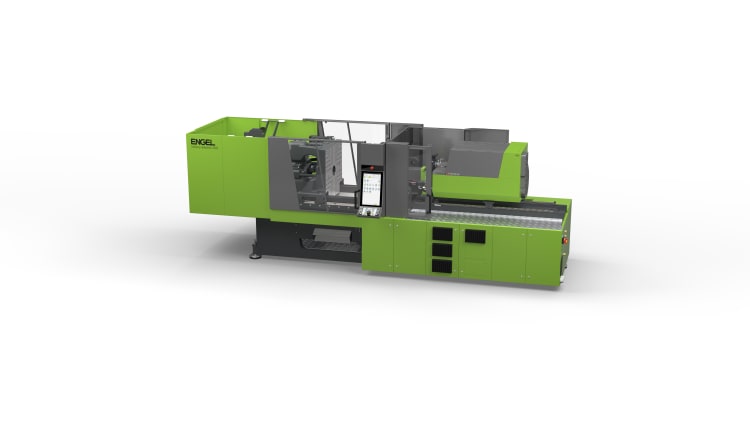
More mould space and automation potential with the victory electric 220
ENGEL is announcing the presentation of the new tie-bar-less victory electric 220 injection moulding machine, previously unveiled at K. The machine has been designed to meet the requirements of fittings production. The manufacturer highlights the combination of extensive freedom in the mould mounting area, resulting from tie-bar-less technology, with high energy efficiency and precision of electric drives. The expected outcome includes short cycle times, simpler and faster set-up processes, and a compact footprint.
In applications with large moulds typical for fittings, the advantages of tie-bar-less technology are intended to be particularly evident. The large mould mounting area and the open mould space without tie bars allow the use of moulds with protruding core pulls and increase the scope for integrating automation. According to the manufacturer, in many cases this enables the use of a smaller machine, reducing investment costs. In addition, improved accessibility of the mould space is expected to simplify set-up and reduce downtime. Combined with all-electric drives, this is intended to provide a solution with high precision, low energy consumption and reduced maintenance requirements.
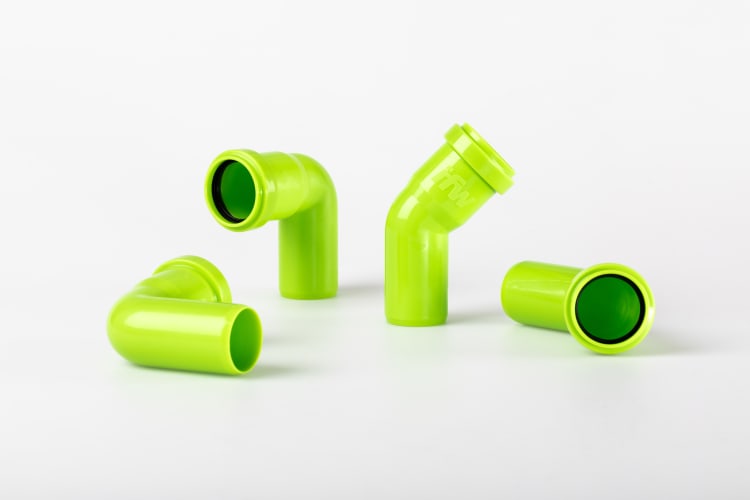
At the trade fair, the machine is to run in an automated production cell representing fittings manufacturing, including assembly and quality assurance. A family mould from ifw will be used, producing four fittings per shot, two with a 90° bend angle and two with a 45° bend angle. Polypropylene from Borealis is to be processed, with a shot weight of four times 80 g.
Process stabilisation is to be supported by digital assistance systems. iQ hold control automatically optimises the holding pressure time, which ENGEL says can increase output; depending on the application, a reduction of holding pressure time by 15% is not uncommon. iQ weight control plus compensates for viscosity fluctuations within the same shot and reduces scrap by cutting weight variation by up to 85%. In addition, the iQ process observer is designed to detect deviations in 1,000 process parameters at an early stage and provide guidance for process control, which is intended to relieve personnel and improve OEE. The digital set-up assistant is also expected to improve cost efficiency by offering structured support during mould changes and reducing set-up time by up to 80%.
Automation is to be fully integrated into the cell. After demoulding, components are transferred via an integrated Z conveyor belt to quality control. Two easix articulated robots pick the parts, feed them to an automated ring inserter, and ensure an automated sequence through to leak testing and discharge of the fully assembled fittings.
All-electric series production with the WINTEC e-win
For series production, ENGEL is also announcing the presentation of the WINTEC e-win injection moulding machine. The company states that the solution is intended to combine high precision, stable processes and low operating costs through all-electric drives and a consistently standardised machine concept. It is positioned for applications in which availability, short delivery times and high reproducibility are key, while digital assistance systems such as iQ weight control are intended to help maintain consistent quality, reduce scrap and lower unit costs.
An e-win with 1,800 kN clamping force is to run on the stand in a compact production cell. The application shown involves the production of small polypropylene storage boxes with a hinge, with a shot weight of 33 g. The manufacturer reports a cycle time of under 15 seconds while maintaining high part quality. In this application, iQ clamp control is said to reduce clamping force by 22%, thereby lowering energy costs.
ENGEL emphasises that all-electric drives enable precise and dynamic control of all main machine movements, resulting in high repeatability, reproducible process behaviour and stable shot weights. In practice, this is intended to support consistent part quality even during long running times and within narrow process windows.
The described design features the interaction of a servo motor, ball screw drive and belt drive, which is intended to ensure efficient power transmission and a dynamic clamping unit response. Energy consumption is expected to occur only when movement actually takes place. Compared with hydraulic machines, this is intended to significantly reduce energy costs. In addition, the absence of hydraulic oil is intended to reduce maintenance effort and downtime, while keeping the production environment cleaner.
AI-based assistance systems and expansion of the inject 4.0 environment
As part of the development of its iQ systems, ENGEL is announcing an extension with AI-based functions under the name inject AI. In the Expert Corner at the stand, the company is to show how inject 4.0 is gradually being expanded towards a data-based and learning production environment. Engel states that systems such as iQ weight control, iQ clamp control, iQ flow control, iQ melt control and iQ motion control already automatically intervene in process variables relevant to quality and efficiency. iQ weight control compensates viscosity fluctuations in real time, iQ clamp control automatically adjusts clamping force, thereby reducing mould stress and energy consumption. iQ flow control stabilises temperature control, iQ melt control monitors plasticising and detects process deviations early. The iQ process observer is intended to support personnel with data and help avoid scrap at an early stage.
The company also points to the ENGEL Virtual Assistant, which makes system-specific knowledge directly available, as well as AI-based applications such as part finder for the rapid identification of spare parts via photo. From ENGEL's perspective, this is intended to reduce scrap, increase system availability and improve the utilisation of machine and personnel resources.
duo 5500 combi M: development of large parts and in-mould surface finishing
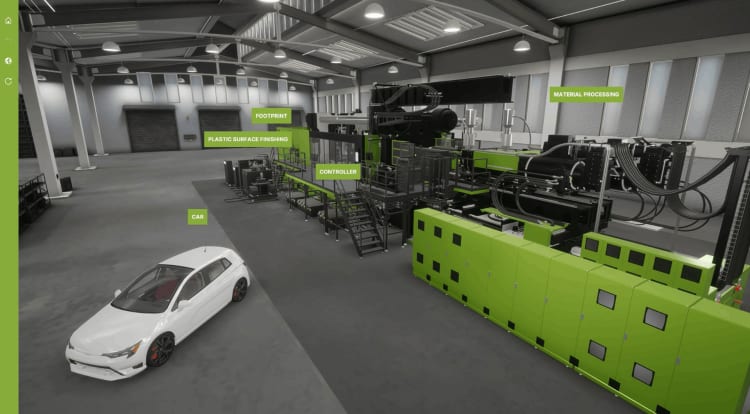
On the stand, ENGEL is to present, using a digital twin, the possibilities of the duo 5500 combi M system in the context of developing large-format plastic components. The company describes this solution as probably the largest injection moulding machine in a technical centre, available for customer trials at ENGEL in St. Valentin. This is intended to enable testing of components and moulds in real dimensions and further development through to mould trials.
The system parameters include 55,000 kN clamping force, 3.5 × 3.5 m platens, 6.6 m platen distance, mould weights of up to 150 tonnes and shot weights of up to 42 kilograms. ENGEL states that this creates the prerequisites for applications required above all in the automotive industry and in technical injection moulding. For processors, the benefit is described as the ability to design and validate large components early under realistic conditions, potentially shortening development times, reducing technical risks and creating a robust basis for later series production, especially where plastics are to replace metal and functions are to be integrated into one part.
As an example of how such components can be manufactured with surface finishing, ENGEL refers to the clearmelt process shown in the digital version of the duo 5500. In this process, the injection-moulded component is overmoulded with polyurethane in the mould. The surface finishing is said to correspond to coating and to be integrated directly into the injection moulding process. According to the manufacturer, this means fewer separate process steps, an accelerated manufacturing chain, improved part quality and high reproducibility.