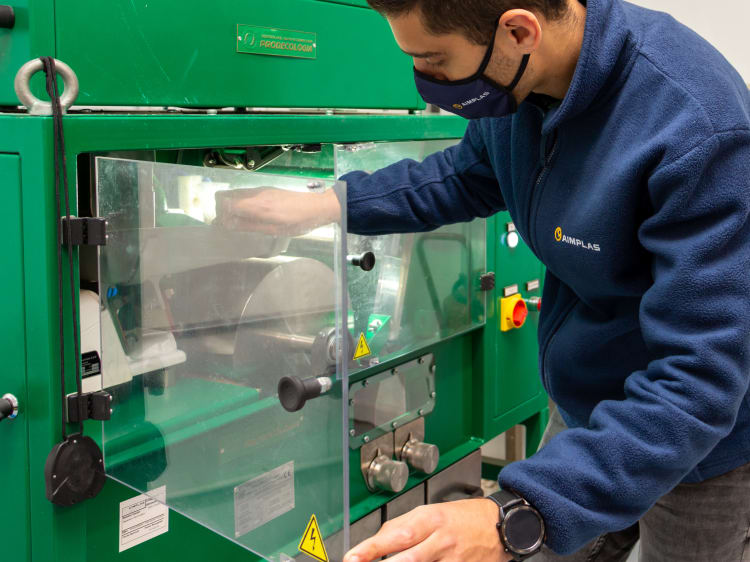
Aimplas, a plastics technology centre, will take part in PRS Europe 2026, an event for the plastics recycling industry in Europe, taking place on 5 and 6 May at RAI Amsterdam. The centre will be present at stand L74, where it will present recycling solutions aimed at converting complex plastic waste into higher-value materials and products. The organisers report that PRS Europe brings together more than 13,000 professionals and over 500 exhibitors from across the recycling value chain each year, providing the context for Aimplas to present its advances in recycling technologies and its approach to the challenges associated with the transition to more circular and sustainable models.
From waste to product, multiple technological routes
Aimplas intends to emphasise that there is no single universal solution for recycling plastic waste. Selecting the most efficient route depends on the material type, its origin, condition and intended application. For this reason, the centre is developing a portfolio of complementary technologies, covering both the preparation of waste streams and feedstock recovery processes, as well as the assessment of implementation viability.
- Sorting and identification: NIR technologies, vision systems, density separation, air-flow separation, and electrostatic and triboelectric separation, aimed at correctly identifying and sorting waste streams.
- Solvent-based recycling: the use of solvents and supercritical fluids (SCF) to separate and purify components of complex multilayer materials.
- Solvolysis and pyrolysis and gasification: chemical recycling routes enabling the recovery of monomers and oligomers or the conversion of waste into fuels and other value-added products, such as fibres.
- Enzymatic recycling: a solution particularly targeted at polycondensation polymers such as PET and bioplastics such as PLA, using enzymes to trigger controlled degradation with substance recovery or layer separation.
- De-crosslinking: the recovery of crosslinked materials such as XPE, rubbers and elastomers such as EVA, which to date have been difficult to recycle.
- Upcycling: processing plastic waste into materials for higher value-added applications.
- Process simulation: techno-economic analysis used to assess the industrial viability of a given route before scaling up and to support decisions for a specific waste stream.
According to Aimplas, these technologies are applied to waste originating, among others, from automotive, packaging, textiles, construction, renewable energy, electrical and electronic equipment, sports and leisure, as well as marine litter. The centre thus points to the breadth of its research activities.
SSbD methodology and life cycle assessment
Aimplas states that the work is carried out under the SSbD (Safe and Sustainable by Design) methodology, which integrates life cycle assessment (LCA), life cycle costing (LCC), social life cycle assessment (sLCA) and health and safety evaluation (H&S). The aim is to ensure that the solutions developed are competitive in technical, economic and environmental terms.
Participation in the PRS Europe 2026 technical programme
In addition to the exhibition presence, Aimplas will take part in the PRS Europe 2026 technical programme. Vanessa Gutiérrez Aragonés, a mechanical recycling researcher at Aimplas, is scheduled to speak on Tuesday 5 May from 12:45 to 13:30 at Conference Theatre One, within the session "Future-Proof Design: Navigating the Recyclability Targets". The presentation, titled "Backstage of recyclability testing: scientific aspects and key results", is to address the scientific aspects and key results of recyclability testing from Aimplas’s technical perspective.