In modern motor racing, vehicle mass, aerodynamics and the construction materials used determine the outcome on the track. For the student racing team Mainfranken Racing e.V. from the Technical University of Würzburg-Schweinfurt, the production of carbon composite parts is a key area of vehicle optimization. As part of a design competition, the students develop a new race car every year, using advanced manufacturing processes. This also applies to vacuum technology from Atlas Copco, used for the production of lightweight, high-quality carbon components. In this process the oil-sealed rotary vane vacuum pump GVS 100A, supplied to the team by Atlas Copco Vacuum, plays a central role.
Oil-sealed vane pump in the laminating process
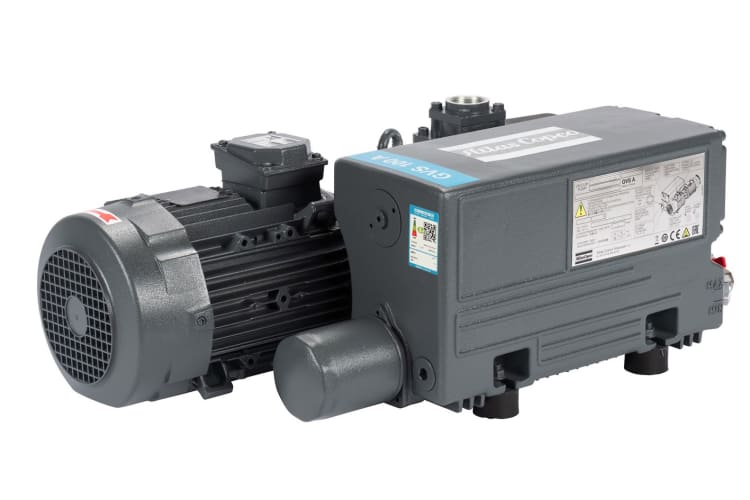
To ensure maximum quality and process repeatability, the racing team uses the oil-sealed rotary vane vacuum pump GVS 100A. The unit was provided by Atlas Copco Vacuum as support for the students' work. As explained by Alexander Braun, Sales Engineer at Atlas Copco Vacuum in Germany, the pump is characterized by a compact, robust design and stable, reliable operation under demanding conditions. It ensures uninterrupted operation and constant vacuum parameters, and is easy to use, with low noise and limited maintenance requirements.
The production of composite parts begins with the preparation of the carbon fiber reinforcement. Marius Hofmann, Chief Technical Officer of Mainfranken Racing, describes the process: "Production starts with cutting and applying several layers of carbon fiber fabric that are impregnated with epoxy resin." The individual layers are carefully stacked on top of one another, with fiber orientation selected according to the load directions the final part will be subjected to. "In the next step the component is placed in a vacuum chamber or sealed using a special vacuum film," adds Hofmann.
Stable vacuum and mechanical properties of the composite
In the subsequent phase of the process, effective degassing of the resin–reinforcement system is crucial. The GVS 100A pump generates a stable vacuum that enables removal of air from the chamber or film package. "This stage is crucial because the vacuum removes air pockets that would later lead to structural weaknesses, such as microcracks in the part, and ultimately to defects," emphasizes Marius Hofmann. At the same time, the negative pressure promotes uniform resin penetration into the fiber structure and squeezes out excess resin from the system.
Increasing the fiber volume fraction while reducing the amount of resin translates into improved mechanical properties of the finished composite parts. After complete evacuation and formation of the laminate, the components are cured at elevated temperature for around twelve hours. During this time the resin hardens and the component reaches its target strength and dimensional stability.
The result of the entire process is a lightweight, durable carbon component capable of carrying high loads and withstanding significant material stresses under racing conditions. Properly designed vacuum technology has a direct impact on the durability and reliability of the vehicle's components.
GVS 100A pump design and process requirements
The Atlas Copco GVS 100A vacuum pump uses rotary vane technology designed for demanding industrial applications. Thanks to oil sealing, it is possible to achieve a stable and repeatable vacuum, which is essential in processes such as the production of carbon composite parts. Constant vacuum conditions enable controlled impregnation of the reinforcement and help reduce the risk of internal defects.
The unit incorporates an integrated oil separation system that limits the emission of oil vapors in the exhaust air, contributing to a clean working environment. The gas ballast valve facilitates the handling of moist gases, which is important in applications where increased vapor content may occur in the process. A check valve at the suction port protects the installation against backflow of air into the system after shutdown, increasing operational safety.
The compact design makes the GVS 100A easy to integrate into existing workstations or installations. The pump is suitable for continuous operation over a wide pressure range, from atmospheric pressure down to the final working pressure, while maintaining a relatively low noise level and limited maintenance needs. For applications in which parameter repeatability and manufactured part quality are critical, this combination of features is of significant importance.
Importance of vacuum technology for the student team
The collaboration between the student team and the supplier of industrial vacuum technology shows how important reliable tools are in the production of components with high operating requirements. The use of the Atlas Copco GVS 100A pump enables precise implementation of laminating and impregnation processes and contributes to improved quality of the carbon parts used in the race car.
This solution also has an educational dimension. Students from Mainfranken Racing e.V. gain practical experience with composite processes and industrial vacuum technology, which translates into better preparation for engineering careers. As the team concludes, the combination of modern vacuum technology with the knowledge and commitment of students supports the technical development of the race vehicle and progress in the racing competition itself.
Selected benefits of using the GVS 100A pump
The most important advantages of the GVS 100A pump in the described application include:
- integrated oil separation that limits the emission of oil vapors in the exhaust air,
- low maintenance requirements and low noise level during operation,
- capability for continuous operation across a wide pressure range from atmospheric to final pressure,
- compact design that facilitates installation in existing systems,
- high reliability and stable vacuum parameters, important for composite processes,
- efficient vacuum generation that supports improved quality of carbon laminates.