Asahi Kasei Advance has announced its first participation in Techtextil 2026, the international trade fair dedicated to technical textiles and nonwovens, which will take place from 21 to 24 April 2026 in Frankfurt am Main. The company will present in hall 12.1 at booth C35 its portfolio of high-performance nonwovens, flame-retardant fabrics and advanced textile and fiber solutions designed for various industrial sectors. In total, 14 material brands will be showcased, with particular focus on four key solutions: the flame-retardant fabric Lastan, the three-dimensional spacer knit Cubit, the continuous filament cellulose nonwoven Bemliese and the spunbond nonwovens Eltas.
Lastan: advanced flame protection
Lastan is a non-mineral flame-retardant fabric produced by air baking a special acrylic fiber at 200–300°C. The material is characterized by a limited oxygen index (LOI) of 47.5–50, which translates into high flame resistance and good electrical insulation properties.
The use of a special coating process enables the material to disperse sparks generated during welding or cutting operations, which reduces the risk of ignition. As a result, the fabric can provide effective protection against flames and particle exposure from venting gases. Owing to these properties, Lastan has been used for many years as a material supporting failure prevention and safety enhancement in various industrial sectors.
Cubit: durable and recyclable 3D spacer fabric
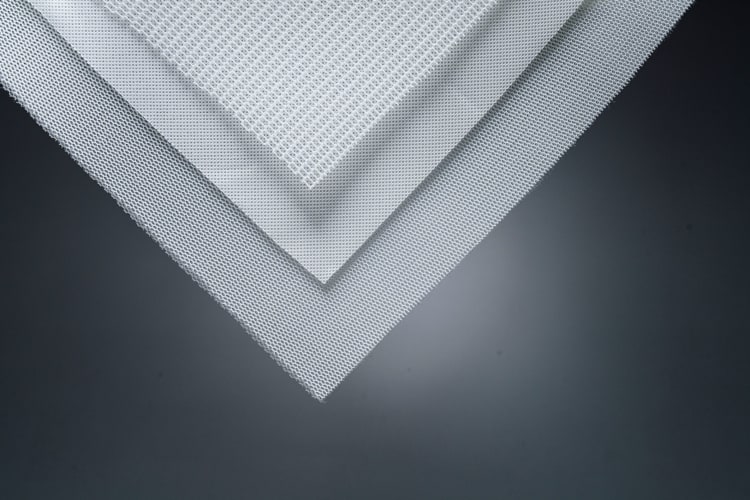
Cubit is a three-dimensional warp-knitted spacer fabric designed for applications that require durability, breathability, easy care and enhanced support and comfort. The front and back surfaces are made of polyethylene terephthalate (PET), while the connecting threads can be selected from poly(trimethylene terephthalate) (PTT), PET or polyamide (nylon), depending on the application requirements.
The all-PET monomaterial variant provides an easily recyclable alternative to polyurethane foam in applications in the healthcare, furniture and automotive industries, where the importance of substitutes for materials that are difficult to recycle is increasing.
Bemliese: nonwovens for hygiene and cleaning solutions
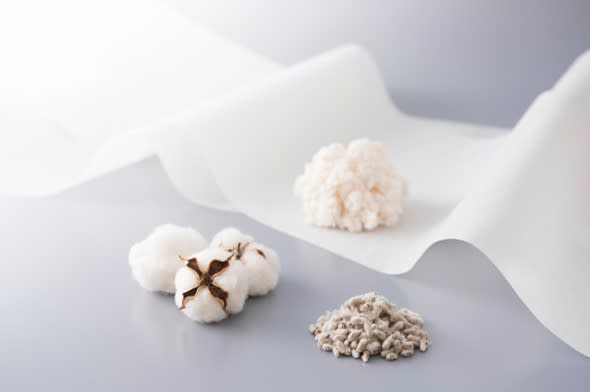
Bemliese is a continuous filament cellulose nonwoven sheet produced from cotton linter. After moistening, the material becomes particularly soft and conforms well to the surfaces it contacts, with a reduced abrasion coefficient. Its high moisture absorption and retention capacity makes Bemliese suitable for hygienic and cosmetic applications, such as face and eye area masks.
In the dry state, Bemliese leaves virtually no lint, scratches or chemical residues on contacted surfaces. This makes the material suitable for cleaning equipment in industrial, laboratory and medical environments where contamination must be minimized. TÜV Austria Belgium NV has certified the biodegradability of this material in soil, water and marine conditions, as well as its suitability for industrial and home composting.
Eltas: binder-free spunbond nonwovens
Eltas is a family of versatile spunbond nonwovens offered in several material variants: polyamide, polyester or polypropylene. All three types feature a structure without additional binder and are available in ultra-thin, low basis-weight grades.
The binder-free Eltas spunbond nonwovens are distinguished by filament evenness, air permeability and edge fray resistance. Selected grades are used in a wide range of products, including hygiene items, consumer and household articles, automotive components, filtration solutions, agricultural and construction materials, as well as other applications such as tea bags and cable wrapping and jacketing.
Portfolio presentation at Techtextil 2026
At the Asahi Kasei Advance booth in hall 12.1, stand C35, all four highlighted material brands will be presented alongside an additional ten material solutions from the company’s portfolio. The aim of the presentation is to address the needs for high-performance nonwovens, flame-retardant fabrics and textile solutions among customers from sectors such as hygiene, medical, automotive, furniture, general industry and the technical textiles and nonwovens segment.