
Ad Rem has presented the Owl system, an automated solution designed for more advanced quality control of plastic flakes. The system was developed to eliminate several fundamental limitations that occur in the analysis of this type of material. According to the company, detailed flake analysis is often time-consuming and performed manually. An operator picks up an individual flake, places it on a detection device, waits up to a minute for the result, then removes the sample and processes the data. This way of working results in high manpower requirements. Another problem is the lack of an integrated analysis method. One device is needed to determine the polymer type, another to identify molecules or elements present in the material, and the data is scattered across different databases. In practice, this means there is no link between results obtained from different sampling technologies, so it is not clear exactly which particle contains which elements. An additional issue is the lack of uniform sample preparation. Ad Rem also points out that commercially available automated systems use NIR, which has significant limitations, including the detection of black plastics, which often account for the majority of material in WEEE or ASR streams.
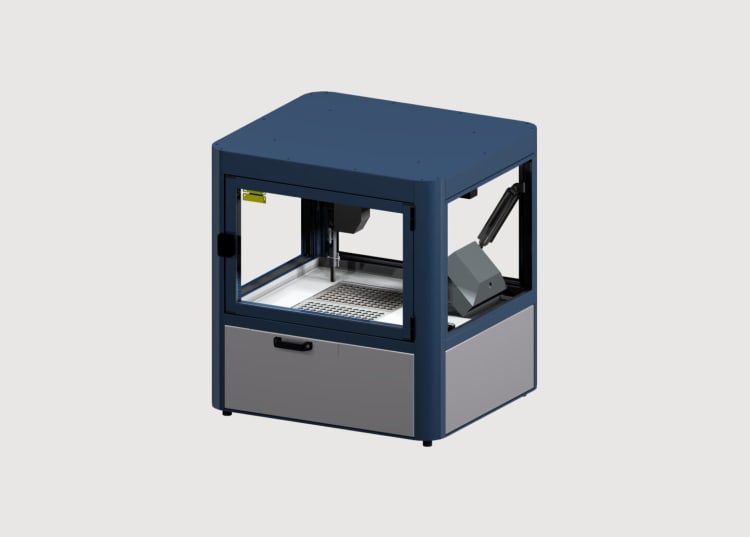
In response to these limitations, a system was developed that combines sample preparation, automatic material handling and analysis using two measurement techniques. Plastic flakes or regranulates are first prepared using a set of pressing rollers. The rollers flatten the flakes so that the surface does not hinder detection, and the samples themselves become easier to pick up. The prepared material is then placed on a tray inserted into the Owl unit. Inside the system, a gantry mechanism automatically picks up a flake, places it onto the sensors and then returns it.
Combination of XRF and FTIR in one system
Two sensors are used in the system. The first is an XRF analyser, using X-rays to detect elements such as bromine, chlorine or antimony. The second sensor is an FTIR spectrometer, using infrared radiation to determine the type of plastic. As stated, both sensors are commercially available models.
The system offers real-time data visualisation, both at the level of an individual flake and of the entire batch. Information on material composition and elemental composition is combined, securely stored and can be exported when needed. According to Ad Rem, the use of the Owl system also enables easy analysis of black plastics, which is one of the main advantages of the solution over systems based solely on NIR.
Applications in plastics recycling
One of the intended applications is the detailed analysis of different input materials in order to optimise process flows and compare the quality of materials supplied by different vendors. In many cases, a significant part of the stream consists of black material, and the share of black and non-black plastics is not constant for individual polymer types. This means that a traditional flake analyser using NIR would not be able to provide a reliable assessment. Such devices usually ignore black plastics and extrapolate data obtained from non-black samples, which leads to a distorted result. Correct identification of black plastics is intended to allow recyclers to value incoming deliveries more reliably based on the actual composition of the mix.
A second indicated application is tracking bromine content in all analysed flakes. As a result, the Owl system can indicate which individual particles contain bromine and determine its quantity, instead of only providing the average bromine content in an extruded mix after compounding, when it may already be too late to react. The system also makes it possible to determine which specific particles and which plastic types contain bromine. According to the solution description, this is a significant advantage and the only way to meet future stricter legal requirements concerning bromine and persistent organic pollutants, POPs.
Another application is monitoring the quality of a recycler's output and the quality of the process itself. The system is intended to simplify quality control of sorting operations. It is enough to take a sample of about 50 flakes, place it in the machine and let the system run for about an hour to obtain detailed real-time data on plastic composition and elemental composition. This makes it possible to quickly assess whether the production process is running correctly and whether adjustments are required. This applies both to separation efficiency and yields, and to quality control in terms of bromine or POPs content.
Ad Rem also indicates that, unlike NIR detection, the applied combination of sampling technologies makes it possible to detect specific fillers such as calcium carbonate, talc or glass fibre.
Research project and market presentations
The Owl system was developed as part of a research project carried out by the University of Leuven, VITO, Galloo and Ad Rem. As part of this project, more than ten thousand samples of plastic flakes were mapped and analysed over many months. When purchasing the device, the user receives a library of reference spectra for plastics from ASR and WEEE streams. This library can be used to compare one's own samples with industry baselines.
As stated, the system was first presented at the IERC conference in January 2026. Live demonstrations are to be held at the PRS trade fair in Amsterdam in May. The solution is patent pending and is already commercially available.


