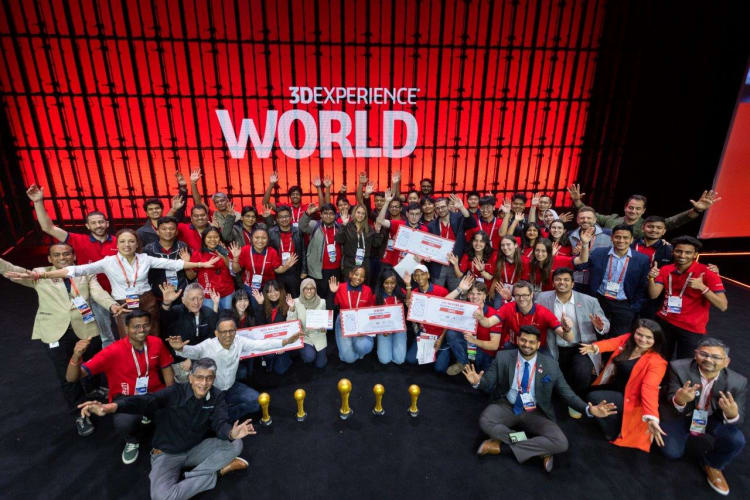
Dassault Systèmes announced the winners of the international Aakruti 2026 student design competition during the 3DExperience World conference in Houston. Student teams developed solutions aligned with sustainable development goals in healthcare, mobility, urban infrastructure and green energy, using digital tools as well as engineering and design skills.
The winning team, Team UJ Wom+n in Tech from the University of Johannesburg in South Africa, was recognized for the Latch project. It is a pedal-powered breast pump equipped with a universal bottle mounting system. The device can be used anywhere, without access to electricity and without the need for specialized components. The solution addresses the needs of users in areas with limited infrastructure, focusing on functionality, simplicity and independence from the power grid.
Twelve teams from higher education institutions in India, Indonesia, Singapore, Malaysia, Mexico, South Africa, Spain, Turkey and the United Kingdom qualified for Aakruti 2026. Participants used the 3DExperience platform and Solidworks applications to develop complete product concepts in one of four categories: sustainable wellness products, sustainable mobility, sustainable urban and residential infrastructure, and generation, transmission and storage of green energy. During 3DExperience World, teams presented their projects in the “EDU Zone” within the 3DExperience Playground, enabling direct exchange of experience with users of Dassault Systèmes solutions and specialists from various industries.
The total prize pool amounted to USD 10,000 in cash prizes. All participants received a one-year Solidworks license, intended to support further development of design and engineering skills and continuation of work on their own product concepts.
Competition objective and development of the Aakruti initiative
The organizer emphasizes that Aakruti is focused on the practical application of students’ technical skills in projects with implementation potential. "The word “aakruti” means the form, shape or figure of something. It reflects the spirit of this competition and supports our commitment to equipping students with key skills in the job market. Our 3DExperience Edu organization, the Solidworks SkillForce initiative, and student-focused programs and competitions such as Aakruti enable the next generation of innovators to achieve professional success" said Suchit Jain, Vice President of Strategy at Dassault Systèmes.
The Aakruti competition was launched in India in 2011 as a national event for students in design, engineering and technology disciplines. Over time, the initiative expanded to more than 37 countries. According to the organizer, more than 55,000 students have participated to date, taking on design challenges aimed at creating solutions that support a more sustainable future.
This year’s Aakruti final was organized for the first time in a format directly linked to the global 3DExperience World event, which brings together users of the 3DExperience platform and Solidworks software. Thousands of designers and engineers attending the conference were able to review solutions developed by students and observe how future professionals use design and simulation tools in practice.

Selected projects by awarded teams
In addition to the winning team from the University of Johannesburg, other finalists representing different regions of the world and thematic areas were also recognized.
The Bou team from the University of Johannesburg in South Africa presented the Dr Bou project. It is a child-friendly device that uses cooling and gentle vibrations to reduce pain and anxiety during injections. The solution focuses on improving the comfort of young patients during medical procedures.
The Belger team from Gazi University in Turkey prepared a project on selective cancer treatment based on resonance induced by low-intensity ultrasound cavitation. The concept assumes targeted cancer treatment using ultrasound resonance to destroy cancer cells based on their unique biomechanical frequency, while simultaneously activating the body’s immune response.
The Shady Business team from the Singapore Institute of Technology developed the TalkingTiles project. It is an intelligent tactile communication set that enables speech for people with aphasia. The solution uses 3D-printed elements and an instant audio feedback function, supporting users’ communication with their surroundings.
The InnoForge team from Vishwakarma Institute of Technology in India presented the Filtron project. It is an intelligent, environmentally friendly brake cooling and dust control system designed to increase braking effectiveness while reducing harmful particulate pollution. The solution aligns with efforts toward cleaner and safer mobility.
The presented projects demonstrate a range of approaches to sustainability, covering both healthcare and assistive technologies as well as mobility and engineering applications. Participation by students from many countries and the use of a shared design platform support the dissemination of similar standards of engineering work and product design, which is also relevant for the plastics processing and manufacturing sectors, including medical equipment, technical components and parts for mobile devices.