At the Paul Rauschert Steinbach GmbH plant in Steinbach am Wald, injection molded plastic components for automotive air suspension systems are now manufactured fully automatically. Standardized production cells based on Wittmann W828 linear robots play a key role here, having in practice almost completely replaced injection molding applications using six-axis robots. The unified automation concept is designed to provide maximum flexibility despite high variability in molds, batch sizes and customer requirements.
During the plant visit, complex plug components made of glass fiber reinforced polyamide with pressed-in contact pins are presented. These parts are used in automotive air suspension systems. Two plug models are produced in a 1+1 cavity mold on a 100 ton injection molding machine. A total of 600,000 units of these plastic parts leave the Steinbach am Wald facility each year. For a long time, these components were manufactured in a semi-automatic mode.
"Between individual work steps there were long idle periods for the operating staff," reports Tobias Büchner, Production Manager at Rauschert. In view of increasingly stringent quality requirements and pressure on cost efficiency, this approach was no longer acceptable. "It became clear to us that we needed to introduce a higher level of automation," he adds.
Today, the plug housings are produced fully automatically. Manual operations have been reduced and idle times between steps have been completely eliminated. Production staff can now be utilized much more efficiently. This move towards higher automation is part of a comprehensive standardization project that Rauschert is implementing across its plastic parts operations to maximize flexibility and efficiency.

These plugs are used in automotive air suspension systems, two different models are being produced.
Standardized injection molding automation for diverse orders
Rauschert is a family-owned company with two plants in Germany and several subsidiaries abroad. For 125 years it has been a manufacturer and supplier of ignition components, engineering ceramics and molded plastic parts. "With our value chain covering three interconnected production segments, including in-house tooling and plant engineering, we are unique worldwide," says Udo Jakob, Purchasing Manager at Rauschert. He emphasizes that one of the company’s strengths is plastic valve bodies with VOSS threading. Rauschert products are used in household, heating, electrical and high temperature technologies, as well as in the automotive sector.
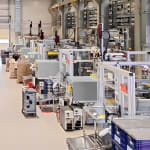
The injection molding department at the Steinbach plant comprises 28 machines. At first glance the clear structure of the equipment and uniform appearance of the production cells are apparent. Fourteen of the most recently acquired injection molding machines are equipped with standardized automation cells, each with a Wittmann W828 linear robot as its core.
"We have designed and built the automation cells ourselves. Thanks to standardization we were able to put new cells into operation very quickly. That is precisely the strength of this system," notes Jakob.
Each cell includes the robot’s working area, an automation station for insertion, assembly and inspection tasks, feeding units and an outfeed conveyor designed to handle boxes of different shapes and sizes, including Euro pallets. "Now everything is possible, from manual part removal right up to complex, fully automatic insert loading operations," comments Alexander Förtsch, Maintenance Manager at the Steinbach am Wald plant.

A total of 14 production cells are each equipped with a standardized automation cell.
The linear robot as master controller of the cell
The plug application for vehicle suspension systems makes full use of the potential of the standardized automation cells. The process starts with pin preparation and injection molding of the plug housings. The W828 linear robot removes the parts from the mold and transfers them to fully automatic downstream processing. At this stage, the pins are joined with the housings and the finished components are presented to a vision system for 100 percent inspection.
"The crucial point of our new standard is full integration into the control system," stresses Tobias Büchner. "In each case, the Wittmann linear robot acts as the master controller for the steps following injection molding."
"The openness of the Wittmann system is something special," adds Manuel Rommel, CIP Manager for molded plastic parts at Rauschert. "We discussed this concept with various robot manufacturers. Only Wittmann was able to offer this integrated solution without any additional control device."
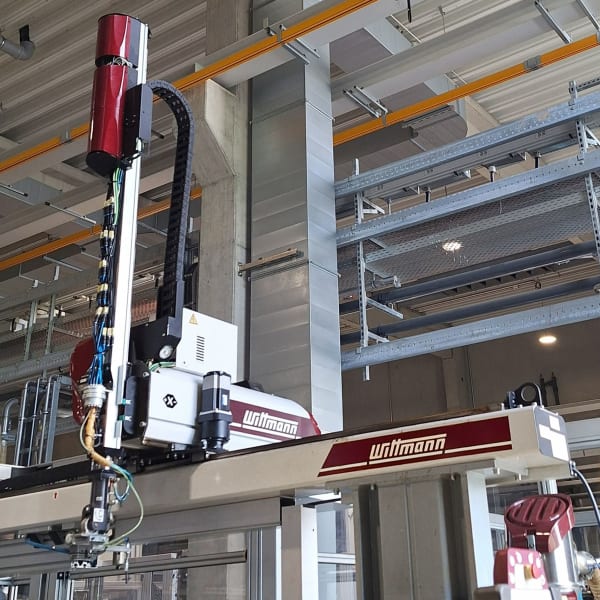
Linear robots from Wittmann play a vital role in the standardized automation cells at Rauschert.
Flexibility for over 300 molds and a wide range of batch sizes
With the new automation cells, the Rauschert team has created a standardized system that covers a very broad range of requirements. This is necessary because more than 300 molds are in active use and the customer base is heterogeneous. "The number of units ranges from 500 up to 3 million," explains Büchner. "That requires a high degree of flexibility. We also consider it important to have backup options."
This approach secures continuity of supply. In the event of an unplanned machine downtime, the mold and associated automation can be quickly transferred to another injection molding machine. Thanks to standardized automation this can be done without difficulty, in a manner similar to plug and play.
Minimized setup times and impact on energy efficiency
In day-to-day operation, short setup times are also an important factor in competitive overall efficiency. Four to five changeovers are carried out during each shift. "Since the startup of our standardized automation cells, we can start production of new batches during the night shift as well, when only one machine setter is on site. All the setter has to do is load the correct program, without having to do any programming himself," emphasizes Förtsch. Previously, changeovers were only possible during the day when the tooling and fixture construction team was present.
Six-axis robots, which were used more frequently in the injection molding hall before the standardization project, were particularly time-consuming. "Following setup we were often still busy with teaching for quite some time. With the linear robots, by contrast, many steps are more intuitive and therefore much faster," reports Rommel.
The standardization project has significantly increased both the flexibility and productivity of injection molding at the Steinbach am Wald plant, while at the same time improving quality consistency. Higher energy efficiency of the lines is an additional benefit.
"Through the optimization of setup times, we are now able to utilize our production cells more effectively, which has a positive effect on our energy balance," explains Tobias Büchner. The objective of a new project will be to calculate the CO2 carbon footprint for every plastic product, as this factor is becoming an increasingly important element of competitiveness.
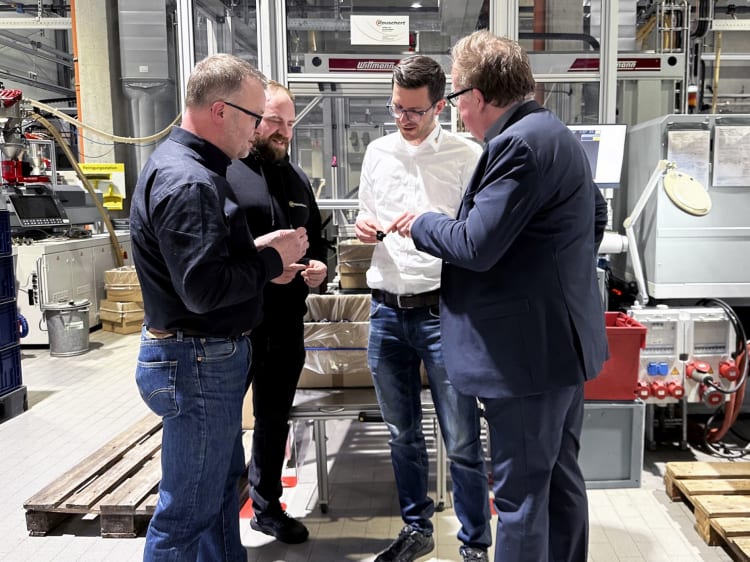
Working as a team for more flexibility and productivity: Alexander Förtsch, Manuel Rommel and Tobias Büchner from Rauschert and Wolfgang Prütting from Wittmann Battenfeld Deutschland (from left to right). Not in the picture: the automation team with Frank Pösel.