As the volume of municipal waste increases worldwide, the management of residual waste is gaining importance. Stadler Group indicates that this stream, traditionally treated as the final fraction remaining after separate collection and directed mainly to landfill or energy recovery, is becoming one of the more important areas for material recovery. This shift is being driven by growing pressure on landfill capacity, higher disposal costs, stricter environmental regulations and increased demand for secondary raw materials. According to the United Nations Environment Programme’s Global Waste Management Outlook 2024, the volume of municipal solid waste is expected to increase from 2.1 billion tonnes in 2023 to 3.8 billion tonnes by 2050. According to Stadler Anlagenbau GmbH, the German supplier of recycling and sorting plants operating globally in the design, manufacture and assembly of complete facilities, residual waste is one of the sector’s most important development areas. Even in markets with well-developed separate collection systems, this stream still contains materials suitable for recycling and recovery.
The company emphasizes that tapping this potential requires integrated plant design, robust engineering solutions, process flexibility and operational safety. A stable regulatory and market environment is also important, giving operators a basis for investing in advanced sorting infrastructure. As Sabine Schlögl, Technical Sales Engineer at Stadler, explains, “the material is no longer simply a problem to be solved, but a potential to be utilized.” In her view, this change has also transformed the relationship between the waste management sector and manufacturing industry, increasing the focus on design for recycling, collection systems and the required quality of secondary raw materials. Sabine Schlögl also adds that this shift affects the role of Waste-to-Energy plants. “Removing metals, inert materials and, increasingly, recyclable plastics before incineration reduces the amount of material sent for energy recovery. It can also improve plant operating parameters, enable the recovery of valuable raw materials and reduce the amount of bottom ash that ultimately requires landfill capacity.”
Environmental and economic benefits
Recovering materials from residual waste reduces the need for virgin raw materials, the extraction and processing of which can cause significant environmental impacts. Aluminium was cited in the source material as an example. Bauxite mining can affect forests, habitats, soil and water resources, while recycling aluminium from waste streams can reduce emissions by as much as 90 to 95 percent compared with primary production. At the same time, recovered secondary raw materials can generate revenue and reduce landfill or incineration costs, while supporting environmental targets and business viability where this is justified by regulations, waste management costs and the value of recovered materials.
Stadler notes that the transition in this direction is being accelerated by developments in optical sorting, higher sensor resolution, automation and artificial intelligence-based detection systems. These solutions increase the range of fractions that can be recovered as valuable secondary raw materials.

Separate collection does not solve the whole problem
Experience from mature recycling markets shows that separate collection remains essential, but it does not capture all valuable materials. In Germany, an analysis by the Federal Environment Agency found that even with developed collection systems, around two-thirds of residual household waste still had recycling or recovery potential. This includes, among other things, metals, plastics, paper, glass, wood, electrical and electronic equipment, textiles and the organic fraction.
According to the company, this illustrates one of the key challenges facing local authorities and waste management companies. The more ambitious recycling targets become, the more important it is to manage materials that still escape separate collection. The importance of clear guidance for residents was also emphasized, as recyclable materials and products may end up in residual waste if collection rules are not sufficiently understood.
Sabine Schlögl points out that “residual waste is highly heterogeneous, often dirty or contaminated, and its composition varies depending on the region, city and season.” This means that recovering value from this stream requires robust and flexible plants capable of handling difficult input material and adapting to changes in composition, market requirements and future regulations.
Global challenge, local conditions
Although residual waste is a global challenge, its composition and management methods are local in nature. What ends up in this stream and which materials can realistically be recovered are determined by regulations, collection systems, consumer behaviour, product and packaging design, and the level of development of recycling infrastructure.
Japan shows that technology, policy and collection systems must work together. Despite the strong involvement of residents in waste separation, the approach differs between municipalities, and valuable plastic packaging may still be directed to Waste-to-Energy plants instead of material recovery. As Megumi Sasaki, Project Director, Stadler Japan Setup, says, “in Japan, the residual waste stream is also influenced by very specific packaging habits, including composite and multilayer packaging, black plastic trays and very lightweight materials, which are often crushed or deformed during collection and processing.” In her view, this creates additional difficulties for sorting and material recovery and shows why solutions must be adapted to each local market.
In Latin America, waste composition can differ significantly in terms of organic matter content, contamination and bulky items. According to André Galuppo, director of Stadler’s Brazilian office, in many countries household waste is still collected in a single system, with limited control over the input material. As a result, plants often have to process non-standard waste such as furniture, electronic waste or construction waste. “There is no copy-and-paste logic for waste processing plants,” he says. “Each project must be designed for its specific context, because the sorting sequence, the type and size of equipment, the recovered products and the balance between automation and manual sorting can and should differ depending on local conditions.”
Project examples in Sweden and Spain
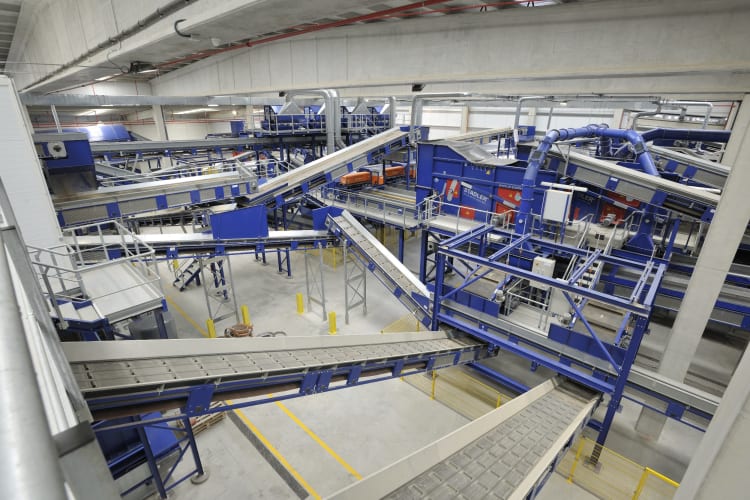
As an example of such adaptation, the company points to Sweden, where Stadler designed and built the Resursutvinning Stockholm municipal waste sorting plant for Stockholm Vatten och Avfall, SVOA. The facility, operating at a capacity of up to 50 tonnes of waste per hour on two independent sorting lines, recovers organic waste collected in green bags, plastics, and ferrous and non-ferrous metals that accidentally entered the residual stream. The plant combines advanced sorting technologies with a highly automated control system to maximize material recovery while maintaining operational flexibility. The project is also intended to demonstrate the importance of continuous optimization. William Frieberg, Project Manager at SVOA, assessed the cooperation as follows: “I appreciate Stadler’s professionalism, responsiveness and commitment to continuous improvement. Their support and expertise helped optimize plant operations while maintaining high standards in health, safety, quality and environmental management.”
In Spain, residual waste is among the most demanding streams in processing, according to Stadler, due to high variability, contamination risk, unpredictable material behaviour and changing recovery targets. Drawing on experience from nearly 50 municipal solid waste processing plants in that country alone, the company designs each facility according to the characteristics of the input material and the client’s operational targets. As emphasized, results are determined not only by individual technologies, but by how the entire process is designed, from material reception and feeding, through screening, sorting, transfer points and storage, to safety and service access. Appropriate machine selection and component sizing are intended to ensure reliable operation, reduced downtime and a safer working environment.
The company concludes that flexibility and safety are key in residual waste sorting. Adaptable plant layouts, mobile conveyors and digital control systems are intended to enable operators to respond to changing waste streams and market requirements. Battery detection, fire protection measures and multi-level plant designs, in turn, are intended to increase operational safety and plant resilience.