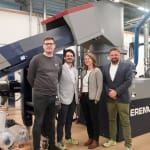
The founding team of LaMa Recycling is carrying out a research project at the SKZ plastics center on recycling production waste from diaper manufacturing that has so far remained unused. Instead of being sent to incineration, cellulose, plastics and superabsorbents are to be separated, processed and returned to the raw material cycle. This solution is intended to help save resources and reduce CO2 emissions associated with the current disposal route for this waste.
The founders of LaMa Recycling are Dr Marieluise Lang, Dr Lars Helmlinger and Thomas Wolz. The team is developing a new recycling process that enables the recovery of valuable raw materials from waste generated during plastics processing. The aim of the research project is to develop an industrially viable technology that will allow previously non-recyclable production residues to be returned to the material cycle. The focus includes, among others, polyolefin blends and plastic chips from industrial manufacturing, which have so far been entirely incinerated, resulting in the loss of the materials they contain and an additional burden on the carbon footprint.
Diaper production waste as a material stream
A specific application area of the technology under development is waste from diaper manufacturing. This waste stream contains different material fractions, including plastics based on polyolefins, cellulose and superabsorbent polymers. Until now, the standard approach to managing this waste has been thermal treatment, despite the high content of valuable components that could potentially be recovered through material recycling.
The scale of the issue is illustrated by data from the German market alone. According to Dr Marieluise Lang, around six billion diapers for children and adults are produced in Germany each year. Around three percent of this volume, i.e. roughly 15,000 tonnes, is production waste that has so far been sent entirely for incineration. As the researcher points out, this leads to the loss of valuable raw materials, while at the same time thermal treatment significantly worsens the greenhouse gas emissions balance linked to this production segment.
Superabsorbents as a barrier to recycling
The key technological challenge in recycling diaper production waste is superabsorbents, that is, highly absorbent polymers responsible for the ability of hygiene products to absorb liquids. The chemical and physical properties of these materials make it difficult to separate them from other components and to process them further in standard plastics recycling operations.
So far, the presence of superabsorbents has meant that recycling this type of waste has been very costly or economically unviable. The technology being developed by LaMa Recycling is intended to overcome this barrier by appropriately separating and treating the individual fractions so that plastics, cellulose and the superabsorbents themselves can be reused. In this way, recycling of diaper production waste could be integrated into existing value chains in the plastics processing industry.
Process scaling and project objectives
Since September 2025 the interdisciplinary LaMa Recycling Technologies team has been working at full capacity on further development and scaling of the process. In the current phase of the project, the main focus is on technical aspects related to increasing recycling throughput from laboratory conditions to a scale close to industrial.
The defined objective is to achieve a stable and scalable process with a throughput of at least 500 kilograms per hour by the end of the project. Reaching this capacity is expected to be an important step towards deploying the technology under industrial conditions and to enable its use in managing real waste streams from plants producing diapers and other hygiene products.
The role of the SKZ research center
The project is being implemented at SKZ, which has extensive research infrastructure in the field of plastics. For many years the institute has been working on recycling technologies, and the new LaMa Recycling project fits into this competence area by using access to modern laboratories and facilities for testing and optimizing processes.
SKZ also supports the spin-off of LaMa Recycling as an independent business entity and assists the team in translating research results into industrial applications. This includes both refining the recycling technology itself and preparing it for integration with existing production lines and waste management systems in the hygiene products manufacturing sector.

The LaMa Recycling project team is conducting an innovative research project at SKZ to develop a novel recycling process as part of the EXIST Research Transfer funding program. From left: Stefan Zuljevic, Dr Lars Helmlinger, Dr Marieluise Lang and Thomas Wolz