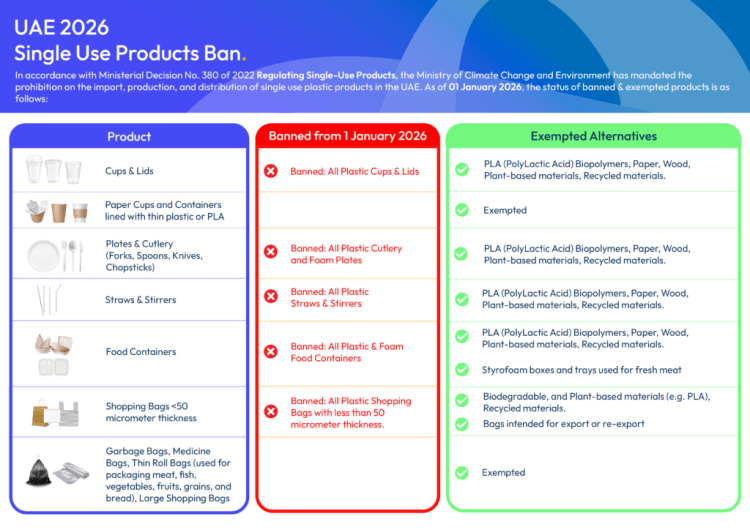
From 1 January 2026, the next stage of restrictions on single-use plastic products will come into force in the United Arab Emirates. Under the decision of the Ministry of Climate Change and Environment (MOCCAE), beverage cups, lids, cutlery, food containers and straws are to be withdrawn from use if they are made from plastics. At the same time, the ministry has confirmed that articles manufactured from plant-based polylactic acid (PLA) are recognised as an acceptable alternative to banned single-use items.
The legal basis for the changes is Ministerial Decision No. 380 of 2022 regulating the use of single-use products in the UAE. This act introduces a ban on the import, production and distribution of specific items, and its implementation is being carried out in phases. In the first phase, plastic straws, stirrers and single-use shopping bags were among the products prohibited. The next stage, starting on 1 January 2026, will cover further groups of single-use products made from plastics, which is in line with the national strategy to reduce pollution and the environmental impact of such items.
Scope of new restrictions for plastic products
According to the ministerial decision, from the beginning of 2026 the list of products subject to the ban, if manufactured from plastics, will be extended to additional categories of single-use items. This applies in particular to beverage cups, lids, forks, spoons, chopsticks and food containers. The restrictions cover import, production and distribution of these articles on the UAE market.
The new regulations are a continuation of earlier measures under which a number of small plastic items such as straws, stirrers and single-use shopping bags have already been banned. The aim is to gradually reduce the use of conventional plastics in single-use products wherever possible, while at the same time promoting solutions with a lower environmental burden.
PLA outside the scope of the single-use products ban
Polylactic acid (PLA), a plant-based polymer material described as fully compostable and biodegradable, has been excluded from the scope of the discussed regulations. This means that single-use products made from PLA remain permitted on the UAE market, in contrast to equivalent items made of conventional plastics that fall under the ban.
According to the information provided, PLA is particularly well suited to single-use applications where hygiene and convenience of use are essential. This includes both cold and hot drink cups and food containers, as well as straws and cutlery. The material is intended to act as a substitute for products that are no longer allowed on the market, while ensuring compliance with regulatory requirements.
Emirates Biotech's position on the new regulations
Representatives of Emirates Biotech, a company involved in PLA-based solutions, highlight both the need to reduce the use of single-use items and the role of polylactic acid as an acceptable alternative in situations where switching to reusable products is not possible.
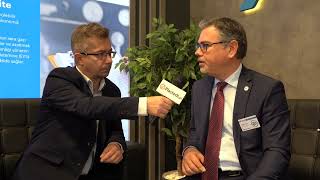
François de Bie, chief commercial officer (CCO) at Emirates Biotech, stated: "It is best to stop using single use products as much as possible and consider re-useable alternatives. But in those cases where re-useable alternatives are not available it is important to recognize that PLA, being a plant-based material, falls outside the scope of the prohibited materials. PLA, like paper, wood and recycled plastics is exempted."
The importance of PLA in the context of the UAE's environmental objectives is also emphasised by Valentina Olabi, public affairs manager at Emirates Biotech. "PLA will play a critical role in advancing landfill diversion and circular economy targets. The decision demonstrates constructive collaboration between government, industry and environmental stakeholders. We welcome this recognition of PLA as a practical enabler of the UAE’s sustainability agenda."
The role of PLA in the circular economy in the UAE
The exclusion of PLA from the single-use products ban is consistent with the broader direction of the UAE's environmental policy aimed at reducing the volume of waste sent to landfill and supporting circular economy models. In this context, PLA is intended to function as a material that maintains required hygiene and convenience standards while reducing the use of conventional plastics in situations where a complete shift to reusable items is not feasible.
Emirates Biotech declares its commitment to supporting local businesses in the transition to compliant, plant-based alternatives. This applies both to manufacturers of packaging and single-use products and to end users in the food service and retail sectors, who will need to adapt their product portfolios to the new regulatory requirements in force from 2026.
According to the company’s representatives, the role of PLA in this process may include both replacing conventional plastic items in existing applications and developing new product solutions based on plant-derived materials that are aligned with the assumptions of the UAE's sustainability policy.