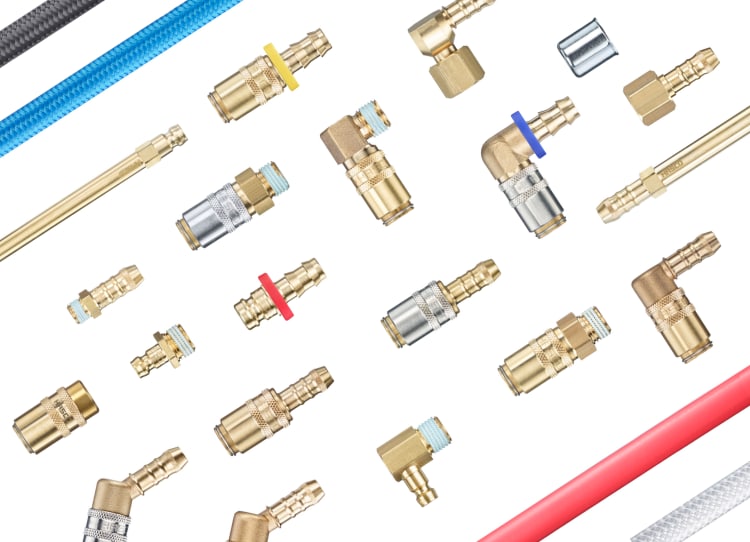
For more than five decades, Hasco has been one of the leading suppliers of solutions for efficient mould temperature control, offering a wide range of cooling components. Mould designers and toolmakers worldwide use the extensive programme of standardised elements that enable precise cooling and high process reliability. The manufacturer is expanding its portfolio in particular in the area of solutions for confined installation spaces and critical mould zones, where the requirements regarding operational safety and process repeatability are especially high.
Push-Lok Ø5 system for sensitive mould areas
The new Push-Lok Ø5 system, available exclusively from Hasco, sets new standards in mould temperature control. The solution has been developed specifically for delicate, hard-to-reach areas of the mould where maximum heat transfer efficiency and high process reliability are required.
The key feature of the system is its innovative connection technology, which simplifies handling and speeds up installation of the cooling circuit. Reducing the number of potential error sources when connecting supply and return lines translates into greater operational safety and more stable mould operating conditions.
An additional aid is the colour coding of the supply and return connections, which ensures unambiguous differentiation of circuits. This solution increases the transparency of the entire cooling system, reduces the risk of assembly errors and supports safety in day-to-day work on moulds with complex cooling channel layouts. With the new Push-Lok Ø5 system, Hasco offers a practical solution aimed at sustainably increasing productivity in injection moulding plants.
Extended Ø5 cooling system for confined spaces
In parallel, the well-established Ø5 cooling system has been further expanded. This solution is characterised by high functionality with minimal space requirements, opening up new possibilities in the design of modern mould concepts. The system has been developed specifically for cooling slides and small mould inserts, which often operate in very limited space where conventional cooling solutions cannot be used.
The compact design of the Ø5 components allows temperature control media to be routed in areas where the diameters of standard cooling components are too large. This enables designers to better control temperature distribution in critical cavity areas, supporting the maintenance of constant processing conditions and consistent part quality.
A key feature of the extended Ø5 system is the robust design of the components and the high tightness of the connections. Reducing the risk of coolant leakage supports the safety of the entire production process and lowers the likelihood of unplanned downtime. Optimised temperature guidance and control enable stable processing parameters, which is particularly important for small parts or moulds with complex cooling channel geometries.
Combined solutions for demanding applications
The combination of the exclusive Push-Lok Ø5 system with the extended Ø5 cooling system shows that Hasco is consistently developing its portfolio in the area of mould temperature control. The broad combinability of different components from the cooling range allows configuration of economical, efficient and safe systems tailored to specific design requirements.
The use of dedicated Ø5 solutions in conjunction with other Hasco standard elements enables the design of advanced cooling systems for both simple single-cavity moulds and complex multi-cavity tools. This allows users to respond flexibly to requirements regarding cycle time, process stability and surface quality of moulded parts, including in demanding, application-specific projects.
The new Ø5 components are part of Hasco's long-term strategy for the development of cooling standards, aimed at increasing the efficiency of mould temperature control while reducing installation and operating complexity. These solutions address the needs of mould makers and plastics processors who require compact and reliable cooling systems for operation under demanding production conditions.