Rising requirements for recyclates used in sensitive applications are accelerating the development of advanced plastics recycling solutions. At Plastics Recycling Show Europe (PRSE), taking place on 5 to 6 May 2026 in Amsterdam, recycling machinery manufacturer and systems provider Erema will demonstrate how advanced technologies and coordinated process chains enable the production of high-quality regranulates for demanding end-use applications. In Europe, technologies focused on degassing performance, odour optimisation and process stability are gaining importance, linked among other things to regulatory requirements such as the EU Packaging and Packaging Waste Regulation (PPWR). Recyclates are expected not only at food and cosmetic grade levels, but also at other premium quality levels. At PRSE 2026, Erema intends to show how such requirements can be implemented in industrial operations.
Volex further developed, more options and higher degassing performance
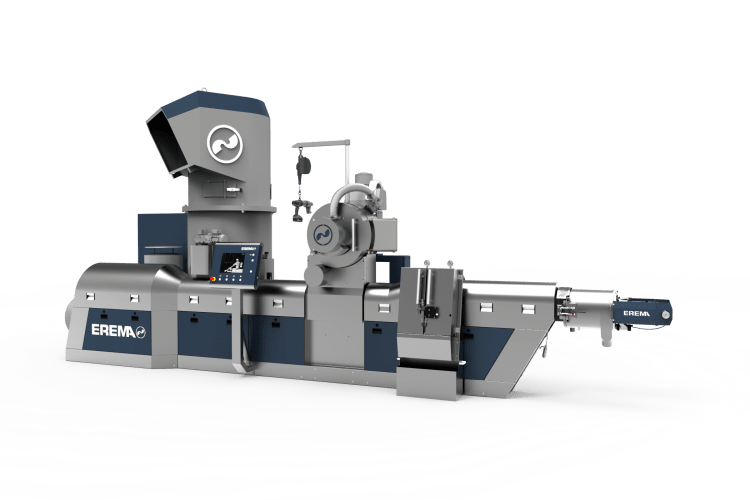
The Volex technology, presented by Erema as a solution for post-consumer streams at K 2025, has been further developed based on experience gained since its market introduction. According to the company, improvements have been made under practical operating conditions. Optimised screw geometry is intended to enable degassing performance levels that previously required a larger machine. The latest technology update is also intended to allow Volex to be used both with and without water stripping, with optional water injection opening up additional potential for sensitive applications.
"Decontamination and deodorisation effects that, compared with standard systems on the market, can only be achieved through several hours of thermal post-treatment of the pellets can already be realised directly during the extrusion process thanks to Volex. This reduces energy consumption and operating costs for recycling companies," explains Markus Huber Lindinger, Managing Director at Erema. "The strong increase in melt surface area, combined with TVEplus technology, results in an optimal balance between degassing performance and thermomechanical stress on the input material," he continues.
Erema reports that, together with customers and partners, it is working on further process optimisation for defined application areas. In particular, it points to applications with high quality requirements where odour plays a role but food or cosmetic grade standards are not required. Examples include automotive interior components such as cable ducts, or packaging for household chemicals, such as bottles for household cleaners. In the context of PPWR, this segment is expected by the company to gain importance. As Clemens Kitzberger, Business Development Manager at the Erema Group, emphasises: "Many companies have so far only addressed the question of which products will fall under the PPWR requirements in the future to a limited extent. At Erema, we are prepared to economically provide the high degassing performance required for applications in the medium sensitive range."
Volex technology has been shortlisted as a finalist in the "Recycling Machinery Innovation" category at the Plastics Recycling Awards Europe 2026. The winners are to be announced at the award ceremony on 6 May.
Food-grade polyolefins, progress in the Novel Technology process
Alongside technological development, Erema, together with joint venture partner Lindner Washtech and Irish recycling company Polymer Matters, will present significant progress in food-grade recycling of polyolefins at PRSE. In the Novel Technology authorisation process led by the European Commission, the project, which aims to return PCR from HDPE milk bottles to the same loop, has reached the next stage.
"In order to produce food-grade rHDPE in Europe, the recycling process must be authorised in accordance with EU Regulation 2022/1616. Achieving Advanced Novel Technology status marks an important milestone and demonstrates that mechanical recycling can also enable food-grade recyclates for polyolefins economically and on an industrial scale," says Kitzberger. "Importantly, this is not a closed-loop system, but input material from mixed household collections."
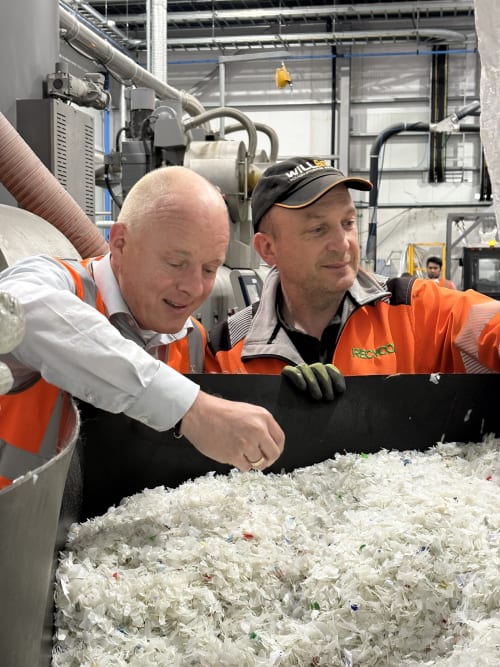
According to Erema, a deep understanding of the entire process chain, from selection and preparation of the input material through extrusion to decontamination, is crucial for this type of progress. The company states that a specialised food-grade team of market experts and experienced chemists translates requirements into suitable concepts. Validated challenge tests as well as internal and external laboratory analyses are said to form the basis for robust material assessments. Experience gained from numerous projects is also intended to support structured handling of authorisation procedures, where reproducible results and clear documentation are essential prerequisites. Erema also highlights the role of cooperation with industry organisations such as Plastics Recyclers Europe (PRE) in supporting further development.
Regranulate quality and efficiency through coordinated processes
Erema notes that high regranulate quality and stable process efficiency in post-consumer recycling require every stage of the plant to be coordinated from the outset. In this context, the company points to close cooperation with Lindner Washtech, in which material preparation, washing and extrusion are designed not as separate stages but as a seamless, integrated process.
The development directions presented include, among other aspects, process stability, energy efficiency and system connectivity. Data exchange across the entire process chain is considered a key lever. Using a jointly developed HMI, process data from material preparation, the washing line, the extruder and downstream steps are intended to be consolidated in a structured overview. Such transparency is intended to enable targeted process optimisation and throughput-oriented plant design.
Erema invites visitors to PRSE 2026 at stand E20.