At Plast 2026, ENGEL will present an offering built around an integrated approach to injection moulding, combining machines, automation, digital tools and solutions using artificial intelligence. The manufacturer presents innovation not as a single technology, but as a set of elements intended to support production stability, scrap reduction, better use of resources and cost control. This approach is intended to address the needs of processors operating in various segments, from automotive and medical to packaging and technical parts. According to the company, the growing complexity of processes means that what matters is not only production capacity itself, but above all maintaining consistent quality and efficiency under changing process conditions. At its booth, ENGEL will therefore announce both hardware solutions and applications showing their practical use.
The central point of the exhibit will be the Expert Corner "Your Industry. Our Solutions". It is intended to serve as a guide to application know-how, production configurations and implementation scenarios that cannot be fully shown through a conventional machine display alone. Visitors will be able to review selected application examples and see how injection moulding machines, automation and digital intelligence work together within one environment. From the processors' perspective, this is meant to facilitate evaluation of which production solutions, automation strategies and digital tools can be transferred to their own plants.
Digital assistants and autonomous process control
One of the main elements of the presentation will be process monitoring and optimisation systems that are part of the inject AI environment. ENGEL indicates that digitalisation simplifies machine operation while at the same time expanding the ability to maintain stable production parameters. In this area, intelligent assistants acting directly on the process are expected to play an important role.
The iQ weight control system is intended to maintain constant part quality by compensating for material and viscosity fluctuations within the same shot, which according to the company can reduce part weight variation by up to 85%. iQ clamp control automatically optimises clamping force, reducing energy consumption during force build-up by up to 10% and protecting the mould. In turn, iQ flow control stabilises mould temperature control, supports reproducible thermal conditions and is intended to allow energy savings of up to 18% in production.
These functions are complemented by iQ process observer, which analyses more than 1,000 parameters, detects deviations in real time and recommends corrective actions that help avoid scrap. According to ENGEL, the system not only reacts to disturbances, but also supports earlier identification of critical situations and operational decision-making.
The most advanced example of this approach is intended to be the first autonomous injection moulding machine, first shown at K 2025 and then also presented during Plast 2026. The solution is based on the all-electric e-mac 80 machine. In this configuration, the system does not merely support the operator, but actively controls the process and adapts in real time to changing production conditions. Human-machine interaction is also supported by ENGEL Virtual Assistant, EVA, a digital assistant based on AI and intended for process engineers and operators. The tool recommends appropriate actions, provides step-by-step troubleshooting and ensures fast access to technical information. In practice, this is meant to result in shorter downtimes, faster problem solving and easier access to expert knowledge, especially when experienced personnel are not directly available at the machine.
In this model, the operator defines quality requirements and the machine automatically selects the parameters needed to maintain them. The aim is to reduce scrap, energy consumption and set-up times, while shifting personnel work towards higher value-added tasks.
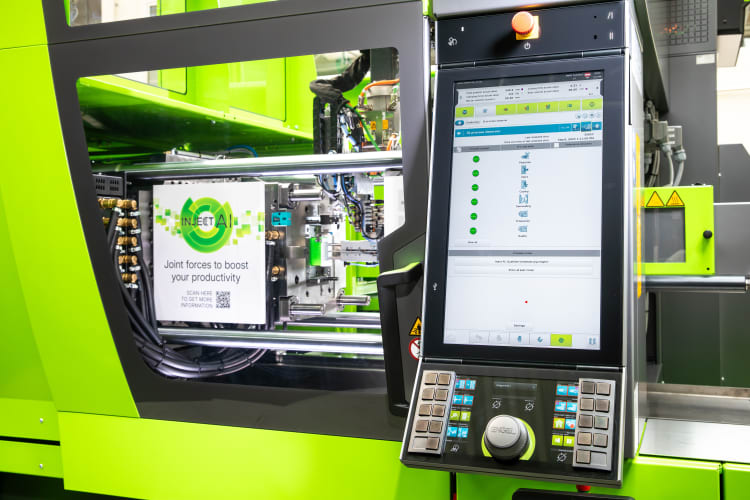
At Plast, visitors will be able to test the performance of the ENGEL autonomous production cell live during dedicated sessions and one-to-one meetings with an ENGEL Italy Master Trainer
The company also announces sessions led at the booth by an ENGEL Italy Master Trainer. These will include both scheduled presentations and individual meetings devoted to the digital assistants of the inject AI framework. Their purpose is to provide a detailed discussion of applications, analysis of real cases and an indication of how such solutions can be translated into specific production conditions in processing plants.
Cell for lightweight thermoplastic composite structures
Another important part of the exhibit will be two fully automated production cells. The first of these concerns lightweight structures and the manufacture of rotor blades for drones from thermoplastic composites using tape-sandwich technology. The application combines the production of components with high performance parameters with noise reduction and an environmental aspect. As stated, life cycle analyses have shown a significant reduction in the CO2 footprint compared with conventional processes based on thermoset materials. The NeoBlade project is funded by the Federal Ministry for Innovation, Mobility and Infrastructure as part of the RTI "Take Off" programme and administered by the Austrian Research Promotion Agency, FFG.
At the heart of the system is a tie-bar-less ENGEL victory 120 injection moulding machine with a clamping force of 1,200 kN, equipped with an easix six-axis articulated robot. The robot performs all process stages in a continuous in-mould cycle through to the removal of a part close to its final shape. The basis of the process is a sandwich structure composed of thermoplastic tapes reinforced with carbon fibre and an injected short-fibre compound.
The tapes form the outer load-bearing layers of the rotor blade and are precisely positioned in the mould and fixed using vacuum. This makes it possible to place reinforcements according to the load paths, so material is used where it is needed from the perspective of structural function. In the next stage, a short-fibre thermoplastic core is injected between the pre-positioned tapes, bonding with the outer layers to form a part structure close to the final shape. To further increase the lightweight potential, the core is chemically foamed, which reduces component weight while maintaining structural properties. The result is a lightweight yet durable rotor blade in which shaping, structural function, noise reduction and material bonding are carried out in one automated cycle, without the need for additional finishing operations.

Injection moulding cell with tie-bar-less Engel victory and easix six-axis robot, the basis of the fully automated production solution for thermoplastic composite rotor blades, front view
The tie-bar-less design of the ENGEL victory improves access to the mould area and simplifies automation integration. The manufacturer also indicates that in many cases it is possible to select a smaller machine, which helps reduce investment costs. In the solution presented, the optimised access for automation is intended to enable a cycle time of less than 60 seconds per rotor blade.
The company will also show a second component made using tape-sandwich technology, a cover for high-voltage automotive batteries made of flame-retardant thermoplastic material, measuring 1.3 x 1.8 m. The application was selected as a finalist for the JEC World Innovation Awards 2026 and, according to the company, confirms the scalability of the process, which can be extended from small components to large structural parts. For processors, this is intended to mean the possibility of serial production of large, lightweight functional parts in an automated process combining structural properties, flame retardancy and production efficiency.
Wintec for packaging and logistics
The exhibit will be complemented by a Wintec t-win 5500 machine with a clamping force of 5,500 kN, equipped with an ENGEL viper 40 linear robot and a single-cavity mould developed by S.C.S. Società Costruzione Stampi from Monsano near Ancona. The system will produce transparent crates from Borealis RJ378MO random polypropylene. The part weight is 232 g and the cycle time is about 11 to 12 s. This application is intended to show how a standardised two-platen injection moulding machine concept, a short cycle and integrated automation can support high output and a competitive unit cost in packaging and logistics applications.
According to ENGEL, this solution shows a more pragmatic and cost-accessible dimension of the group's portfolio. Wintec machines are positioned as a response to market needs requiring competitiveness without giving up reliability and precision. The company emphasises the combination of standardisation and performance, meaning an engineering platform intended to simplify technological complexity and translate it into easier operation and production efficiency. For processors, this means solutions for high-volume production where stable output, short cycles and consistent part quality are important.

The Wintec t-win 5500 two-platen injection moulding machine with integrated viper 40 robot will produce transparent PP crates weighing 232 g, in an 11 to 12 s cycle, demonstrating high-output production with reliable automation and a competitive cost
The entire presentation is intended to show how ENGEL combines process technologies, software, data use and automation towards a more stable, efficient and transparent production environment. From the perspective of end users, the emphasis is placed on practical effects such as lower scrap levels, shorter set-up and troubleshooting times, more consistent part quality and better control of manufacturing costs. The company will be present at Plast 2026 in Hall 24, Booth C82.