At FIP 2026, to be held from 2 to 5 June 2026 in Lyon, the ENGEL Group will present solutions intended to help processors use production space more efficiently, apply mould concepts more flexibly, reduce unit costs and bring new applications to stable series production more cost-effectively. At its stand, the company will show solutions based on the tie-bar-less electric victory electric 220 injection moulding machine, the all-electric WINTEC e-win 1800, digital assistance systems from the inject AI family and clearmelt technology for integrated surface finishing of large-format parts. The presentation will cover both complete production cells and digital tools supporting process stability, lower energy consumption and increased machine and equipment availability.
The scope of the display indicates that ENGEL is focusing on solutions that combine process precision with economic benefits. This includes machine drive systems, integrated part-removal automation and assistance systems optimising quality- and performance-relevant parameters. A separate area will be dedicated to solutions for multi-component applications and to a digital presentation of the capabilities of a large two-platen injection moulding machine for the production of large plastic parts.
Tie-bar-less victory electric 220 with more freedom in the mould space
At the stand, ENGEL will present an electric tie-bar-less production cell built around the victory electric 220 injection moulding machine with a clamping force of 2,200 kN, which had its world premiere at K 2025. The machine combines the advantages of a tie-bar-less design with the dynamics of electric drive technology. In practice, this means more usable space in the mould area, high precision and productive manufacturing with a small footprint.
On this machine, an electrical distribution box with lid made of polycarbonate will be produced in a family mould with two cavities. The cycle time is 60 seconds. The part weight is 41.2 g for the housing and 23.5 g for the lid. Removal is handled by an ENGEL viper 12 linear robot, which places the components on a conveyor belt. The robot is fully integrated into the CC300 machine controller. In combination with the iQ motion control system, the robot movement is adapted to the mould opening process, which further reduces cycle time and energy consumption.
The tie-bar-less design is intended to simplify set-up, improve operator and automation access to the working area and increase flexibility in mould design. At the same time, according to the company, the solution offers economic benefits. The compact design reduces machine length by around 200 mm. At the same time, larger moulds can be used than on tie-bar machines in the same clamping force class. This means that a mould can run on the victory electric 220 that would require around 3,200 kN in a conventional design. All main movements are electric, using servo drives with ball screws. Integrated recovery of braking energy reduces energy consumption. The machine on display is also equipped with assistance systems from the inject AI family, including iQ weight control plus and iQ process observer.
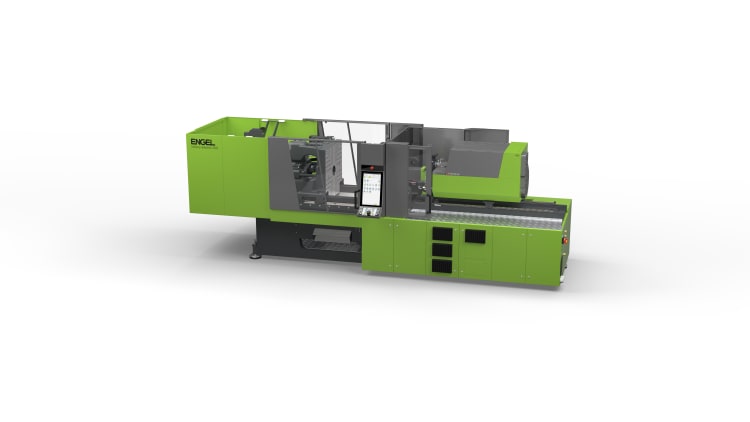
The tie-bar-less ENGEL victory electric provides more freedom in the mould space, facilitates automation and set-up, and enables cost-efficient production with high precision
All-electric WINTEC e-win 1800 for standardised solutions
Another exhibit will be an all-electric production solution with the WINTEC e-win 1800 machine with a clamping force of 1,800 kN. The compact machine produces Appetitiv trays made of PP with a part weight of 175 g in a 60 s cycle. Part removal from the mould is handled by a viper linear robot, which places the mouldings on an automatic discharge conveyor.
The particular potential of this presentation is to result from the ASM France mould used. Adapters for different part layouts can be used in the mould. This makes it possible to adapt the production solution to changing requirements, reduce mould costs and increase flexibility in production planning.
The all-electric drive technology of the e-win is intended to ensure high repeatability, stable shot weights and consistent component quality. As energy is consumed only during actual movements, energy costs can be reduced compared with hydraulic machines. The absence of hydraulic oil is also intended to reduce maintenance effort and the risk of downtime. Process control is supported by digital assistance systems. iQ clamp control automatically optimises the clamping force to the value actually required and reduces it by up to 35%. This is intended to protect the mould and save energy. iQ hold control automatically optimises the holding pressure time, shortening the cycle by up to 14% and accelerating the start of series production. iQ weight control automatically compensates for fluctuations in melt viscosity within the same shot, increasing process stability and reducing scrap by up to 50%.

The all-electric WINTEC e-win stands for high repeatability, low energy consumption and cost-efficient series production in standard-oriented applications
Assistance systems and AI functions for process stability
In the Expert Corner, ENGEL will show how digital assistance systems and AI-based functions are intended to create measurable added value throughout the production process. These solutions are intended to support product development and mould trials by helping to optimise processes earlier and prepare series production start-ups more reliably. In ongoing production, intelligent assistance systems and shopfloor management solutions are intended to ensure stable processes and high productivity.
Systems such as iQ weight control, iQ clamp control, iQ flow control, iQ melt control and iQ motion control intervene directly in the process and automatically optimise parameters relevant to quality and performance. In addition, monitoring and remote service tools are intended to increase operational transparency and help secure the long-term availability of machines and systems. Using AI, iQ process observer analyses more than 1,000 process parameters simultaneously, detects deviations at an early stage and provides specific recommendations for action. This concept is complemented by the ENGEL Virtual Assistant and AI-based applications such as part finder for identifying spare parts from a photo. According to the company, this helps reduce scrap, increase system availability and improve the use of machine and personnel resources.
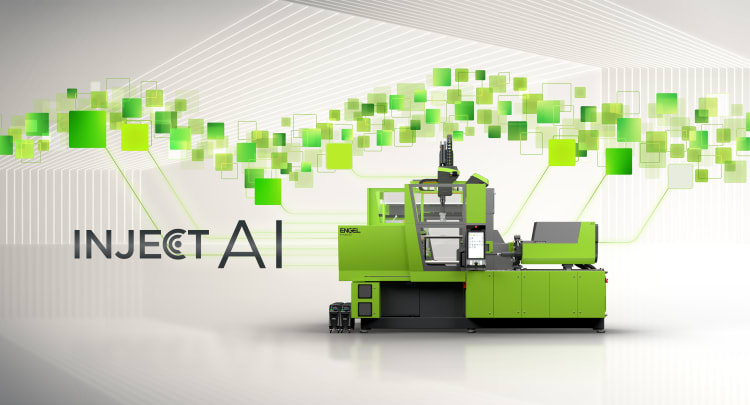
ENGEL inject AI shows how digital assistance systems can stabilise processes, reduce scrap and use systems more efficiently, while effectively countering the shortage of skilled workers
Rotary tables, index plates and the digital twin of duo 5500 combi M
Another area of the presentation will be rotary tables and index plates. In this way, ENGEL is addressing the needs of many processors for compatible solutions for multi-component applications that remain available over the longer term. ENGEL index plates are designed so that, in many cases, existing mould concepts can continue to be used. This is intended to reduce the technical and economic scope of follow-up investments and increase planning reliability.
Using a digital twin, the company will also show the potential offered in the development of large-format plastic parts by the duo 5500 combi M two-platen injection moulding machine. The machine is available for customer trials at the ENGEL technical centre in St. Valentin. With a clamping force of 55,000 kN, platens measuring 3.5 x 3.5 m, a platen distance of 6.6 m, mould weights of up to 150 t and shot weights of up to 42 kg, it creates the conditions for testing large parts under realistic conditions. This is intended to shorten development times, reduce technical risk and create a solid basis for subsequent series production.
clearmelt for integrated surface finishing
ENGEL will also show how large parts with high-quality surfaces can be manufactured cost-effectively using the clearmelt process as an example. In this technology, the injection-moulded part is coated directly in the mould with PUR polyurethane. Surface finishing is therefore integrated directly into the injection moulding process, as an equivalent of in-mould coating. For processors, this means fewer downstream operations, a shorter production chain and improved reproducibility of surface quality.
At its stand in Lyon, the ENGEL Group intends to show how appropriately selected machines, automation solutions and process tools can specifically improve precision, cost efficiency and process stability for different production requirements.