Swiss Plastics Expo 2026 in Lucerne, taking place from 20 to 22 January, will serve as an important platform for Switzerland as a high-technology hub. In a market environment defined by stringent precision requirements, zero-defect strategies and an acute shortage of skilled labour, ENGEL will present solutions focused on digitalisation and autonomy in injection moulding. The company’s trade fair presence will highlight the evolution from its established inject 4.0 concept to the new inject AI framework, alongside what it describes as the world’s first autonomous injection moulding cell. The exhibits are intended to demonstrate how Swiss plastics processors can secure and expand their global competitiveness through higher efficiency, improved process stability and the targeted use of artificial intelligence (AI).
Inject AI: autonomy for high-precision production
The inject AI framework is presented by ENGEL as a direct response to the specific requirements of Swiss industry, especially in medical technology and for demanding technical components. These segments are strongly characterised by a focus on quality and regulatory compliance, while at the same time facing high labour costs and an ongoing shortage of qualified personnel. Inject AI builds on ENGEL’s existing portfolio of intelligent assistance systems, of which around 20,000 are already in use worldwide, and transfers them into what the company describes as a new era of autonomy.
According to ENGEL, inject AI integrates decades of application engineering expertise directly into the machine control system so that this knowledge can be systematically accessed on the shop floor. CTO Gerhard Dimmler explains: "We integrate decades of application engineering expertise directly into the machine control system and make this expert knowledge usable for every employee." In industries such as medical technology, where validation, process documentation and traceability are central, ENGEL’s digital assistance systems are designed to support seamless documentation and reproducibility, while at the same time contributing to scrap reduction and lower energy consumption.
For the Swiss market, ENGEL sees a double benefit. On the one hand, process knowledge is made available independently of individual key specialists, which is relevant in a cost environment where highly qualified technicians account for a significant share of production expenses. Every hour saved in troubleshooting or manual process optimisation can have a direct impact on operating results. On the other hand, AI-supported optimisation is intended to achieve a level of process consistency that was previously difficult to realise. The iQ process observer continuously analyses more than 1,000 parameters, proactively detects even minor deviations and issues actionable recommendations before scrap is produced. Complementary tools such as the ENGEL Virtual Assistant (EVA), which functions as a 24/7 support resource, and an AI-based part finder for spare parts identification, are combined into a digital ecosystem aimed at increasing efficiency along the entire value chain.
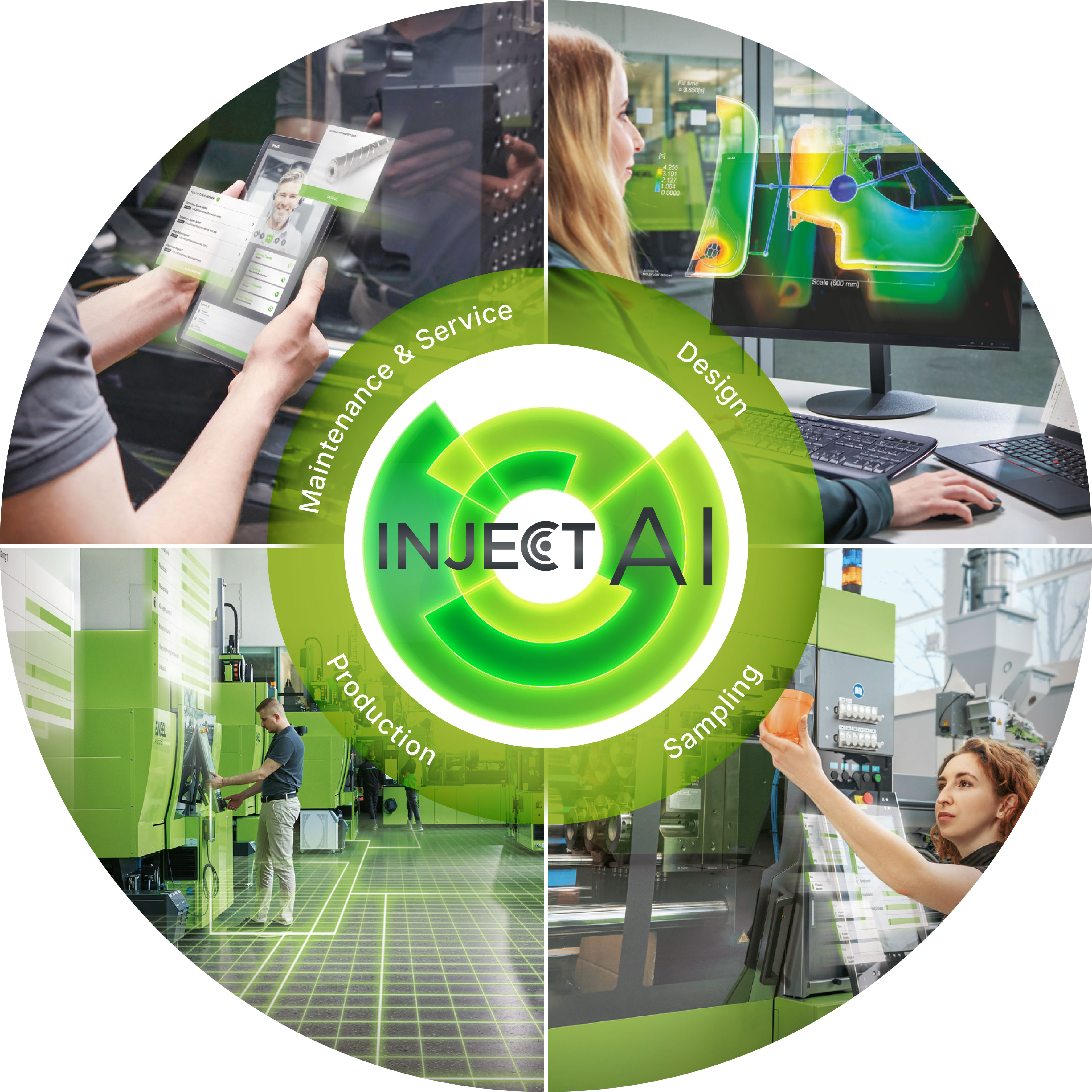
The image shows a circular inject AI logo with images from design, sampling, production and maintenance arranged in quarter circles
Autonomous injection moulding cell based on e-mac 80
The technical highlight of ENGEL’s presentation in Lucerne will be an autonomous manufacturing cell built around an all-electric ENGEL e-mac 80 injection moulding machine. The e-mac series is already established among Swiss processors as a compact system solution, particularly where precision and energy efficiency are required. In the configuration shown at Swiss Plastics Expo, the cell is designed not only to produce parts, but also to regulate itself during operation.
In this concept, the vision of a self-regulating injection moulding cell is translated into industrial practice. Instead of working primarily with abstract machine parameters such as pressures and speeds, the operator specifies the desired quality characteristics of the finished component. Based on these requirements, the cell automatically adjusts its process settings and maintains the defined part quality within the prescribed window. Continuous monitoring and closed-loop adjustments are intended to secure stable production conditions over time.
This approach is positioned as relevant both for cost efficiency and for the sustainability targets that many Swiss companies have adopted. By stabilising the process and reacting autonomously to disturbances, scrap rates can potentially be reduced, which also has an impact on material and energy use. ENGEL notes that this applies in particular when processing recyclates, where fluctuating material properties are a common challenge. Here, assistance systems such as iQ weight control plus support consistent filling behaviour and shot weight, contributing to process robustness even with variable raw material qualities.
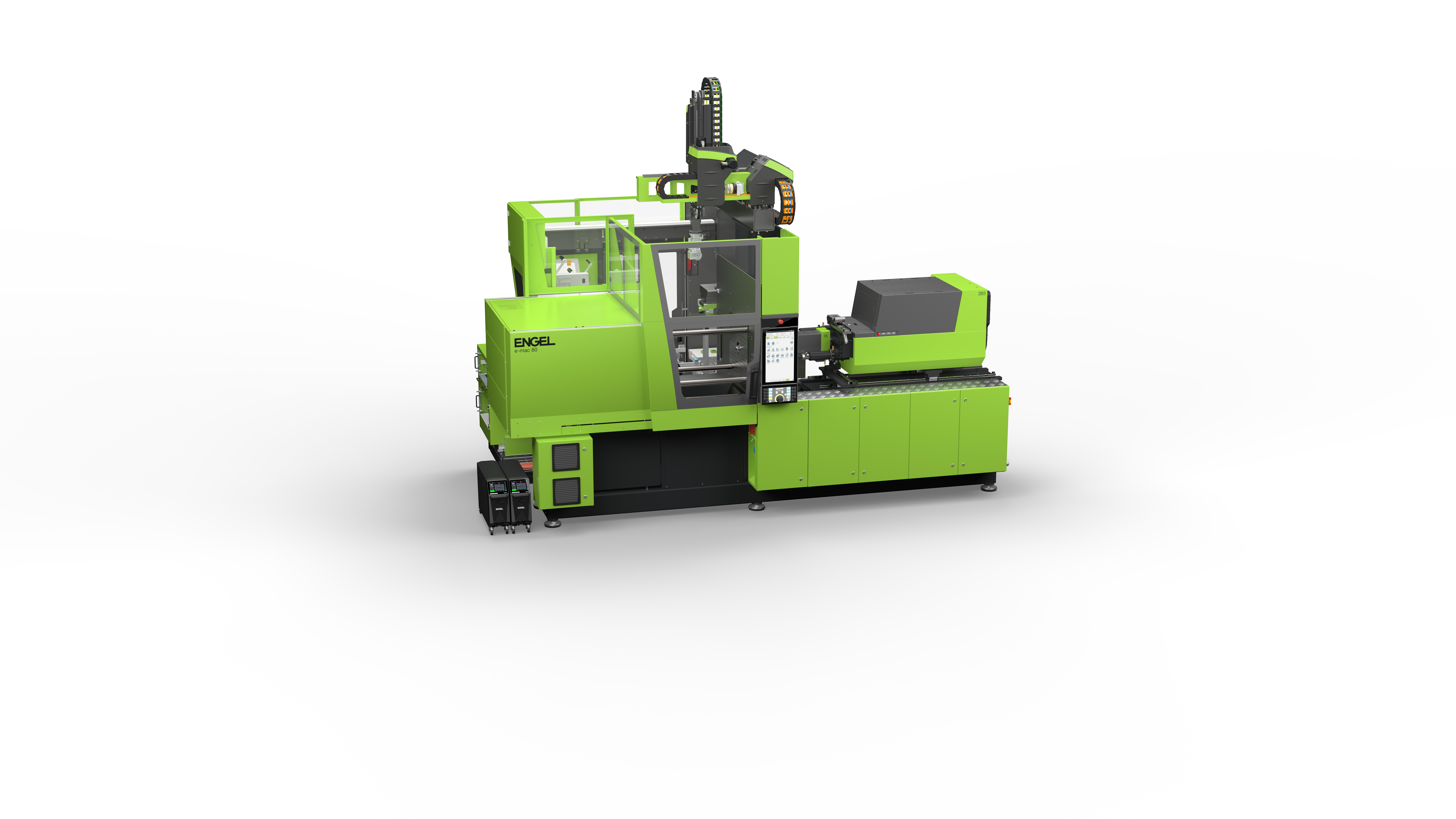
Image shows a compact green ENGEL injection moulding cell with automation via a linear robot
Addressing skills shortages and reinforcing the Swiss Made profile
With its presence at Swiss Plastics Expo 2026, ENGEL explicitly targets the needs of the Swiss precision market. The inject AI solutions are positioned as tools to address the shortage of skilled labour by embedding process expertise in the control system and providing guided operation. At the same time, they aim to lower production costs through reduced scrap, higher machine utilisation and more stable operation, while fulfilling strict quality and documentation requirements.
According to the company, these developments are intended not only to secure the "Swiss Made" quality promise under increasing global competition, but also to extend it through the use of digitalisation and AI as technological differentiators. ENGEL’s exhibit in Lucerne will be located in Hall 1 at stand A 1001, where visitors can see the inject AI framework and the autonomous e-mac 80-based injection moulding cell in operation.