The implementation of a central material supply system from Wittmann has enabled elasto to comprehensively reorganize material logistics in its injection molding department. The investment is part of a broader modernization program aimed at maintaining competitive unit production costs in the long term at the German plant in Sulzbach-Rosenberg. Under strong price pressure in the promotional items market and with environmental criteria gaining importance, the company focuses on combining process efficiency with a consistently pursued sustainability strategy. Automation of material handling, reduction of manual operations and limitation of material losses and dust contamination play a key role in this context.
“Made in Germany” production versus cost requirements
elasto is one of the largest suppliers of promotional items in Europe. The portfolio covers a wide range of products, from simple giveaways to high-quality household, lifestyle and sports articles. Since its foundation in 1980, the company has been growing steadily, with one of the pillars of this growth being the linkage of economic and ecological strategies. As emphasized by Marcus Sperber, who manages the company in the second generation, in the segment of plastic promotional items more and more major brand owners are opting for production in Europe.
The “made in Germany” label is an integral part of elasto’s sustainability strategy and strengthens the local economy, while at the same time creating cost challenges. Customers are not always willing to pay a higher price solely for the country of origin, so it is necessary to continuously improve efficiency and productivity on the shop floor in order to keep unit costs competitive.
EUR 12.5 million investment in a new production and logistics center
More than 600 out of 1400 items in elasto’s portfolio are manufactured in Germany, mainly plastic products produced at the parent plant in Sulzbach-Rosenberg. The machinery consists of 18 injection molding machines with clamping forces from 50 to 300 tons, as well as a stretch blow molding machine and a blow molding machine. Recently, the company has invested EUR 12.5 million in a new, resource-saving production and logistics center.
A completely new hall was built for the logistics department, and production was moved into the original hall after it had been emptied and thoroughly refurbished. The modernized hall offers significantly more space, meeting the growing demand for promotional items made in Germany. As reported by Production Manager Markus Rösel, several new, larger injection molding machines had been added in previous years, pushing the original hall to its limits.
A permanent challenge was the low, gable-shaped roof, which required such positioning of the machines that the robots could operate below the ridge. This restricted layout flexibility and additionally made it impossible to install an overhead crane. The previous material supply was organized in a decentralized way: granulate containers were positioned directly next to the injection molding machines and the hoppers were filled manually. According to Rösel, two employees were constantly occupied with refilling granulate, while a shortage of skilled workers was already noticeable in other areas. With the expansion of production, it became necessary to increase the level of automation.
Central material supply system as a basis for growth
The core element of the new production setup is a large central material supply system from Wittmann. Marcus Sperber points out that its implementation has created the structural basis for further growth. Several large Drymax material dryers are installed on a platform, and directly below them there are 750 kg containers for the most frequently used materials and colors. The dominant material is polypropylene, which accounts for the majority of the granulate consumed.
Via a closed pipeline system, the granulate is transported to the coupling station and from there to the individual processing machines. Currently, not all coupling points are yet in use, which has also been planned with future expansion in mind. A characteristic feature of elasto is its very wide range of colors. As Sperber notes, production batches starting from 5000 units can be supplied in any color.
The coordination of material flows with the machines is carried out using bar code labels and hand scanners. The M8 control system of the central material supply system automatically checks whether the given combination is correct and only then releases the material transfer, eliminating the risk of mix-ups that occurred in the past. Rösel states that the M8 system has been very well received by the team. After training at Wittmann, all users were able to work with the system without any issues, even though RFID-controlled granulate feeding was completely new to them.
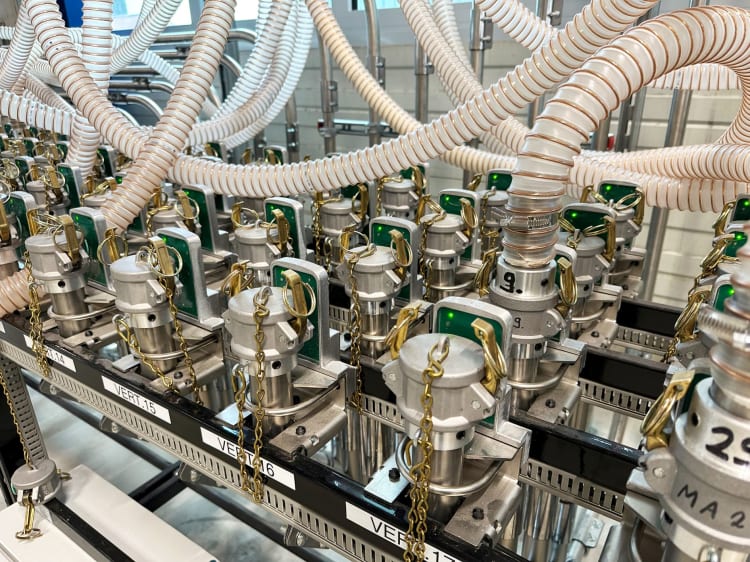
The new coupling station still leaves room for further growth.
Fast relocation and start-up of the injection molding shop
An important factor in the implementation of the system was the proximity of Wittmann’s regional subsidiary in Nuremberg, which has a large training center and application technology center. The travel time of less than one hour is also an advantage in terms of service. As emphasized by Wolfgang Prütting, Regional Sales Manager at the Wittmann Group, when online support is not sufficient, rapid on-site intervention is possible.
Marcus Sperber notes that the company prefers regional partners when selecting suppliers. The decisive incentive to choose Wittmann as the supplier of the central material supply system came from a reference visit to a major manufacturer of electronic components. The elasto team observed the practical use of the system there, talked to employees and received clearly positive feedback. The installation phase itself provided further confirmation of the right choice.
The project schedule was very tight. Within just two weeks, the injection molding shop was relocated and the new central material supply system was commissioned, after which full production was resumed.
Regrind processing and dust reduction
Markus Rösel concludes that the central material supply system has significantly improved the plant’s processes. Color changes are now carried out much faster: residual material is simply sucked back into the system instead of ending up in a handheld vacuum cleaner. The issue of granulate scattered on the floor has also been eliminated. The very clean material handling increases occupational safety, process reliability and material efficiency.
Dust generation has been completely eliminated, which is the result of the closed pipeline system and the Feedmax Clean material loaders with integrated dedusting function. As Prütting explains, Feedmax Clean achieves very high separation rates, up to 80% of all particles smaller than 1 mm in diameter. Wittmann originally developed this solution in response to the growing requirements of the circular economy, with the aim of enabling the safe use of recycled materials also in demanding applications through thorough dust extraction.
According to Rösel, for products not certified for direct food contact the company increasingly uses regrind, partly generated in-house from sprues and scrap parts. One example is the “Profi 320” tray made of recycled polystyrene. The round waiter’s tray with a high rim and a slip-resistant inner surface, often used for beer advertising, is one of elasto’s top-selling products. It is manufactured by two-component injection molding with in-mold labeling (IML).
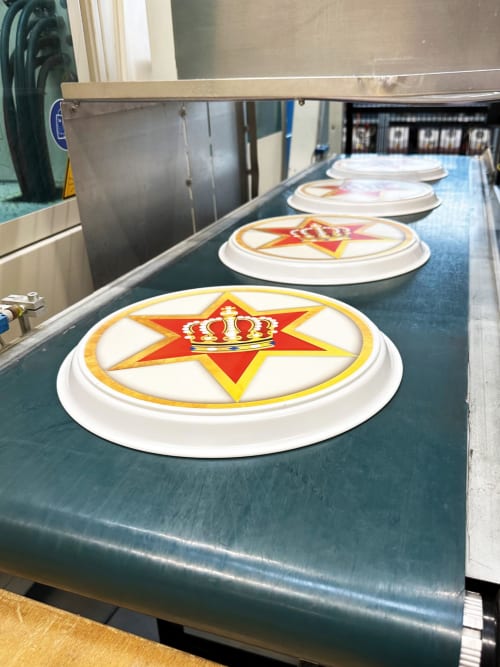
Round waiter’s trays are well-known products from elasto.
Specialization in product finishing and use of recyclates
One of elasto’s main specialties is downstream finishing of injection molded products. In addition to IML, screen printing, pad printing and digital printing technologies are used. Furthermore, items such as drinking bottles and cups are engraved with a name, logo or other motif, enabling personalization of short runs and made-to-order batches.
elasto is the first company on the promotional items market to obtain ISCC Plus certification, demonstrating the production of resource-saving materials and ecologically valuable products. In addition to recycled materials, polypropylene produced from agricultural and forestry waste contributed to the successful certification.
Photovoltaics and logistics automation
The company’s own photovoltaic system makes a significant contribution to reducing greenhouse gas emissions. A total of 1560 solar modules have been installed on the roof of the new logistics center. As Sperber emphasizes, on sunny days the plant can operate entirely on energy generated in-house.
The new logistics hall, covering an area of 5500 m², provides space for 5000 pallet racks and a storage zone for 7000 small parts. This area holds stocks of the most frequently ordered small injection molded products, which elasto also sells via online marketplaces. Products ordered online are transferred fully automatically, with a mouse click, to the person responsible in the shipping department. There they undergo final finishing steps, such as engraving, and are then packed for dispatch.
According to Sperber, the efficient processing of numerous small individual orders is only possible because processes have been optimized and automated also in the logistics area. The overall production flexibility at the company’s headquarters has increased significantly, which contributes to maintaining high competitiveness.
Estimated increase in granulate feeding efficiency
Determining the exact share of the central material supply system in the overall efficiency gain is difficult, as a number of other optimization measures were implemented in parallel. However, Markus Rösel estimates that in the area of granulate feeding the plant has become about 20% more efficient.
Marcus Sperber stresses that the central material supply system makes a significant contribution to maintaining elasto’s competitive position. The company now has the level of efficiency required to manufacture in Germany products that others source from Asia.
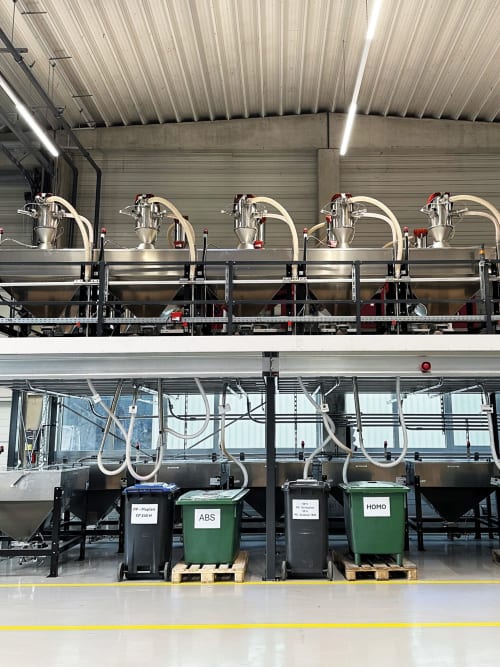
The dryer platform provides a view across the material storage area. The space directly under the platform is reserved for containers filled with the most frequently used materials.