In the fresh-cut products segment there is virtually no margin for error. Raw material is highly perishable, logistics windows are very narrow, and retail chains impose strict requirements on quality, completeness and timeliness of deliveries. The market is accelerating and growing – according to Grand View Research, the European packaged salad market reached a value of USD 4.11 billion in 2023 and is expected to grow at 7.2% annually through 2030. This means both new opportunities and stronger competitive pressure. In addition, the EU Packaging and Packaging Waste Regulation (PPWR) is tightening environmental requirements for all categories of food packaging, which gives current logistics and packaging decisions long-term significance.
Almeda, a specialist in fresh-cut (so-called IV range) products, drawing on more than 50 years of entrepreneurial experience in the Italian agri-food sector, took these conditions into account from the outset. When the company was established, a decision was taken that is still rare in the industry: instead of starting operations with conventional single-use packaging and planning a later transition to returnable solutions, Almeda built its logistics model from day one around reusable transport packaging. The partner that enabled this concept to be implemented was Tosca.
Strategic choice of partner from the start of operations
The decision to cooperate with Tosca did not stem from regulatory pressure or a sudden cost crisis. The key criterion was service quality and operational reliability. In a retail environment where a packaging failure can result in spoiled product, delayed deliveries or pallets that do not meet standards being delivered to a distribution centre, Almeda needed a partner whose operating standards would be consistent with the company’s own requirements.
Edoardo Leone, owner and CEO of Almeda, stresses the importance of service stability: "The quality of service makes the difference. Tosca’s reliability and close customer support allow us to focus fully on our core business, with the confidence that our logistics packaging is managed efficiently and sustainably."
The cooperation covers not only the supply of load carriers but also full management of them within a pooling model. This limits the risks typical of self-managed returnable packaging and makes it possible to maintain stable operating parameters throughout the supply chain.
Integration of reusable crates across the entire operation
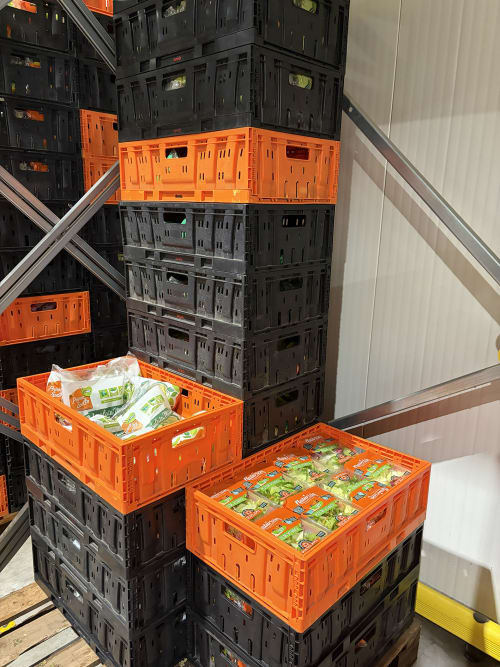
Almeda currently uses Tosca 6419 reusable plastic crates in a pooling model covering the entire logistics cycle – from production and storage, through order picking, to distribution and deliveries to retailers. These crates are designed for high-performance supply chains, combining robust construction, hygienic design and high dimensional consistency, which translates into reliable handling of load units in transport and storage.
The crate sides can be folded without applying significant force, which facilitates both manual and automated handling, while the Active Lock function secures the container once assembled, stabilising it during filling, transport and storage. This solution is intended to reduce damage to packaging and loads, limit delays and product losses, which is particularly important in fresh food logistics.
Management of availability, collection and rotation of crates is handled entirely by Tosca within its pooling system. Each container is washed in line with strict hygiene standards before reissue, ensuring a consistent level of cleanliness and compliance with sanitary requirements in every cycle.
For Almeda this means that packaging is not a variable that needs to be additionally controlled and compensated for in planning. It becomes a predictable, standardised element of the process, and the complexity typical of single-use systems – related to sourcing, storage and disposal of packaging materials – in practice does not occur.
As Marco Mangano, Sales Manager Retail at Tosca, comments: "By integrating reusable packaging into a managed pooling system, we remove friction from our customers’ operations. The result is greater efficiency, consistent product flow, and a more reliable supply chain that supports both performance and growth."
Operational efficiency and sustainability in a single model
The benefits of the implemented model are visible in various areas of Almeda’s activities. The packaging flow is stable and predictable, and the entire system has been designed from the outset around reuse. The absence of typical sources of disruption associated with single-use packaging, such as variable raw material availability, waste handling and disposal costs, makes it possible to keep logistics processes more orderly and repeatable.
For a company working with products with a very short shelf life and under the pressure of retail deadlines, this reliability is not just a convenience but one of the factors of competitive advantage. Stable parameters of transport packaging also facilitate process standardisation and the use of automation in warehouses and distribution centres.
The sustainability aspect in this model is primarily practical. The reuse cycle of crates directly reduces consumption of packaging materials and the volume of packaging waste, which follows from the structure of the system itself rather than from a separately implemented environmental programme. For Almeda, sustainability is not a separate project or only a reporting obligation but an element of the everyday functioning of the supply chain.
In the context of new requirements arising from PPWR, which tightens obligations on packaging across the European Union, the circularity embedded in the system becomes both a competitive asset and a factor facilitating regulatory compliance.
Gianpaolo Mezzanotte, Managing Director Italy, France, Spain at Tosca, sums up this strategy: "Almeda’s approach offers a compelling model for the sector. By committing to reusable packaging from the outset, they have embedded both efficiency and sustainability into a single operating model. This is the value of a true partnership with Tosca – not just supplying packaging, but actively supporting customers to optimise performance, reduce complexity, and scale with confidence over the long term."
Long-term partnership in a dynamic fresh-cut segment
The fresh-cut and ready-to-eat segment will continue to evolve, for example through an increasing number of SKUs, shorter replenishment cycles and stricter environmental requirements for packaging. The model adopted by Almeda is oriented towards these changes and is intended to enable adaptation without the need to rebuild core logistics processes.
The relationship with Tosca goes beyond a standard packaging supply contract. It is defined as a shared operational commitment, based on service quality and mutual trust. At Almeda this cooperation is described with three terms: reliable, collaborative and efficient.
For other operators in the fresh-cut and ready-to-eat segment that are only now considering a transition to reusable packaging, Almeda’s experience provides a clear point of reference. The earlier the decision is taken to base the supply chain on reusable systems, the greater the potential operational and environmental benefits that can be achieved in the long term.