Vector awards 2026 for cable carrier applications
In the 10th edition of the vector awards 2026, igus recognised four cable carrier applications. The awards went to projects in shore power supply, microchip production, stage technology and water treatment.
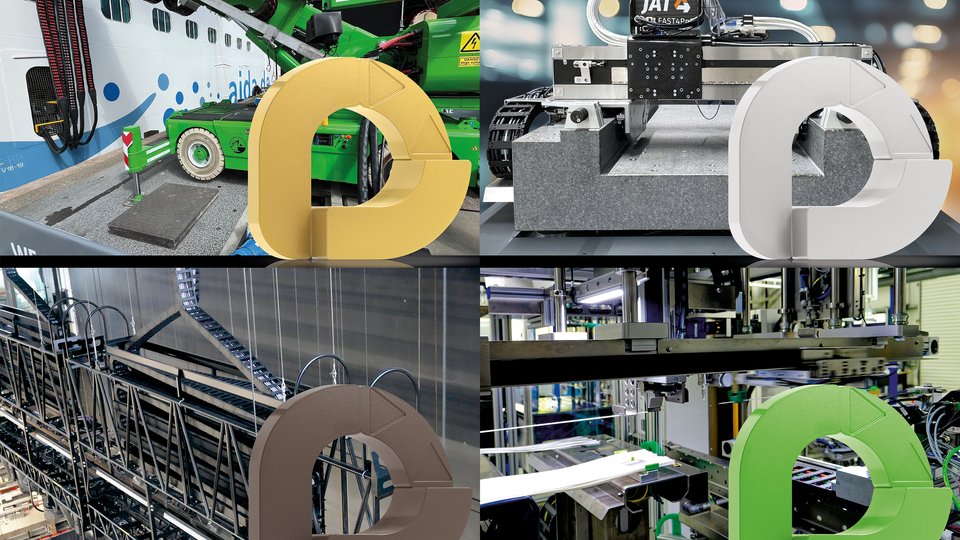
The winners of the 10th edition of the igus vector award 2026 were recognised for cable carrier applications in projects from Germany, the United Kingdom and the Netherlands. Terminal operator Cruise Port Rotterdam won the gold award for its system supplying power to cruise ships in ports. The silver vector award went to Jenaer Antriebstechnik GmbH for a precision positioning system used in microchip production, while the Royal Ballet and Opera in London received the bronze vector for a 37-metre stage tower with retractable multimedia technology. Membion GmbH, which developed a membrane bioreactor for filtering microplastic particles from drinking water, received the green vector. For the anniversary edition of the competition, which recognises creative and sustainable cable carrier applications, igus received 424 entries from 36 countries.
Gold vector for shore power in the port
Many port cities face high levels of exhaust emissions when ships run their engines to generate electricity. Measurements carried out by the German Nature and Biodiversity Conservation Union, Naturschutzbund, NABU, show that one cubic metre of air in terminals can contain more than 400,000 particles. The emissions burden is up to 80 times higher than on major transport routes.
To reduce this pollution, terminal operator Cruise Port Rotterdam provides cruise ships with an alternative in the form of shore power. The solution reduces local emissions to zero. However, creating the connection was a challenge, as ocean-going vessels differ significantly in size and berthing position. The designers therefore had to build a mobile shore power connection unit.
One of the requirements was to guide power cables over long travel distances and protect them against salt and UV radiation. The application uses the igus mobile shore power outlet, iMSPO. The system can be adapted to the requirements of modern terminals. It works with a rail system on which a trolley moves, transporting cables in roller energy chains made of high-performance plastic. The carriers move in covered guide troughs in the quay surface.
The system can be discreetly integrated into the existing terminal infrastructure and is barely visible in everyday use, so terminal operations are not disrupted. The cables that the ship lowers onto the quay are connected using the trolley. This allows cruise ships to switch off diesel generators and avoid emissions. The jury, composed of experts from research, industry and the specialist press, awarded Cruise Port Rotterdam the gold vector 2026.
Silver vector for the positioning system
The production of modern microchips used, among other things, in smartphones, electric vehicles and diagnostic equipment requires machines capable of placing components within a positioning range of 0.1 µm. By comparison, a human hair is about 700 times thicker.
Jenaer Antriebstechnik GmbH develops pick & place solutions for this type of precision task. The company's systems achieve accelerations of up to 100 m/s2 with a repeatability of ±0.1 μm. Such high precision is possible only if the machine components do not generate disruptive vibrations.
When guiding power and data transmission cables, the engineers encountered a problem because conventional cable carriers generated excessive vibrations when the chain links engaged with each other. In addition, many systems produced too much abrasion, which ruled out their use in cleanrooms.
The solution was to use a cleanroom-compatible system, igus e-skin flat, in combination with chainflex cables. The system minimises disruptive forces and friction effects, ensuring high accuracy and dynamic movements of the multi-axis system without friction.
Bronze vector for stage technology
The Royal Ballet and Opera in London is one of the world's major cultural institutions. Its permanent ensemble of dancers, singers and musicians gives around 250 performances on stage each year. Above the stage is a 37-metre tower that can lower two complete sets, including lighting trusses, to enable rapid scene changes between different productions.
Hundreds of power and data transmission cables must follow the movement of the trusses down to the floor as quietly as possible, without causing damage or disrupting the performance. Motorised cable drums were ruled out because of the large quantities of cables.
As early as 2000, the designers chose a solution from igus, a customised and space-saving zig-zag cable carrier system for the lighting trusses in the upper stage machinery. The system has been operating reliably and without failure for more than 25 years.
In 2025, when the lighting was equipped with LED technology and requirements concerning weight, load and design changed, the experts again turned to igus. One challenge was the pendulum deflection of the cable carriers, which was significantly reduced by the counter-running zig-zag arrangement. The weight of the guide boxes was reduced from 200 kg to 150 kg thanks to an optimised design using aluminium.
Today, 20 pre-assembled cable carriers from the E4.56 series with chainflex cables are installed, transporting power and data to the LED lighting. The opera asked igus to recycle the old cable carriers, thereby improving its sustainability balance.
Green vector for water filtration
Safe drinking water cannot be taken for granted, including in Germany. Increasing amounts of microplastic particles and pharmaceutical residues are pushing conventional wastewater treatment plants to the limits of their technical capabilities because the particles are too small. "While the German government is increasing pressure on wastewater treatment plants by introducing stricter limits in the National Water Strategy," technology manufacturers are looking for new filtration options.
One such company is Membion GmbH from Roetgen. The company develops membrane bioreactors that look like large bundles of spaghetti. Their filters have pores so small that even bacteria and microplastic particles cannot pass through. In combination with powdered activated carbon, micropollutants such as pharmaceutical residues can be removed.
Automated membrane production operates without failures only if cables that are constantly exposed to humid conditions and located in confined installation spaces are reliably protected. The designers use cable carriers from the igus E2 series with chainflex cables. Small bending radii allow installation even in very confined spaces. The result is a robust cable carrier that can operate in demanding conditions for a long period.
Read more: