BOPP film demand set for steadier growth to 2030
AMI Market Intelligence reports that global BOPP film demand is expected to return to a more stable growth path, with a CAGR of more than 3% through 2030, despite regional differences and recent macroeconomic pressures.

BOPP films remain an important material in the global delivery of goods, particularly in packaging applications where biaxially oriented polypropylene continues to be difficult to replace. According to the new edition of AMI Market Intelligence's report on the global BOPP films market, investment in production capacity indicates continued confidence in the material's long-term prospects. The report examines market dynamics, technological developments and competitive pressures affecting producers, converters, suppliers and investors. Although inflationary pressure, economic instability, geopolitical conflict and rising protectionism have affected the market, AMI's biax film research team points to positive signs. After a volatile period in material consumption, first driven by the COVID-19-related increase in retail packaging demand and later by widespread destocking, global demand for BOPP is expected to move back to a more stable growth trajectory. Forecasts cited by AMI indicate a compound annual growth rate of more than 3% through to 2030.
Capacity investment continues, but at a slower pace
Global investment in BOPP production capacity has continued throughout the five-year period to 2025. AMI's research indicates that the pace of capacity expansion is likely to slow over the next five years, but output is expected to rise due to wider and more efficient production assets.
The report underlines the strong position of BOPP in many core applications. The material remains significant in essential food packaging and in the expanding global snacks sector. AMI also notes greater penetration of BOPP films in retort pouches, as well as in emerging high-tech and new energy applications. These areas support the view that BOPP films are positioned for sustained long-term growth.
Regional differences shape the market outlook
Despite positive global growth prospects, AMI emphasises that the main developments are taking place at regional level. From rapidly expanding emerging markets to more mature economies facing changing demand patterns, each region follows a distinct path. This reflects both the complexity and resilience of the global BOPP film market.
According to AMI, 2025 was marked by tariff disruption, yet inter-regional film trade still increased compared with previous years. This was largely due to export-focused producers in Asia offering large volumes of low-cost BOPP film.
AMI's BOPP market report analyses eight separate world regions and also provides a total world view. The findings are based on in-depth interviews conducted across a broad network of BOPP film producers, converters and suppliers. AMI states that this approach allows the report to present a broad view of market trends and to show how these trends differ between world regions.
China and the Indian Sub-Continent lead key developments
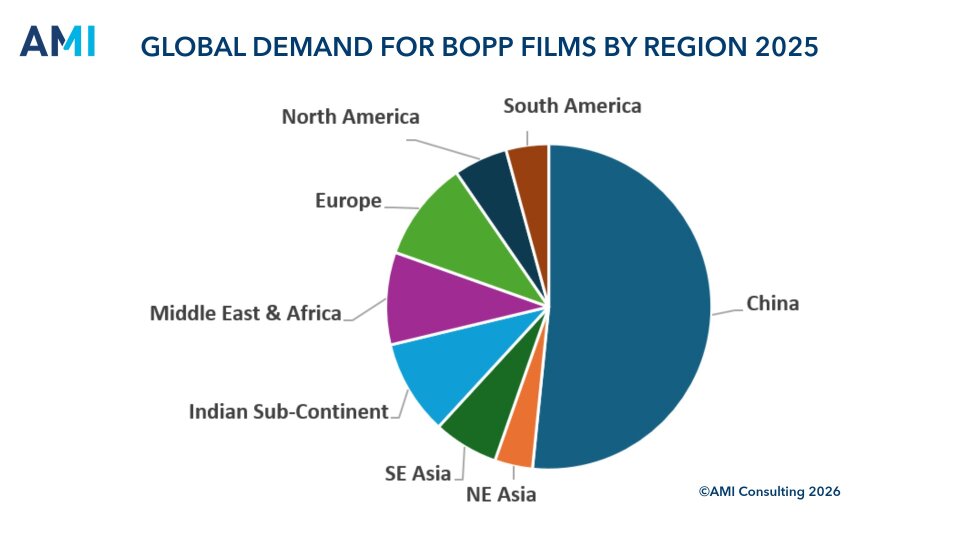
Each world region has different drivers for BOPP film use, making it necessary to understand regional conditions in order to assess current and future opportunities. The largest capacity increase is found in China, which accounts for more than half of line installations during 2020-2030. While larger Chinese companies continue to pursue export-led strategies, AMI also identifies a growing focus on domestic demand prospects in the country.
The Indian Sub-Continent has the fastest demand growth, while per capita consumption remains far below the global average. AMI links confidence in future BOPP demand in the region to a growing and youthful population, a large section of society with more disposable income, and an increasing tendency to buy packaged foods and snacks.
The region also has a low-cost manufacturing base. Experienced biax film producers are expanding both within the region and outside it, while new players continue to enter the market. AMI notes that these companies need to be mindful of a looming supply and demand imbalance, with timing indicated by data included in the report.
North East Asia faces demographic and cost pressures
In contrast, North East Asia is dealing with a declining and ageing population. Although sophisticated packaging remains an important part of consumer products in the region, production costs are high. Producers face difficulty competing with lower-cost Asian neighbours and must rely on speciality BOPP grades as well as technical films for non-packaging applications.
Global demand for BOPP films by region