At the Swoboda CZ plant in Jihlava one of the largest and most complex production cells at this site is in operation. On a floor space of around 200 m², millions of switchbox housing components are manufactured every year. A key feature of this installation is the high degree of automation, covering vertical injection molding as well as an extensive system for handling metal inserts and internal part transfer within the cell.
The Jihlava plant, which belongs to the global Swoboda Group, specializes in complex metal–plastic assemblies. As explained by Václav Dostal, Managing Director of Swoboda CZ s.r.o., the switchbox housing components themselves are not a new product, but the way they are manufactured has been completely changed. According to Dostal, strong cost pressure led the company to invest in a new fully automated production cell that has replaced the previous semi-automatic solutions. The two earlier cells are still in operation, which makes it possible to trace the evolution of the process. Compared with them, the new line has enabled the plant to double its production capacity for the same product. Orders connected with this project are related to the global expansion of renewable energies, which is also strategically important for the Czech team, as it helps reduce the plant’s dependence on the automotive sector.
The key element of the new setup is the modified automation concept. During the engineering phase the entire handling and transfer layout for the parts was redesigned, while some proven components were retained, including the central position of a large Wittmann vertical injection molding machine with a clamping force of 270 tons and a two-station rotary table. The cell also uses temperature control units supplied by Wittmann, which provide stable temperature conditions in the mold.
Vertical Wittmann injection molding machine at the heart of the automated cell
The production of switchbox housing components is based on a vertical machine with a two-station rotary table on which the bottom mold halves are mounted. This arrangement enables several operations to be carried out in parallel. While injection of the plastic onto prepared inserts is taking place at one station, the other station is served by robots that remove finished parts and load new metal components.
According to Production Manager Pavel Bohuněk, all vertical injection molding machines in the plant come exclusively from the Wittmann Group and some of them have been operating reliably for many years. In his view, an important advantage of these machines is the convenience they offer to the production staff. This arises from two main aspects. First, from the intuitive user interface of the Wittmann machine control system, which enables even less experienced operators to maintain a consistent level of part quality and to restart the process efficiently after any stoppages. Second, a structural feature typical of vertical machines with a two-station rotary table, supplied as a standard design, plays an important role.
Michal Slaba, Managing Director of Wittmann Battenfeld CZ, points to the way the media for mold temperature control are supplied. The connections are located at the top, which makes it possible to dispense with a central rotary distributor. This improves access to the mold and simplifies both the integration of automation and manual activities such as servicing and mold changes. The design of the vertical injection molding machine therefore supports efficient integration with the advanced system for transferring and positioning metal inserts.
Transfer system coordinates key process steps
A large six-axis robot is used to service the mold. In every cycle it removes the finished parts from the cavities and simultaneously loads new inserts into them. As emphasized by Václav Dostal, the main challenge with this component is the large number and variety of metal parts that must be handled safely and consistently by the automation system. The inserts include several types of signal pins, power pins and sockets, and individual elements are supplied to the robot in different feeding formats.
A second robot supports the six-axis robot in preparing the inserts. Its task is to pre-position the metal elements in special transport frames. Some inserts are supplied on trays, while certain pins are produced in-line in a reel-to-reel process in which they are punched and bent. All of this is integrated into the internal transfer system of the cell, whose design enables the clamping unit to be supplied smoothly with complete insert sets and then to remove them after the injection step.
The frames move along a rail system that guides them to the clamping unit. There, a multi-axis robot picks up complete insert sets and places the pins and sockets into the mold cavities. In the next step the inserts are over-molded with a white plastic material reinforced with glass fibers, which provides the required mechanical and insulation properties of the finished component. The transfer system is also responsible for removing the freshly injection molded parts from the area of the clamping unit and transferring them to subsequent inspection and marking operations.
After leaving the clamping area, the housing components are conveyed to a vision inspection station where they are checked by a camera system. This is followed by DMC code marking to ensure product traceability. The finished parts are then placed on trays and leave the production cell in this form. Empty frames and transport carriages are automatically returned to the starting point, closing the cycle and enabling fully automated continuous operation.
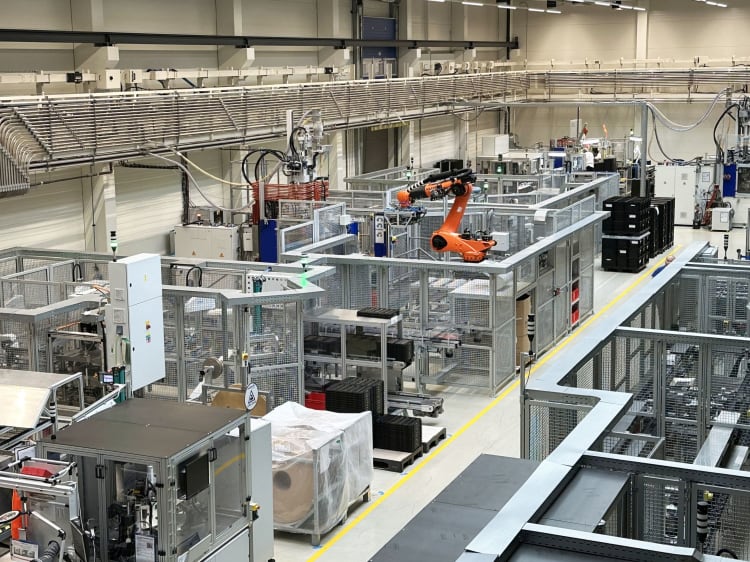
Automation equipment with an advanced transfer system surrounding the vertical injection molding machine
Benchmark for other plants and the role of local cooperation
The new production cell in Jihlava, where a fully automated process for manufacturing switchbox housing components has been implemented, was developed and built on site by the local team. Automation solutions from this plant are also used at other Swoboda Group locations worldwide, and the Jihlava project serves as a reference example of complete integration of all process steps.
According to the company, full automation of the operations, combined with the high repeatability of the Wittmann injection molding machine, has increased process efficiency and reduced unit production costs. At the same time, high process stability and consistent quality standards have been achieved, which is crucial for such complex metal–plastic assemblies.
The cooperation between Swoboda and Wittmann in the Czech Republic has a partnership character, supported by short distances and the facilities of the Czech Wittmann subsidiary with its own spare parts warehouse, training center and technical center. As noted by Michal Slaba, in the optimization of processes aimed at improving efficiency the local company acts as an important partner for many customers in selecting and refining technical solutions, including integrated automation systems around vertical injection molding machines.
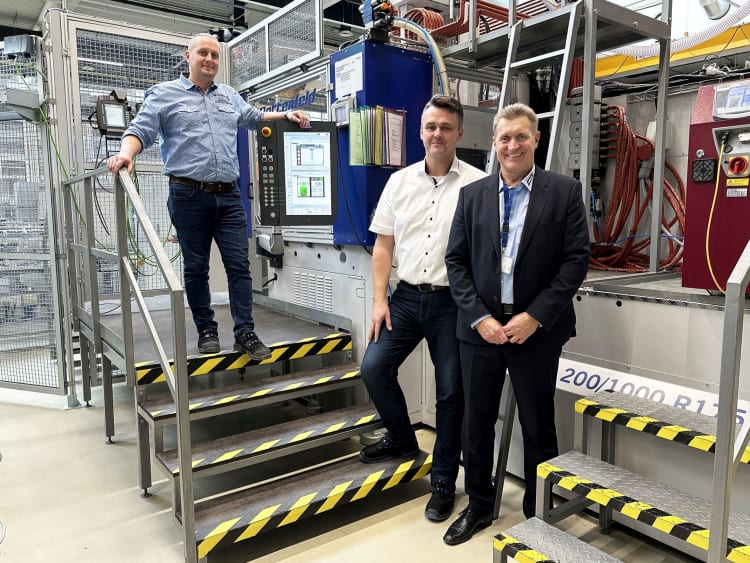
Working together for maximum efficiency: Pavel Bohuněk and Marek Hejl from Swoboda CZ and Michal Slaba from Wittmann Battenfeld CZ