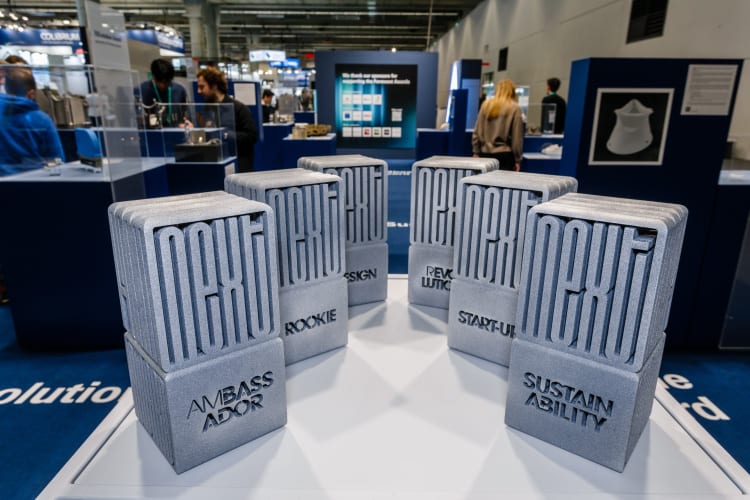
The Formnext Awards 2025 shortlist spotlights faster and more sustainable additive manufacturing, pioneering applications in medicine, moldmaking and the oil and gas industry, and new approaches to AM training and education. Finalists were selected for the level of innovation, technological maturity and robustness of their business concepts. Entries are being presented online ahead of the fair and in person at a special showcase at Formnext. Visitors can review all finalists at the Formnext Awards special showcase in Hall 11.0, Booth D82. The winners will be announced on Thursday, 20 November 2025 from 4:20 p.m. on the Industry Stage in Hall 11.0, D72. Public voting is open in all categories until noon on 20 November and will count as one additional juror vote. The program covers six categories, namely the AMbassador award, Design award, (R)Evolution award, Rookie award, the Start-up award supported by Fluxo Technologies, and the Sustainability award supported by Renishaw. Further information, online voting and a full overview of the finalists are available at formnext.com/awards.
AMbassador award
This category recognizes individuals or organizations that have made a unique impact on the AM industry through innovative training, education or advocacy. Finalists include Naiara Zubizarreta, Director of ADDIMAT, who has led the strategy and growth of the Spanish AM ecosystem since 2015 and built a community of more than 100 members. Irena Heuzeroth, engineer and senior trainer in injection molding and additive manufacturing, reached the finals for her commitment to training. IHK Würzburg-Schweinfurt and Kunststoff-Zentrum (SKZ) jointly offer a vocational study program culminating in the qualification Certified Industrial Technician in Additive Manufacturing, covering the entire 3D printing process chain, from materials and processing to design, energy, hydraulics and occupational safety. Gustavo Melo from RWTH Aachen University developed a data-driven, technology-based methodology for AM training.
Design award
The Design award finalists impressed with exceptional AM designs and products. The Limb Kind Foundation, in association with Hewlett-Packard and global partners, set up a 3D printing project in Kenya that manufactures and ships bespoke prosthetic socket parts for children, which are fitted locally free of charge by orthopedic technicians. IKM Flux, EOS, Valland and ToffeeX jointly developed a Flux vaporizer for LNG sampling that measures heating value more accurately than conventional analyzers. Using thermo-fluidic topology optimization among other methods, the vaporizer aims to eliminate minor yet costly measurement inaccuracies in LNG deliveries. The Hochschule für Gestaltung Schwäbisch Gmünd developed Grabbit hand therapy gadgets to help strengthen the hands of ill, injured or elderly patients, combining TPU lattice structures, PA12 and ash wood.
(R)evolution award
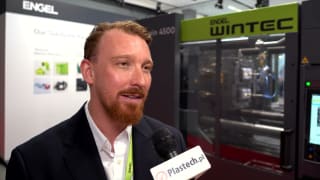
This award honors pioneering products, technologies or services that deliver significant user value in industrial manufacturing and the dental sector. As part of its Inov.iQ project, Portuguese company Erofio 3D-printed a full-metal mold for a 100-tonne injection molding machine, developed with injection molding machine manufacturer Engel. Designed for ultra-thin parts with 1 mm wall thickness, the project achieved a 75 percent tool weight reduction, a 30 percent energy reduction and higher productivity through shorter cycle times. Laempe Mössner Sinto GmbH developed and commissioned a fully automated high-volume 3D printing line for the BMW Group foundry to produce sand cores, with output exceeding 1,100 cores per day, making it one of the fastest binder jetting printers worldwide. imes-icore is presenting CoriTEC Mythos, described as the first fully automated hybrid manufacturing system combining coating and layering with the precision of the latest 5-axis milling and grinding techniques, offering higher precision, improved surface quality and expanded design options for multi-material and multi-color dental restorations including dentures, crowns, bridges and implants.
Rookie award
The Rookie award recognizes young individuals with promising business ideas who have not yet founded a company or launched less than a year ago. Finalists include Fidentis, whose digital production system uses multi-material PBF-LB/M, robotics and automation to manufacture high-quality, multi-material cobalt-chrome and gold prostheses at scale for the dental sector. 3DMyMask applies 3D facial scanning and AM to produce bespoke silicone masks to improve treatment of respiratory distress, driven by a team of neonatologists, industrial engineers and entrepreneurs integrated in the IAM3DHUB ecosystem. Tesseract has developed accessible linear motors optimized for FDM printers. Using direct, straight-line motion powered by magnetic forces, the self-correcting linear motors target high speed and seamless precision.
Start-up award
Supported by Fluxo Technologies, this category highlights faster AM and advances in robotics and medicine. Perfi Technologies promotes volumetric additive manufacturing by printing all points in an object simultaneously, reducing production times from hours to seconds, removing the need for support structures and minimizing post-processing. Hungarian start-up Allonic has developed 3D Tissue Braiding, a textile-based manufacturing approach intended to simplify complex robotics for mass production. Swiss company Nureo AG focuses on automating design and engineering workflows and is building next-generation 3D design tools for engineering. Thai start-up OsseoLabs targets improvements in orthopedic and maxillofacial surgery with AI-supported surgical planning and 3D-printed personalized implants. According to the company, its OsseoMatrix porous architecture and OsseoVision web-based platform improve precision, cut operating time by 50 percent and reduce planning time by 90 percent, with more than 200 successful clinical cases to date. Biomotion Technologies FlexCo from Vienna has developed a platform to automate and standardize 3D tissue bioprinting, aiming to improve reliability in drug screening.
Sustainability award
Supported by Renishaw, this category evaluates AM applications and products based on their life cycle. Finalists are Smart Materials 3D, Continuum Powders and EOS. Smart Materials 3D develops biodegradable 3D printing materials made from regional agro-industrial waste, aiming to set new benchmarks for circular economy practices in AM. Continuum Powders relies on its Greyhound Melt-to-Powder platform and OptiVantage quality assurance and control framework to convert high-quality waste into ready-to-use metal powder. EOS presents a filtration system for metal laser sintering that separates reusable powder carried in the exhaust stream and neutralizes reactive byproducts of metal AM, such as condensate, soot and ultrafine particles, within the process. These substances are classified as hazardous waste and incur high disposal costs, while recovering reusable powder can reduce expenses and CO2 emissions. The new recirculating air filtration system, to be introduced at Formnext 2025, converts highly reactive condensates into stable metal oxides for safe disposal. According to EOS, the filtration and integrated oxidation technology supports environmental protection and economic sustainability.
Awards ceremony and further information
At the awards ceremony, winners in each category will receive cash and non-cash prizes and unique trophies provided by sponsors Sutosuto, responsible for design, and FKM Sintertechnik, responsible for production. Details on finalists and public voting are available at formnext.com/awards.