The ENGEL Group will present six live production solutions at Chinaplas 2026, taking place from 21 to 24 April in Shanghai, for the automotive, packaging, medical and technical moulding sectors. One of the key highlights will be a foammelt application in technical moulding, showing how physical foaming can reduce material consumption, part weight and unit costs. In parallel, the company will present inject AI as a separate focus area, in which digital assistance systems have been expanded with artificial intelligence-based functions. Both approaches are intended to stabilise processes, reduce scrap and improve the cost efficiency of series production. The scope of the presentation includes both specific injection moulding applications and digital tools supporting ongoing process control, deviation analysis and the use of machine and personnel resources. In this context, ENGEL is highlighting solutions intended for production environments where repeatability, reduced material losses and high system availability are important.
In the field of technical moulding, a production cell based on a Wintec t-win 6500 two-platen injection moulding machine with a clamping force of 6500 kN will be shown. This machine will be used to demonstrate the production of a mini refrigerator housing using foammelt technology. The application is intended to show that complex components for the white goods sector can be produced more lightly and more economically by means of physical foaming, without compromising design requirements. According to the information provided, the use of foammelt makes it possible to reduce cycle time, part weight and raw material consumption, thereby permanently lowering unit costs. In physical foaming, material savings of up to 40% are possible, depending on the application.
Physical foaming in the production of a mini refrigerator housing
Foammelt technology operates with nitrogen or carbon dioxide introduced into the polymer melt. The MuCell screw geometry optimised for foammelt is responsible for even gas distribution, which results in a fine cellular structure in the mould. The outcome is a lighter part while maintaining high dimensional stability and stiffness. In the application presented at Chinaplas, a PP compound with 20% long glass fibre content is processed. The part weight is 493 g and the cycle time is 62 seconds.

The mini refrigerator housing produced using MuCell shows how material consumption and part weight can be reduced through physical foaming while maintaining stable part quality.
The t-win two-platen injection moulding machine from Wintec was described as a solution with a robust design intended for applications involving large moulds and high clamping forces. Short-stroke pressure cushions are intended to enable short cycle times, while the synchronous locking system and servo-hydraulic drive are designed to operate quickly and energy-efficiently. According to the manufacturer, high energy efficiency, a compact footprint and optimised maintenance access contribute to lower total operating costs and a fast return on investment.
The application also uses the iQ weight control system, which automatically compensates for viscosity fluctuations during the same shot. According to the information provided, this made it possible to reduce scrap in this application by 37%.
The Wintec injection moulding cells are equipped with the intuitive C3 control system, supporting clear process management with high performance. In addition, the new viper 20 linear robot is fully integrated into the control system, removes the parts and relieves operating personnel. The close integration of robot and machine within a single control system is intended to increase production stability and reduce cycle times through optimisation of motion sequences.
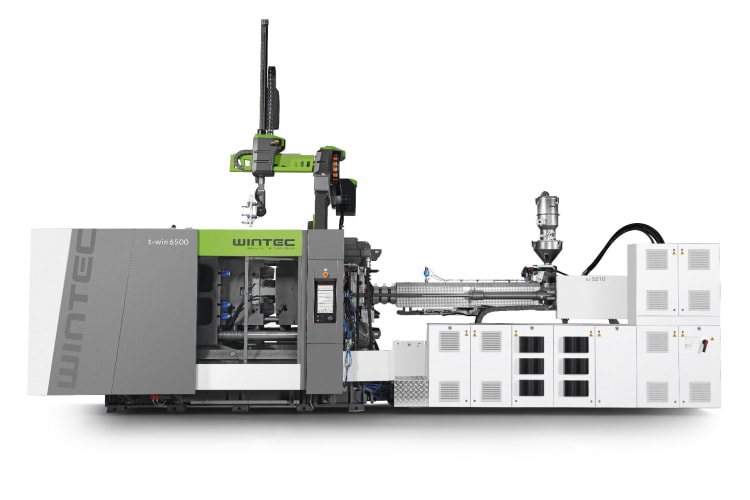
The Wintec t-win 6500 two-platen injection moulding machine with integrated viper 20 linear robot enables cost-efficient production of large-volume components at short cycle times.
Inject AI as an extension of the iQ systems
The second main area of the presentation will be inject AI, through which ENGEL expands its iQ assistance systems with functions based on artificial intelligence and develops the inject 4.0 platform towards a connected and learning production environment. This solution will be presented in the expert corner at the stand. Already today, systems such as iQ weight control, iQ clamp control, iQ flow control, iQ melt control and iQ motion control intervene directly in the process and automatically optimise parameters relevant to quality and efficiency.
For example, iQ weight control compensates for fluctuations in material viscosity in real time and ensures consistent part quality. iQ clamp control dynamically adjusts the clamping force, reducing mould stress and energy consumption. iQ flow control stabilises temperature control, while iQ melt control monitors the plasticising process and detects process deviations at an early stage.
For processors, this means a comprehensive support system that not only stabilises processes but also continuously optimises them. The iQ process observer uses AI to analyse more than 1,000 process parameters simultaneously, identifies deviations at an early stage and derives specific recommendations for action. This is complemented by the ENGEL Virtual Assistant, which makes system-specific knowledge immediately available, as well as AI-based applications such as part finder, used for rapid identification of spare parts based on a photo. Overall, this is intended to improve the cost efficiency of production by reducing scrap, increasing system availability and making more efficient use of machine and personnel resources.

Inject AI improves process stability, reduces scrap, lowers production costs and increases system availability through AI-based process optimisation.
Scope of the ENGEL Group presentation at Chinaplas 2026
At Chinaplas 2026, the ENGEL Group will present a broad spectrum of production solutions for different requirements in injection moulding production. This includes applications for the automotive, packaging, medical and technical moulding sectors, as well as digital solutions for further production optimisation. In the technical moulding segment, the company shows how even large-volume and demanding components can be manufactured cost-efficiently. Through inject AI, ENGEL also highlights the direction of development towards more connected, learning and operationally efficient production.
From the processors' perspective, this means the possibility of running processes more stably, reducing scrap and costs, and making more efficient use of machine and personnel resources. Visitors to the ENGEL Group stand will be able to familiarise themselves not only with individual machines and applications, but also with a broader range of solutions supporting economical and future-proof series production.