At JEC World 2026 in Paris, taking place from 10 to 12 March, ENGEL will demonstrate a fully automated process for series production of composite rotor blades for drones based on thermoplastics. The global manufacturer of injection moulding machines and automation systems will present a scalable production solution that combines high component performance, integrated noise reduction measures and sustainability in a single, continuous process. The demonstration will be carried out on a tie-bar-less ENGEL victory 120 injection moulding machine with an easix six-axis robot, with a target cycle time of less than 60 seconds per rotor blade.
Drawing on its experience in injection moulding technology and automation, ENGEL is transferring proven high-volume manufacturing principles to lightweight composite applications. The core of the presented solution is an integrated process which brings together, in a single cycle within the mould, the successive steps of placing the reinforcement layers, forming, functional integration and removal of the finished rotor blade. The individual stages run in an automated manner to provide consistent quality and high production efficiency.
Lightweight, durable and near-net-shape
The heart of the demonstrated process is a structural sandwich design based on carbon fibre reinforced thermoplastic tapes and an injection moulded short-fibre compound. The tapes form the load-bearing outer layers of the rotor blade. They are precisely positioned in the cavity and stabilised using vacuum, which enables accurate alignment along the expected load paths. Material is therefore used only where it is required from a structural performance standpoint.
In the next step, core material made of a short-fibre thermoplastic is injected between the pre-positioned tapes. Together with the outer layers it forms a structurally bonded component structure, shaped close to the final part geometry. To further increase the lightweighting potential, the core is chemically foamed. This reduces component weight while maintaining the required mechanical properties.
The result is a lightweight yet highly durable rotor blade in which shape reproduction, structural function and material bonding are realised in a single automated cycle. After a defined final finishing step, including trimming, the component is ready for use in the target drone application.
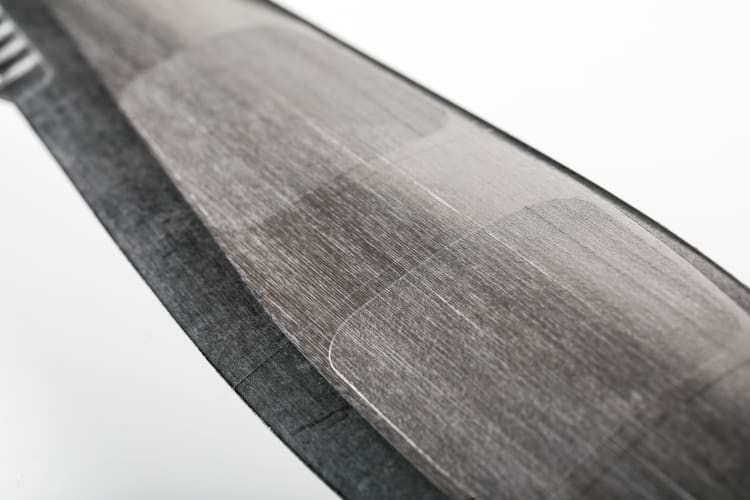
Detail view of a carbon-fibre reinforced composite rotor blade, manufactured near-net-shape using tape-sandwich injection moulding
Functional integration and design freedom
One of the key advantages of injection moulding is the high level of design freedom for component geometry. In the process presented by ENGEL, functional features such as serrated trailing edges to support noise reduction can be integrated directly into the rotor blade geometry by using interchangeable inserts in the mould. No additional machining steps are required, which simplifies the process chain.
The integration of acoustic features makes it possible to better address the requirements of drone deployment in modern environments, particularly in urban areas where noise emissions are becoming increasingly important. Solutions of this kind are relevant for the social acceptance of unmanned aerial vehicle applications and must at the same time remain consistent with the structural and weight requirements of the design.
Production cell with ENGEL victory 120 injection moulding machine
The process will be demonstrated live on a tie-bar-less ENGEL victory 120 injection moulding machine equipped with an easix six-axis robot. The tie-bar-less design provides unobstructed access to the mould area, which facilitates the integration of systems for fully automated material feeding, handling of tape inserts and removal of the finished mouldings. As a result, cycle times of less than 60 seconds per rotor blade can be achieved.
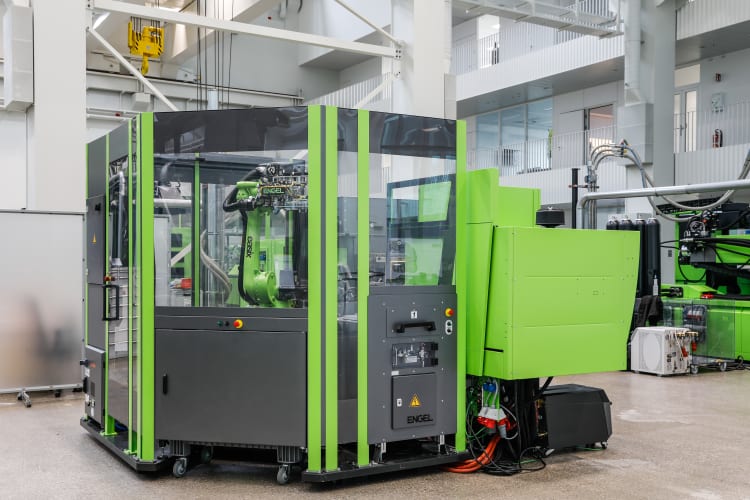
Injection moulding cell with ENGEL victory and easix six-axis robot as the basis of the fully automated production solution for thermoplastic composite rotor blades (rear view)
NeoBlade project and interdisciplinary approach
The technology has been developed within the NeoBlade interdisciplinary research project covering the entire value chain. The aim was to link aeroacoustic design, material and tool development, process automation and sustainability assessment at an early stage and to translate these aspects into an industrially viable overall solution.
Project partners include companies and institutions such as Alpex Technologies, the Energy Institute at JKU Linz, FACC Operations, Plastic Innovation and TU Wien (Aircraft Systems Research Group). The work involved evaluating different thermoplastic systems ranging from high-temperature-resistant materials to more cost-efficient alternatives. Compounds with recycled carbon fibres were also used, adding an extra element of reducing the consumption of primary raw materials.
Environmental aspects and recyclability
Within the NeoBlade project, life cycle assessments were carried out which showed a significant reduction in carbon footprint compared with established processes based on thermoset resins. One important advantage of thermoplastic materials is their recyclability potential. Production waste and end-of-life components can be more easily returned to the material loop, for example in the form of regranulates or feedstock for subsequent composite manufacturing processes.
In addition to environmental aspects, the project also examined economic efficiency. The main cost advantage of thermoplastic processes lies in their ability to be scaled up to industrial conditions, for example through the use of multi-cavity tools, combining multiple operations in a single cycle and a high degree of automation. Short cycle times combined with series production are a key argument in terms of unit component cost.
Scalability from rotor blades to battery covers
In parallel with the rotor blade demonstrator, ENGEL is presenting another component at JEC that is produced using thermoplastic tape-sandwich injection moulding technology, a high-voltage battery cover made of flame-retardant thermoplastic with dimensions of 1.3 x 1.8 metres. The component has been named a finalist for the JEC World Innovation Awards 2026, highlighting the scalability of the process from rotor blades around 30 centimetres long to large-format structural components.
The battery cover combines low weight, high stiffness and full recyclability. Features such as spacers, fastening points or guiding elements can be integrated directly in the process, reducing the need for additional parts and assembly operations. The technology, developed using the example of the drone sector, therefore also shows potential for applications in the field of electromobility components.
ENGEL at JEC World 2026
ENGEL invites visitors to its stand at JEC World 2026, where a complete, fully automated production cell for manufacturing thermoplastic composite rotor blades and other demonstrators based on tape-sandwich injection moulding technology will be on show. The company will be present in hall 5 at stand 5L106.