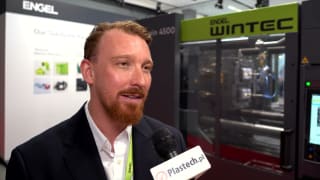
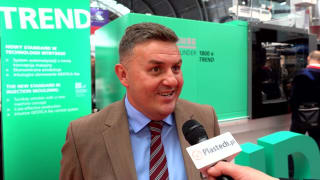
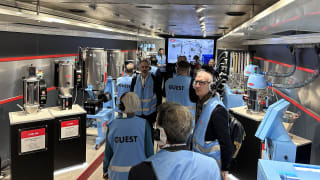
At Plastpol 2026, held in Kielce, Poland, from 19 to 22 May, the ENGEL Group will present solutions for plastics processing focused on stabilising injection moulding processes, improving efficiency and ensuring cost predictability in manufacturing. The exhibit is intended to show how integrated injection moulding cells equipped with digital systems enable processors to react faster to deviations based on data, reduce scrap rates and make production more robust against process variability. The company points to solutions covering data acquisition, remote access, real-time process analysis, self-optimising control loops and operator support in production.
At the ENGEL stand, visitors are expected to see examples in which digital assistance systems are used to stabilise parameters within the cycle and reduce the impact of changes in melt viscosity or thermal conditions on process outcomes. The presentation centres on two production cells, one for medical applications on an all-electric ENGEL e-mac injection moulding machine, the other on a Wintec t-win two-platen machine, in both cases with integrated automation and in-process quality control functions.
ENGEL e-mac 200 for medical technology, process stability and lower energy consumption
In the medical segment, ENGEL is presenting an all-electric e-mac 200 injection moulding machine with a clamping force of 2,000 kN. The machine produces a component for a medical auto-injector from random PP with white masterbatch. The mould has 32 cavities, the part weight is 0.396 g and the cycle time is less than 10 s.
The cell uses iQ weight control, a function that optimises injection volume in real time by automatically compensating for fluctuations in melt viscosity within the same shot. According to the manufacturer, this is intended to ensure consistent part quality and maximum process stability and, as a result, support higher OEE.
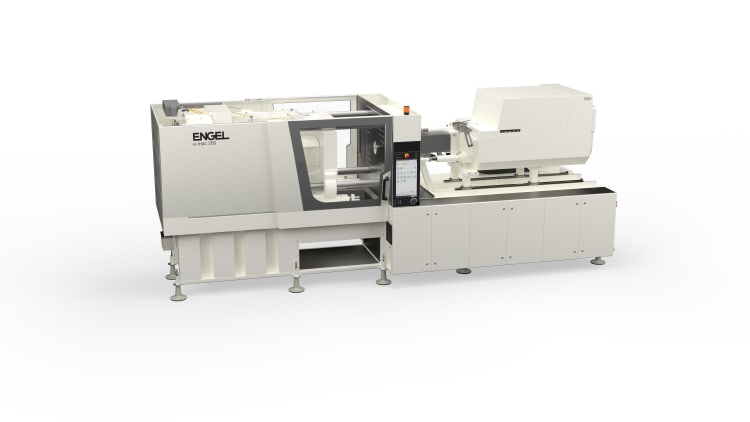
For additional stability in continuous operation, ENGEL uses digital assistance systems from the inject AI family. With iQ clamp control, the system automatically optimises the clamping force, reducing it by up to 33%. This is intended to protect the mould, lower energy consumption and extend tool service life in serial production.
In the same cell, iQ flow control supports automatic adjustment of mould temperature control by continuously adapting the pump speed of the temperature control units during the process. The aim is to keep thermal conditions stable, further reduce scrap and lower energy consumption in production by up to 18%. ENGEL states that this demand-based optimisation of mould temperature control stabilises processes and sustainably reduces manufacturing costs as well as CO2 emissions.
In addition, the exhibit includes the Parameter Limits feature, intended to prevent process parameters from being changed outside the defined process window. This is meant to reduce the risk of operator errors and support efficient use of personnel resources.
The exhibit also shows iQ process observer. Using AI, the system analyses more than 1,000 process parameters, detects deviations at an early stage and provides specific recommendations for action. According to ENGEL, this results in greater transparency, faster responses to process changes and higher process reliability. The manufacturer states that, thanks to root cause analysis, the effort required for troubleshooting can be reduced by up to 30 minutes per machine, which is also intended to mitigate the impact of the shortage of skilled labour.
The finished parts are removed by an ENGEL viper linear robot and placed on an automatic conveyor belt. The robot is fully integrated into the CC300 machine control system. Combined with iQ motion control, its movements automatically adapt to the machine sequence, which is intended to further reduce cycle time and energy consumption.

Wintec t-win 4500, automation and productivity per unit area
Another element of the exhibit is a Wintec t-win 4500 two-platen injection moulding machine with a clamping force of 4,500 kN, shown in a production cell with a fully integrated viper linear robot. The manufacturer points to high platen rigidity, low operating costs, low energy consumption and a small footprint.
The Wintec t-win is designed for applications with large moulds and high clamping forces. The two-platen machine is intended to combine robust construction with short cycle times and cost effectiveness, supported by features such as short-stroke pressure cushions, synchronous locking and a servo-hydraulic drive. In operation, processors are expected to benefit from a compact machine layout, good maintenance accessibility and energy-efficient performance, which is intended to reduce total operating costs and shorten payback times.
In this cell, iQ weight control is also used to support process stability. At the stand, PP lunch boxes are produced with a shot weight of 176 g and a cycle time of 35 s. A two-cavity family mould is used, producing the lunch box and the lid at the same time.
After injection moulding, a viper 20 linear robot, fully integrated into the C30 machine control system, removes the finished parts from the mould and places them on an automatic conveyor belt.
According to ENGEL, the Wintec cell demonstrates how automation, process stability and compact system concepts can be combined in a cost-effective way for standard applications. For processors, this is intended to provide opportunities to improve efficiency, productivity per unit area and unit cost performance.
End-to-end digital solutions: Mes authentig and shopfloor monitoring
In the Expert Corner area, ENGEL is also presenting the Mes authentig system and shopfloor monitoring. authentig is intended to connect injection moulding machines, make production data and KPIs available in real time and support reduced set-up times, scrap levels and downtime. shopfloor monitoring is intended to provide a real-time overview of machine statuses and key figures across multiple locations, enabling faster responses to deviations and targeted improvements in OEE.
ENGEL states it will be present at stand 6-03 during the trade fair.