At PRS Europe in Amsterdam, scheduled for 5 and 6 May, Hellweg Maschinenbau is set to present the latest developments in its range of digitally controlled, efficient and energy-saving grinders for plastics recycling. The company says it will focus on innovations in high-performance wet grinding and on progress in digitalisation. Examples of grinding results are to be shown at the stand, including films, high-performance plastics and technical fibres, intended to illustrate the wide range of applications for the machines.
The release emphasises that the developments address both end-product quality and energy efficiency, as well as process monitoring. Hellweg points, among other things, to solutions designed to reduce power-consumption fluctuations and improve the consistency of material feeding. In terms of operation, functions supporting maintenance planning based on process data and operating-hour counters for components are also highlighted. The company also describes the range of applications in which its grinders are used, from plastics with different mechanical properties to selected materials and products beyond the traditional plastics market.
Wet grinder for producing flakes with consistent quality
The wet grinder with a forced feed system, introduced at the end of 2023, and intended among other things for film recycling, is expected to be at the centre of the display. According to the company, the drive concept includes motors rated from 45 kW to 110 kW, and energy consumption is stated at approx. 70 kWh to 90 kWh. Hellweg reports that the solution is designed to enable throughput of up to 5,000 kg of film. The company also says that new observations indicate that similar energy efficiency can be achieved when processing materials such as non-wovens, textiles and pulp.
As a factor influencing regrind quality, the company points to a double shear cutting process that is intended to produce flakes of consistently high quality, with controlled particle distribution and geometry. The manufacturer draws attention to the sharp edges and flat shape of the flakes, described as advantageous for further processing. The blade arrangement and the associated pulling cut are also described as limiting the share of unwanted fines. In addition, an advanced closure and operating concept is to be available, enabling the machine to be closed and locked hydraulically, which Hellweg says translates into time savings during maintenance work.
Control-system digitalisation and new measurement modules
Hellweg states that all grinders can be equipped with the Smart Control system, which monitors parameters including energy consumption, motor speed and bearing temperatures. Operating-hour counters are intended to record and analyse the service life of blades, screens and V-belts. According to the manufacturer, Smart Control can also continuously optimise the ratio between motor load and throughput.
Among new digitalisation solutions, the company mentions the smart sonic module, which uses ultrasound to measure material flow in the feed system. The results are then used to regulate the flow to ensure stability. Hellweg indicates that reducing power-consumption fluctuations is intended to lower energy use while improving the quality of the regrind.
Another solution is the smart flow module, an online throughput measurement system using microwave technology. As stated, it was unveiled for the first time at K 2025. A maintenance-free sensor located in the riser section of the extraction system piping is intended to measure the flow of bulk material without contact with the medium. Sensor signals are to be used by Smart Control to determine the current output in terms of mass per hour, and to generate summaries for a selected period, such as a day, week or month. According to Hellweg, this data can support maintenance planning and help reduce unplanned downtime.
Application range of the machines
The manufacturer states that its grinders can shred various types of plastics, whether hard, soft, brittle or tough, and that dust and fine particle content can be reduced by up to 90%. At the same time, the grinding process is said to use up to 75% less electricity than conventional mills. Hellweg also points to applications involving textiles and non-wovens, as well as selected products for the cosmetics, food and pet food industries, including the grinding of tendons and bones.
The range is described as including small laboratory and benchtop systems for milling sprues, as well as high-performance systems for solid parts, films and sheets with a throughput of five tonnes per hour or more. The scope is also said to include edge strip grinders and servo-motor-driven edge trimming systems for film or sheet production.
Raw-material market situation and the role of regrind quality
In the context of the raw-materials market, Managing Director Mark Hellweg commented: "Stringent recycling requirements and the tight supply of virgin plastic make the availability of regrind a crucial factor for the recycling cycle. The quality of the regrind is a key determinant of the cost-effectiveness of its use. Hellweg’s mills have traditionally set the standard in terms of productivity, energy efficiency, low dust emissions and the ideal geometry of the regrind for further processing. At PRS Europe, we will be demonstrating how the use of state-of-the-art grinding technology can help recyclers capitalise on the current circumstances."

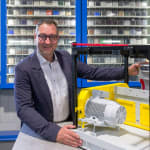
Mark Hellweg with the model of the upgraded wet grinder.