The concept of the circular economy is increasingly permeating the practice of Polish companies, startups and the academic community. In this approach, waste is no longer seen as a problem but treated as a resource that can be reintroduced into the material or product loop. The focus is not only on sourcing new raw materials but above all on intelligent design of existing products and systems. This year's ninth edition of the Stena Circular Economy Award – Leader of the Circular Economy showed that circularity is no longer an add-on to business activities but is becoming one of the pillars of many organisations' development strategies.
This change is a response to growing pressure on natural resources and the need to reduce their exploitation. Modern product and service design increasingly assumes longer use, the possibility of repair, reuse and effective recycling of materials at the end of their life cycle. Innovators on the Polish market seek solutions that make it possible to extend product lifetimes, recover valuable raw materials from items already placed on the market and reduce waste generation at source. In practice, this translates into the development of repair services, sharing and rental models, take-back and redistribution systems and the use of materials that can be recycled or safely returned to the environment.
Urban mining and design for resource recovery
One important context for the development of the circular economy is the phenomenon known as urban mining. It highlights that existing infrastructure, products and devices already in circulation constitute a significant source of raw materials that can be recovered and reused. In practice, these include metals, electronic components and other materials that can be extracted from products once their use has ended.
The scale of this potential is clearly visible in the case of electronic devices. From one tonne of used mobile phones, it is possible to recover around 340 g of gold, 3.5 kg of silver and more than 100 kg of copper. This demonstrates that properly designed systems for collection, disassembly and recovery can significantly reduce the need to rely on primary raw materials. Designing products in such a way that they can be easily dismantled into components and material fractions can be efficiently separated is becoming one of the key tools for protecting resources.
This approach also has an important business dimension. Companies that design products with disassembly and recovery in mind can reduce their dependence on unstable external raw material supplies and limit risks associated with price volatility. At the same time, they reduce environmental pressure resulting from the extraction and processing of primary resources. Such solutions fit into the assumptions of the circular economy, in which the value of resources is maximised over time and production and consumption processes are linked to recovery systems.
Changing consumer expectations and the role of the market
The transformation towards circularity is not limited to technology or industrial processes. Evolving consumer attitudes are an important driver of change, as people increasingly expect solutions that enable longer and more responsible use of products. The approach in which equipment becomes useless after a single failure is becoming less and less acceptable.
Consequently, products designed in a modular way, facilitating repair and replacement of parts, as well as systems enabling the return of products to the manufacturer or their responsible transfer for recycling, are gaining importance. In practice, this translates into growing interest in service offerings, buy-back schemes, secondary markets and models based on sharing and rental. Such solutions help reduce the amount of waste and change the perception of products, which cease to be elements of one-off consumption.
The 9th edition of the Stena Circular Economy Award
Against this backdrop, the 9th edition of the Stena Circular Economy Award – Leader of the Circular Economy, held since 2017, was decided. This year, nearly 80 entries were submitted. The competition jury evaluated projects representing a high substantive level and selected three winners of the Leader of the Circular Economy title and granted five distinctions.
The importance of this year's initiatives for the market is emphasised by Piotr Bruździak, Sales and Operations Director at Stena Recycling and a member of the competition jury. He points to the measurable environmental and business effects resulting from the implementation of circular solutions. In his view, this year's entries show that moving up the waste hierarchy, such as focusing on reuse and recycling, can simultaneously deliver environmental benefits and support the competitiveness of enterprises. He stresses that these solutions can be scaled up and implemented on a wide scale.

Leaders and distinguished projects in the competition categories
In the category Companies implementing circular economy practices, the title of Leader of the Circular Economy was awarded to Decathlon for the project "Circular business models at Decathlon Poland". The jury appreciated a comprehensive ecosystem of services that extend product life, including repair, rental and resale of used items. This model reflects the shift from selling only new products to offering a full cycle of services aimed at maximising the use of their functionality.
Two entities received distinctions in the same category. Enverde was recognised for its Cellsorb Circular Paper Pad solution, a fully compostable cellulose-based absorbent pad. The use of this type of material makes it possible to reduce plastic waste and facilitates the management of residues after use. Another distinction went to the Żabka Polska chain for an environmental policy system that integrates circular economy requirements throughout the value chain. This covers the approach to raw materials, packaging, logistics and operations with circular economy principles in mind.
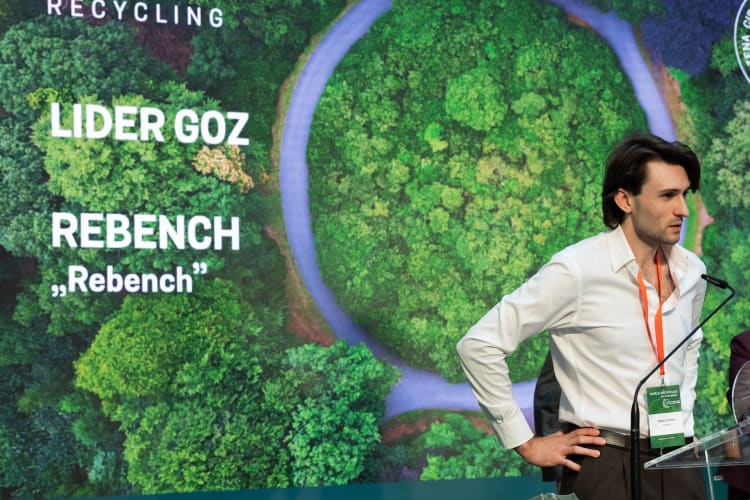
In the category Startups implementing circular solutions, Rebench received the Leader title for a solution that helps companies extend the life cycle of office furnishings. The key elements of this approach are digital inventory of equipment, its refurbishment and redistribution, which enables the reuse of furniture and fittings instead of their disposal. The project illustrates how digital technologies can be combined with practices for reusing equipment.
A distinction in this category went to the TerraLight project. This initiative redefines the grave candle and lantern market by using earth as the primary raw material in line with the zero waste concept. The use of such material aims to reduce waste generated after the use of traditional products and fits into the trend of seeking alternative material solutions.
In the student category, the Leader title was awarded to Mateusz Rembowski for the "Aqua-Loop" project describing an innovative water recovery system for households. The solution focuses on water reuse, which from a circular economy perspective means reduced freshwater consumption and lower volumes of wastewater.
The jury also granted two distinctions in this category. The project by Julia Agata Czyż addresses the use of coffee grounds as a raw material for the production of biocomposite cups. This is an example of an approach in which waste from the food service sector becomes a component of a new material. The project by Marcelina Reminger focuses on the use of grape pomace in the cosmetics industry, providing an example of how by-products from food processing can be utilised in another economic sector.
These examples illustrate the broad spectrum of activities, from comprehensive service systems developed by large companies, through specialised startup products, to student concepts that use waste as a raw material for new products. The common denominator is a shift in the approach to resources and design focused on the full life cycle of products and materials.
Circularity as a development strategy element
The success of this year's winners indicates that the circular economy is becoming one of the new standards of Polish innovation. The changes affect both large companies operating on national and international scales and young technology firms and the academic community. Regardless of the scale of operations, every step towards circularity is important for reducing environmental pressure, stabilising access to raw materials and shaping new business models.
The Stena Circular Economy Award – Leader of the Circular Economy has, for nine years, served as a platform for knowledge exchange and presentation of best practices on the Polish market. This initiative helps disseminate solutions that reduce resource wastage and promote an approach in which every gram of raw material placed on the market is treated as a value rather than a burden. As a result, circularity is becoming an important element of development strategies for a growing number of organisations, including in sectors that rely heavily on raw materials and materials, such as the plastics processing industry and the packaging sector.