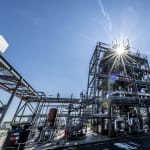
Borealis has entered into a strategic partnership with BlueAlp, a technology company based in Eindhoven, the Netherlands, specializing in chemical recycling. Under the agreement, Borealis will transfer its majority stake in Renasci, a chemical recycling company located in Ostend, Belgium, to BlueAlp, while at the same time acquiring a 10% stake in BlueAlp to support the further development and scale-up of this technology. Both companies state that the objective of the cooperation is to accelerate technological innovation and increase the supply of high-quality circular feedstock for the plastics industry, in particular for packaging applications requiring contact with food and cosmetics.
Renasci uses licensed BlueAlp technology to operate a 20 kt per year scale-up plant. BlueAlp was responsible for the engineering and construction of this facility and has also supported its operation in recent years. The transition from the role of operational support to that of direct asset operator is presented as the next logical stage in BlueAlp’s development. It is expected to enable faster progress in technology development, further optimization of the chemical recycling process and a stronger position of the company as a licensor of this technology.
Since its equity entry into Renasci, Borealis has participated in the development of the plant, which has become one of the few operating chemical recycling facilities in Europe. According to the new agreement, BlueAlp will take over responsibility for the next phase of development of the Ostend installation and its further advancement, while Borealis will focus on developing customer solutions based on chemically recycled feedstock.
Importance of the partnership for the development of chemical recycling
The parties emphasize that the cooperation is taking place at a time when the chemical recycling sector is facing the need for a rapid increase in processing capacity. Growing requirements for recycled content in plastic products, especially in the packaging sector, are driving the development of technologies that can convert more challenging fractions of plastic waste into high-quality feedstock. In this context, investments in chemical recycling plants are intended to support the achievement of targets related to the use of circular raw materials.
"Borealis’ direct support comes at a pivotal moment in the chemical recycling industry, where rapid expansion of capacity is needed to achieve recycled content targets. Their market experience and materials expertise will support our growth and position us well to turn more plastic waste into high-quality circular feedstock," says Valentijn de Neve, CEO BlueAlp.
The joint activities of Borealis and BlueAlp are also important for preparing the customers and partners of both companies for upcoming European Union regulations, in particular the planned Packaging and Packaging Waste Regulation (PPWR), which is to apply from 2030. The regulation is expected to increase demand for recycled materials suitable for contact-sensitive applications, such as food and cosmetics packaging. Among the materials considered for these uses are polymers produced from feedstock obtained through chemical recycling processes.
Expanding the range of polymers based on circular feedstock
From Borealis’ perspective, deepening the partnership with BlueAlp is intended to increase the availability of polymers based on chemically recycled feedstock for existing and future customers. The company views the transaction as part of its We4Customers strategy, aimed at supporting customers in achieving their sustainability goals and expanding its material portfolio with circular solutions.
"The deepening of the partnership with BlueAlp, combining assets and technology, will accelerate progress in chemical recycling for the industry," says Stefan Doboczky, CEO Borealis. "It will allow Borealis to accelerate serving our customer base with an ever-broadening range of polymers based on chemically recycled feedstock. This transaction is fully in line with Borealis We4Customers Strategy, helping customers to deliver on their sustainability ambitions, whilst strengthening the innovation and operational focus of the group."
The parties are not disclosing financial details of the transaction. They have also not announced a timetable for the further development of the Renasci installation or the planned target processing capacities beyond the already operating 20 kt per year unit. However, information published by Borealis and BlueAlp indicates that the main objective of the agreement is to scale up the use of chemical recycling technology to produce circular feedstock for the plastics industry.