Operators of facilities processing municipal and industrial waste as well as post-consumer wood handle material streams with changing properties, from compact fractions to bulky ones, from wet to dry, often occurring at the same time. In practice, this means the need to maintain a stable and economical process with heterogeneous feedstocks and under conditions that can change quickly. An additional factor is the increasingly common project-based work model or operation across multiple locations, which increases logistics costs and complexity. In such applications, solutions that can be started up directly where the material is generated are gaining importance, reducing internal and external transport and simplifying work organization. Mobile shredding technologies are presented as a way to increase process flexibility while maintaining the required throughput.
Requirements for modern shredding systems
Variability in material streams translates into loads on the cutting system and drive as well as requirements for material intake. Modern shredding systems must operate reliably regardless of feedstock properties and maintain stable processing despite fluctuations in raw material parameters. What matters is the interaction of the machine design, cutting system and drive, understood as readiness for high loads while ensuring safe material feeding. As a result, it should be possible to cover different applications, from pre-shredding to single-stage processing, and to integrate with different process chains in stationary layouts and in changing working environments.
Vecoplan reports that it is addressing these needs with a new generation of the Vez series, including the Vez 3300 model available in a stationary version and in a mobile variant, the Vez 3300 e-mobil. Both solutions are based on the same technical platform, while the mobile version was designed for location-independent operation. According to the manufacturer, the Vez 3300 is designed to handle high loads and to provide safe, continuous and reliable shredding of highly diverse materials. Applications include, among others, homogeneous production of refuse-derived fuels, i.e., shredding of municipal and industrial waste, as well as shredding of post-consumer wood and applications in the biomass sector.
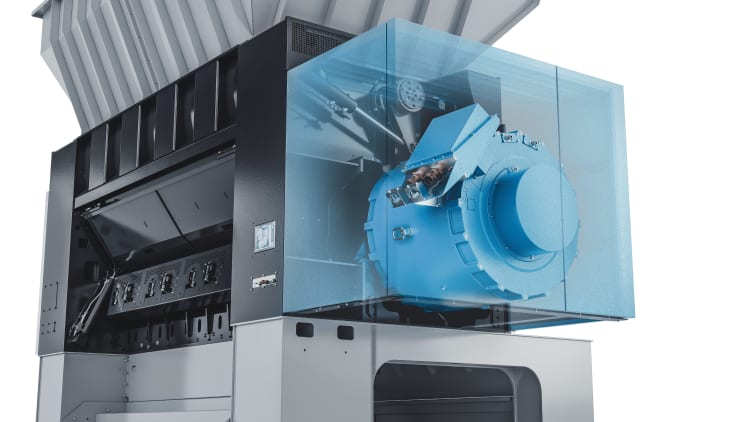
In the technical description, the HitTorc drive is indicated as an energy-efficient electric direct drive with a synchronous motor and frequency inverter, providing high torque and stable process performance. The cutting system is intended to be suitable both for pre-shredding and for single-stage processing, which is expected to facilitate integration into different process chains.
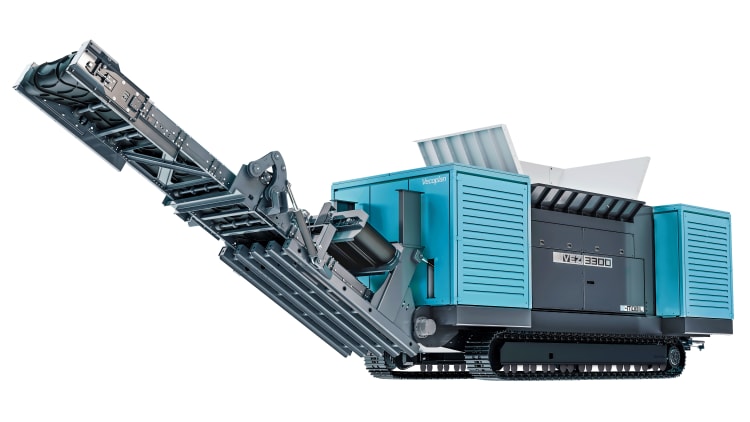
Vez 3300 e-mobil and a plug-and-play concept at the material source
For the mobile version, the underlying approach is to bring the shredder to the place where the material is generated, instead of transporting the feedstock to the machine. Vecoplan states that this can reduce logistics effort and save time, especially for temporary projects, changing locations and varying material volumes. The manufacturer specifies a throughput of up to 80 tonnes per hour for the Vez 3300 e-mobil.
One element highlighted for the mobile version is that no foundation or earthworks are required, which is intended to shorten commissioning time and eliminate the need to obtain construction and environmental permits. "The Vez 3300 e-mobil model is very practical for users and, thanks to quick commissioning, is ready for operation in no time," explains Joschua-Noah Berger, product manager at Vecoplan. "Because no complex installation, connections or construction work are required, many time-consuming and costly steps are completely eliminated. The machine only needs to be positioned and can be used immediately thanks to the plug-and-play function."
The tracked undercarriage is intended to enable safe movement on uneven ground and precise positioning of the machine at the operating location. Integrated components, such as a foldable belt conveyor, are also mentioned as supporting compactness and operational flexibility, including a reduction of internal material transport.
Control, operating functions and remote support
Vecoplan states that the operating and control logic in the mobile version corresponds to the stationary version and includes basic functions such as HitTorc control, contaminant detection (Vid) and the Vecoplan Smart Center (Vsc). For mobile applications, the shredder is additionally equipped with a remote control, which is intended to enable, among other things, control of the discharge conveyor, overband magnet and the tracked undercarriage. The control cabinet is mounted directly on the undercarriage, allowing the machine to operate as a self-contained mobile unit.
The integrated Vsc system is intended to provide intuitive operation, real-time data, tutorials, a connection to a remote technical support service and early fault detection. The description also indicates the ability to display reports, analyze operating data and plan future tasks. Remote service is intended to enable diagnostics and support without an on-site visit, which, according to the manufacturer, can reduce downtime and minimize service call-outs.
Summary
In applications involving variable material streams and work across multiple locations, flexibility, process stability and the reduction of organizational and logistics costs are key. Vecoplan positions the Vez 3300 and its mobile version, the Vez 3300 e-mobil, as solutions combining robust design, high throughput and the ability to operate in stationary or mobile configurations depending on operating conditions. The concept of commissioning without foundation work, along with control functions and remote support, is presented as addressing the needs of operators working in a changing process environment.