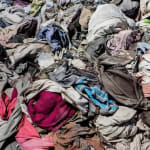
In Europe, around seven million tonnes of textile waste are generated every year, of which only a small portion is returned to circulation in the form of second-hand clothing, secondary raw materials or alternative fuels. The new European Union directive, in force from the beginning of 2025, obliges Member States to separately collect and dispose of used clothing and textiles. This means that directing them into the residual waste stream must be reduced and, at the same time, a functioning circular economy must be established in the textile sector. Well-designed collection systems, recycling processes and appropriate processing technology, which enable textiles to be converted into uniform recycling streams or alternative fuels for energy recovery, are becoming key.
Scale of textile waste and environmental impacts
The average resident of the European Union generates around 16 kg of textile waste per year. In 2022, this translated into a total of just under 6.94 million tonnes. To date, on average only around 4.6 kg per person has been collected separately, while around 11.1 kg has gone into residual waste and was then landfilled or subjected to thermal recovery without prior targeted preparation.
Textile production involves high consumption of resources, energy and water, and improper management of textile waste results in significant wastage of these resources. More responsible handling of used clothing and textiles is becoming an important element in improving the environmental performance of the sector. The new regulations are intended not only to increase collection rates, but also to drive the development of processes that allow better utilisation of the material and energy value of textiles.
Current methods of managing textiles
Well-preserved, high-quality used clothing has for years been systematically collected, sorted and reintroduced to the market through second-hand shops, charitable organisations and export channels. As a result, part of the clothing goes directly to reuse, which is the most desirable solution from the perspective of the waste hierarchy.
Textiles that do not meet quality requirements are sent to companies specialising in their treatment. Some are subject to material recycling, most often with downcycling of application, for example as wipers, upholstery filling or insulation materials. Initial research teams are developing more advanced recycling technologies designed to return larger quantities of textiles to material circulation and reduce the consumption of primary raw materials. At the current stage, however, these are still early-stage solutions.
One of the main challenges is the high diversity of material composites in textiles, which requires precise sorting by type of fibre and additives. At the same time, the potential for thermal energy recovery remains important: polyester, cotton and blended fabrics are characterised by high calorific value, which makes them suitable for use as substitute fuels in thermal energy generation processes.
The role of shredding in preparing textiles for recycling
At the current stage of market development, energy recovery remains one of the more efficient ways of making broad use of textile waste. A prerequisite for achieving stable combustion parameters and for producing alternative fuels is appropriate material preparation, above all shredding to the required fraction. In the case of textiles, a major complication is their design: cotton, blended fabrics and synthetic fibres are generally engineered for high strength, which makes separation and shredding more difficult.
This applies not only to clothing, but also to a wide range of production and post-consumer waste such as mattresses, covers, various types of protectors, carpets, curtains, upholstery and products for special applications. These materials often contain zippers, buttons and other foreign objects that must be taken into account in the mechanical process.
For such demanding applications, industrial shredders capable of handling diverse material streams are used. Untha’s single-shaft XR class shredders are designed to process around 6–10 tonnes of textiles per hour. The C-cutting mechanism used enables effective shredding of particularly tear-resistant and elastic fabrics.
Different perforated screens make it possible to obtain a homogeneous output fraction with a particle size below 30, 50 or 100 mm, depending on the requirements for the alternative fuel produced. The narrow cutting gap promotes precise cutting and reduces the risk of fibrous materials wrapping around moving parts. In this application, the machine operates at speeds of up to 35 rpm, which allows trouble-free processing of material containing foreign objects.
In lower-throughput installations, four-shaft RS class shredders are used, available in variants with shaft lengths from 300 to 1500 mm. This allows the configuration to be adapted to the scale of the process and the characteristics of the material stream.
Energy and operating requirements for equipment
For operators of textile waste processing plants, operating parameters are of key importance: energy consumption, noise level, dust emissions and reliability in multi-shift operation. Untha textile shredders use the Untha Eco Power Drive, which, according to the manufacturer, enables high energy efficiency. The slow-speed drive also helps reduce noise and dust emissions in the machine’s working area.
XR class models can be used for various material streams, which increases the operational flexibility of the installation and facilitates adaptation to the changing composition of waste. The robust design and resistance to foreign objects in the material stream help maintain high technical availability and stable operation in multi-shift systems.
Prospects for the development of textile recycling
Textile recycling is undergoing intensive change, driven by new regulatory requirements, ambitious environmental targets and the growing importance of efficient resource use. To manage used clothing and technical textiles more sustainably in the future and at the same time gradually reduce the quantity of waste sent to landfill or incineration without prior preparation, it is necessary to combine more conscious consumption with the development of new recycling processes and processing technologies.
Shredding technologies used as a preparation step for textiles destined for RDF production enable better utilisation of their energy potential and a long-term reduction in waste volumes. As advanced material recycling methods develop, the role of precise shredding and preparation of homogeneous fractions is likely to increase also in applications other than energy recovery alone.