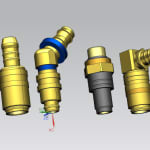
The optimisation of design processes is playing an increasingly important role in modern mouldmaking, where short development cycles and high precision are standard expectations. In this context, digital availability of standard components is becoming a key factor in speeding up engineering workflows. Hasco has expanded its support for designers and mouldmakers by providing CAD data for its complete portfolio of cooling elements, enabling direct integration of these components into mould designs and existing CAD environments.
According to the company, users can now access CAD models for a wide range of cooling systems, including Hasco Standard, High-temperature, Stainless steel, Push-Lok, ZI, Safety, French and Low-leakage variants. The portfolio is intended to cover a broad spectrum of application requirements, from conventional mould cooling to more demanding operating conditions. The models are described as highly detailed, providing visual orientation and facilitating intuitive selection of suitable components. By integrating these data sets into their projects, designers are expected to shorten planning phases and reduce manual data handling during the layout of cooling circuits.
Reducing design workload through ready-to-use CAD data
The provision of digital cooling elements is aimed at significantly reducing design and planning effort. Hasco states that the CAD models help to ensure precise, fault-free design while maintaining flexibility for adaptation to customer-specific requirements. Since the relevant technical data such as dimensions and thread types are embedded in the models, time-consuming manual lookup in catalogues or datasheets can be avoided. This is intended to make the overall design process both faster and less prone to errors, particularly in the recurring tasks of defining connections, interfaces and installation space for cooling components.
From the outset of a project, designers are given a clear overview of all available installation options. The data can be transferred directly into existing CAD systems so that the configuration of cooling circuits can be carried out in a consistent digital environment. By eliminating intermediate steps, such as re-entering or checking dimensional data, the risk of introducing inconsistencies between the virtual model and the final mould is reduced. This approach is particularly relevant for complex moulds with dense cooling layouts, where minor deviations can have implications for performance, manufacturability and maintenance.
Impact on planning of complex moulds
The integration of an extensive cooling portfolio at CAD model level is positioned by Hasco as a further step towards more efficient, flexible and reliable mould design. The company emphasises that users can benefit from reduced work pressure, increased precision and a more streamlined workflow when dealing with sophisticated mould projects. A consistent set of digital components can support forward-looking planning, for example by enabling collision checks, verification of assembly sequences and the evaluation of alternative cooling concepts at an early stage in the design process.
By allowing designers to work with predefined, standardised elements, the likelihood of design iterations caused by incorrect dimensions or incompatible interfaces is reduced. This is particularly important in multi-cavity moulds and tools with integrated high-temperature or stainless steel cooling sections, where coordination between different component types is critical. Standardisation at the CAD level can also facilitate communication between design, manufacturing and purchasing, as all parties refer to the same digital definition of the components being used.
For companies operating in mould design and mouldmaking that prioritise efficiency, consistent quality and process reliability, the availability of such CAD data for cooling components represents a practical tool. It is intended to support the systematic planning of cooling systems, reduce the administrative workload associated with data handling and contribute to more predictable project execution.