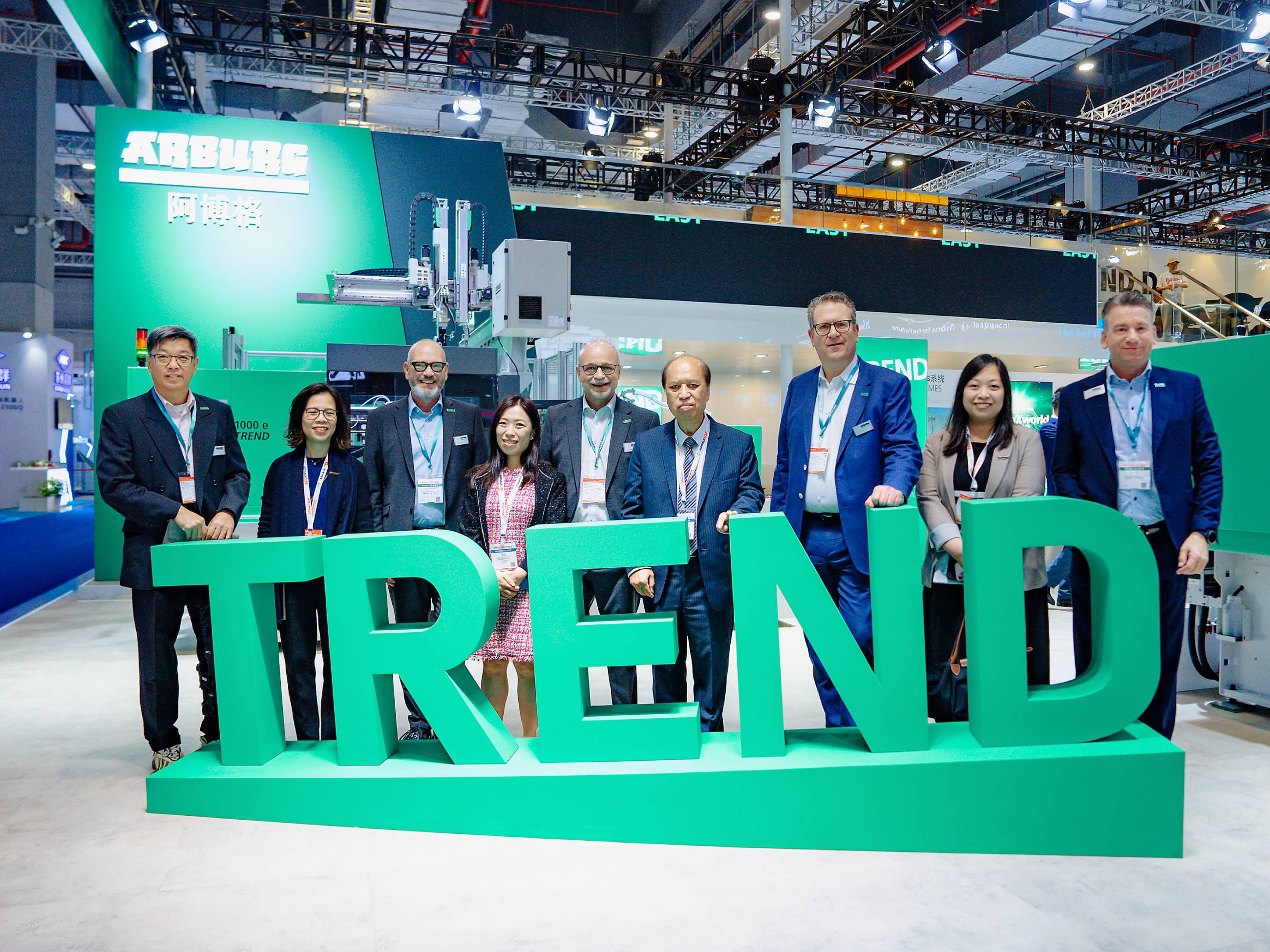
Chinaplas 2026 (21–24 April) provided Arburg with an opportunity to present new solutions for the Asian market and to meet customers from China, Asia and other regions. The manufacturer emphasised the high visitor numbers at its booth and the interest in the new standard machine concept as well as in automated production cells implemented in cooperation with local partners. One of the key highlights of the exhibit was the Asian premiere of the all-electric Allrounder Trend injection moulding machines, shown together with the new basic Gestica lite control system. As part of the presentation, Arburg also highlighted its offering for digitalisation and the smart factory, including its own MES system and portal tools for customers.
Dr Volker Nilles, CEO of Arburg, summarised the company’s presence at the event as follows: "At Chinaplas 2026, we demonstrated that the Asian market is of enormous importance to us. We delivered performance in every respect: From the robotic system developed specifically for Asia, through the new Trend standard machines, to complex production cells that we realise in collaboration with local partners". He added: "We see it as a very positive sign that our stand was extremely well attended, that we were able to speak with high-profile customers, and that we have already sold two exhibits directly at Chinaplas". The delegation from the company’s headquarters in Lossburg also included Guido Frohnhaus (CTO) and Tobias Baur (Managing Director Sales and After Sales).
Allrounder Trend: standard machines for the Asian market
Arburg indicates that the new Allrounder Trend line is a response to changing market requirements, including the need for short time-to-market and cost pressure. Zhao Tong, Managing Director of Arburg China, emphasised: "The Allrounder Trend is our response to changing market requirements, which include fast time-to-market and intense price pressure. However, it is not just about price advantages. Rather, we provide our customers with comprehensive support in reducing their costs and increasing efficiency". He also pointed to strong interest in the standard machines and in the local-to-local strategy, as well as to digitalisation and the smart factory, where the company refers to its product portfolio and decades of experience.
According to information provided by Arburg, visitors could assess in practice elements highlighted by the manufacturer, such as simple, intuitive operation, technology focused on high quality, short delivery lead times and low total cost of ownership (TCO). In addition, fast machine set-up and ease of maintenance were emphasised.
The booth featured, among other things, an injection moulding machine with a clamping force of 1,000 kN and an injection speed of 350 mm/s, producing thin-walled plug connectors made of liquid crystal polymer (LCP). The second standard machine was used to demonstrate the automated production of a gear made of POM. This cell was equipped with an Arburg Flexlift linear robot, available exclusively in Asia.
Automated cells and turnkey solutions
In the part of the exhibit dedicated to complete solutions, a fully automated example was shown based on the vertical rotary table machine Allrounder 1600 T. In the demonstration, metal inserts were overmoulded with PBT to produce ready-to-use connectors for the automotive industry. Two six-axis robots were used for complex handling operations.
Arburg reports that turnkey systems of this level of complexity are designed at the Arburg Technology Factory (ATF) in Pinghu and are then built and implemented in cooperation with local partners. Pinghu is also where Allrounder Trend machines for the Asian market are assembled.
Digitalisation and the smart factory at the Arburg booth
Alongside the machinery, the company also presented its range of services and solutions supporting production digitalisation. It pointed to its own MES, the Arburg host computer system ALS, the arburgXworld customer portal and the Gestica lite control system. As stated, these tools attracted visitors’ attention with smart assistance and pilot functions.